TheJakartaPost
Please Update your browser
Your browser is out of date, and may not be compatible with our website. A list of the most popular web browsers can be found below.
Just click on the icons to get to the download page.


Popular Reads
Top Results
No results found. Please check your search term and try again
Can't find what you're looking for?
View all search results
Popular Reads
Top Results
No results found. Please check your search term and try again
Can't find what you're looking for?
View all search resultsJokowi’s deregulating can cripple Indonesia’s climate plan
With coal-fired energy having latitude to fuel Jokowi’s national strategic projects, the greater amount of carbon emissions arising from it would considerably castrate the government’s own 29/41 climate action plan.
Change text size
Gift Premium Articles
to Anyone
Share the best of The Jakarta Post with friends, family, or colleagues. As a subscriber, you can gift 3 to 5 articles each month that anyone can read—no subscription needed!
A
fter Joko “Jokowi” Widodo became President on Oct. 20, 2014, he swiftly consolidated Indonesia’s climate agenda with a series of assertive acts.
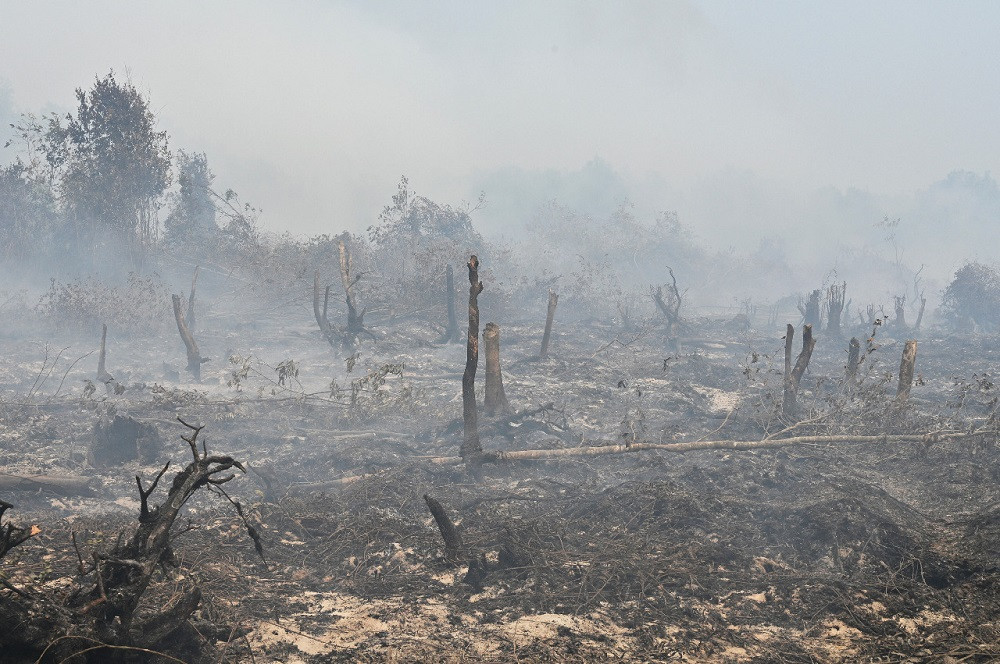
Jokowi created the Environment and Forestry Ministry, which has a climate change director general. He maintained a special envoy on climate change. He announced at the Paris climate summit on Nov. 30, 2015 Indonesia’s plan to reduce carbon emissions by 29 percent by 2030 and 41 percent with international cooperation. In January 2016 he established the Peat Restoration Agency (BRG) to revive 2.4 million hectares of Indonesia’s damaged peatland.
Now in his second term, Jokowi’s climate drive seems to have slackened. The first sign of this is that he dissolved the office of the President’s special envoy on climate change.
In his 2019 campaign, then-presidential candidate Jokowi issued a 35-page vision-mission statement.
Climate change mitigation, action to reduce greenhouse gas emissions, got buried in plank 4, sub-plank 4.2, of Jokowi’s nine-plank platform. In that sub-plank, Jokowi pledged to prevent forest fires, regreen degraded land, develop renewable energy, continue to conserve (not restore) peatland, decrease carbon emissions and improve environment-friendly mass transport, enhance environment conservation education, and multiply forest-cities and green open spaces. All seven pledges are a welcome mouthful.
However, this noble intent apparently is not getting the full measure of implementation. Why?
First, in his inaugural address after taking his oath of office on Oct. 20, 2019, Jokowi spelt out a five-point program for his second five-year term.
The program covers human resource development, infrastructure building, deregulation, simplified bureaucracy and economic transformation from dependence on natural resources to modern manufacturing and services competitiveness. The program, as Jokowi’s do-list, has no mention of climate action.
Second, despite the prevailing coronavirus pandemic, Jokowi has gone full steam ahead with deregulation. Deregulation is evident in the mining sector, particularly coal mining.
Government regulation requires coal miners to restore their mining pits once operations have ended. East Kalimantan, the province with the most coal mines, has 1,735 hazardous pits that unwary children fatally tumble into. Environment NGO Auriga reports that the Minerals and Coal Mining Directorate General records minimal compliance among concession holders to deposit guarantee funds to carry out post-mining obligations. Government oversight has been lax.
Oversight has been more lax as Jokowi has now removed many restrictions from the coal industry with the May 12, 2020 passing of the revised 2009 Mineral and Coal Mining Law (Minerba). It eliminates the 15,000-hectare cap on the size of mining activities under one permit. It consents to automatic mining contract renewal with two 20-year extensions. In short, it allows larger concessions and longer operation time. Moreover, environmental safety measures like restoring abandoned pits are no longer taken into account.
Further, on May 19, 2020 Jokowi mutely issued Presidential Regulation No. 66 on funding for land procurement for national strategic projects. It allows the government to appropriate traditional community land and protected forests for clearance. The government has a list of 89 priority projects, many in infrastructure, that would benefit from this regulation.
The main driver for Jokowi’s pro-business program is the controversial, multisectoral omnibus bill. This focuses on two major drafts on employment creation and on taxation. The dictionary-thick 1,028-page draft on job creation was submitted to the House of Representatives on Feb. 12. It has 1,244 articles amending 79 existing laws.
One aim is to give investors incentives by loosening regulations and weakening the means for environmental surveillance. Deregulation includes discarding environment impact assessments for projects and depriving local governments of the power to issue permits for natural resource exploitation.
The climate implications of Jokowi’s second-term program are clear. Indonesia is a major producer, user and exporter of coal. This high carbon-emitting fossil fuel made up 58.3 percent of Indonesia’s energy mix in 2017. This figure is expected only to drop to 54.4 percent in 2025, according to the Electricity Supply Business Plan (RUPTL) 2018-2027.
Economic growth is Jokowi’s priority. One target is for Indonesia to reach on its centennial in 2045 a per capita income of US$23,200, envisaged by Bappenas, the development planning agency. The 2020 figure is $4,500.
With coal-fired energy having latitude to fuel Jokowi’s national strategic projects, the greater amount of carbon emissions arising from it would considerably castrate the government’s own 29/41 climate action plan.
Not only would Indonesia fail to achieve this carbon emissions reduction target by 2030, the country would be at the receiving end of more frequent extreme weather events as a consequence of that failure.
Jokowi may realize the classic policy predicament he has created where one policy is impairing another. His choice, it seems, is to sacrifice the latter for the sake of the former.
United Nations Secretary-General Antonio Guterres aired concern about coal in Bangkok at the ASEAN-UN summit on Nov. 3, 2019. With new coal power plants still expected in East Asia, South Asia and Southeast Asia, he said, this “addiction” could undermine efforts to defeat the climate crisis.
President Jokowi attended the Bangkok meeting. Apparently, he has not budged from the five-point program he announced the previous month. But Jokowi needs to overpower the COVID-19 calamity first before he can reach for his growth targets, his intended legacy.
***
The writer is a senior journalist.