TheJakartaPost
Please Update your browser
Your browser is out of date, and may not be compatible with our website. A list of the most popular web browsers can be found below.
Just click on the icons to get to the download page.


Popular Reads
Top Results
No results found. Please check your search term and try again
Can't find what you're looking for?
View all search results
Popular Reads
Top Results
No results found. Please check your search term and try again
Can't find what you're looking for?
View all search resultsTokyo event brings Gaza's lost kitchens to life through food
A hands-on session in the Japan’s capital invites people to taste Gaza’s heritage through recipes like fogaiyya, its chard substituted with Japanese komatsuna, blending culinary discovery with reflection on a culture facing erasure.
Change text size
Gift Premium Articles
to Anyone
Share the best of The Jakarta Post with friends, family, or colleagues. As a subscriber, you can gift 3 to 5 articles each month that anyone can read—no subscription needed!
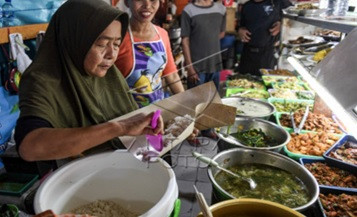
 Taste of culture: Fogaiyya stew (front) and other dishes are served at an event commemorating the Japanese publication of 'The Gaza Kitchen: A Palestinian Culinary Journey' at Koto Laboratory in Tokyo in October. (Kyodo/-)
A
s Gaza begins to recover following a cease-fire agreement between Israel and Hamas, a recent cooking event offered people in Japan a rare chance to connect with the region's people through food, and to imagine daily life before the devastation.
At Koto Laboratory, an experiential learning studio operated by Orangepage Inc. in Tokyo's Suginami Ward, participants gathered to cook and taste recipes from The Gaza Kitchen: A Palestinian Culinary Journey, a cookbook translated into Japanese by the cooking and lifestyle magazine publisher.
Following a well-received first event in July, the second session was held in October, coinciding with the two-year mark since Israel's invasion of Gaza, which suffered extensive damage during the conflict, with about 80 percent of buildings estimated to have been destroyed or damaged.

Inside the packed venue, Arab confectionery and cooking expert Aki Komatsu, who studied in Syria and Egypt, prepared traditional Gazan dishes using ingredients that are not easy to come by in Japan.
The menu included fogaiyya, or lemony chard, chickpea and rice stew, made with komatsuna Japanese mustard spinach as a substitute for chard, a leafy vegetable that is difficult to obtain in Japan.
Israel has faced international criticism for what rights groups including the United Nations and the International Criminal Court have concluded is the use of hunger as a weapon of war, blocking relief supplies and leaving civilians starving. Some attendees said they felt uneasy about eating food from Gaza while residents there still face shortages.
But after listening to an explanation from one of the translators of the book, Hikaru Fujii, associate professor of American literature at the University of Tokyo, and watching the appetizing dishes come together, participants were captivated.
As they shared the meal, a lively discussion followed, part culinary exploration, part reflection on Gaza's people and culture.
Fujii, known for translating contemporary American literature including Anthony Doerr's novel All the Light We Cannot See, said The Gaza Kitchen was his first attempt at translating nonfiction.
"I was shocked to realize I knew nothing," Fujii said. "I couldn't imagine what specific aspects of life were being lost."
"There are many people like me who are interested, but don't have any concrete knowledge about Gaza," he said. "What kind of meals did they eat, and how did they eat together? I couldn't help but wonder, so I began searching, and that's when I came across the original version of this book."
"I thought this was a book that everyone should read. I wanted to have a go at translating it," Fujii said. "I thought we have to act fast."
Fujii said a translation team was formed with three graduate students, two from the University of Tokyo and one from Kyoto University.

The original English-language book was written by Laila El-Haddad, a writer with roots in Gaza now based in the United States, and Maggie Schmitt, a US-born author living in Spain who specializes in the Mediterranean world.
Recipes from Gaza
The book documents the home-cooked meals of Gazans. Since around 2010, the authors have gathered recipes, interviews and photographs that reveal Gaza's food culture, from rice and fish dishes familiar to Japanese palates to spiced stews and Mediterranean fare.
The book's pages capture not only recipes but also scenes of the vibrant streets of Gaza, now largely destroyed.
Fujii said the translation team relied on advice from Mari Oka, a Waseda University professor of Arabic literature, to ensure accuracy. "It was a challenge since none of us had been to the Gaza Strip," he said.
Historically, Gaza has been a key trade hub linking Africa and Asia. After World War I, it came under United Kingdom Mandate administration and later Egyptian control following the 1948 Arab-Israeli War.
Refugees from other parts of Palestine increased its population from tens of thousands to about 2.2 million by 2023.
This mosaic of origins created a rich and diverse culinary heritage. Oka describes Gaza's cuisine as "a museum of Arab cooking."
Tokyo-based Orangepage said the project was intended to share food culture beyond Japan.
"As a food magazine, we believe it is our mission to introduce what people are cooking in homes around the world," said editor Kei Okano.
While some of the Gazans featured in the book are believed to be missing or dead, Fujii described the collection of family recipes as "a form of living testimony literature."
The book, priced at 4,950 yen (around US$32), has received domestic media attention and has been added to many public library collections.
One participant at the Tokyo event said the experience helped make the distant conflict feel more personal.
"I always thought Gaza was a faraway place I saw only in the news. Learning about its food made me feel closer to the people who live there."
In a world divided by politics and distance, The Gaza Kitchen offers a reminder that shared meals can bridge understanding.
For some, the book is simply a collection of recipes. But for others, it is a quiet act of connection, one that helps restore the image of a city where, despite hardship, families once gathered around tables to enjoy good food and each other's company.

More from The Weekender
Idul Fitri without the excess: Finding the real meaning of Hari Raya
We're scaling back the festivities and finding more meaning this Idul Fitri.

Show up, show off and call it self-care: Strong is the new flex
With toned arms as the new status symbol, maybe it’s time we rethink why we come to the gym and pick up those dumbbells.

When a friend becomes a stranger: Healing after a platonic breakup
We expect heartbreak in romance, but no one warns us how much it hurts when a friendship falls apart.