TheJakartaPost
Please Update your browser
Your browser is out of date, and may not be compatible with our website. A list of the most popular web browsers can be found below.
Just click on the icons to get to the download page.


Popular Reads
Top Results
No results found. Please check your search term and try again
Can't find what you're looking for?
View all search results
Popular Reads
Top Results
No results found. Please check your search term and try again
Can't find what you're looking for?
View all search resultsBreeding crabs in the mangroves
Sukardi, who heads a community group tasked with managing the crab breeding site in Gunung Kijang village, Bintan regency, holds two bred crabs (Scylla serrata) from the top of a bamboo bridge
Change text size
Gift Premium Articles
to Anyone
Share the best of The Jakarta Post with friends, family, or colleagues. As a subscriber, you can gift 3 to 5 articles each month that anyone can read—no subscription needed!

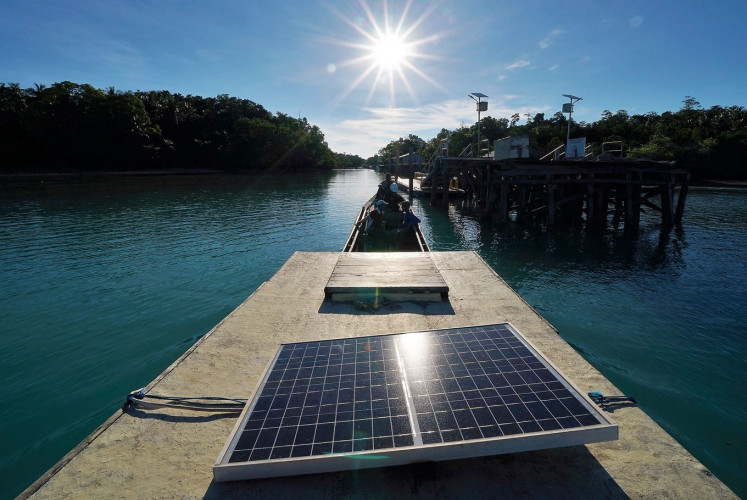
Sukardi, who heads a community group tasked with managing the crab breeding site in Gunung Kijang village, Bintan regency, holds two bred crabs (Scylla serrata) from the top of a bamboo bridge. Underneath him is a pond where some 400 crabs are raised among the mangroves. (JP/Desy Nurhayati)
As many as 2,000 crabs are being bred in the middle of a mangrove forest in Gunung Kijang village, Bintan regency, as part of an alternative livelihoods project conducted under the Coral Rehabilitation and Management Program, known as Coremap.
Coremap's coral reef conservation institution (LPSTK) set up the special breeding site, in which Scylla serrata crabs live and breed, with little destruction to the mangrove forest.
To reach the site, visitors can take a 3-minute boat ride from the village and then cross a 50-meter-long bamboo bridge.
The site is divided into five ponds; two 225-square-meter ponds and three 144-square-meter ponds. There are around 400 crabs in each pond, crawling around the mangroves' trunks.
Pathways have been built above the ponds so that visitors can see the crabs underneath.
Coremap's coordinator for the alternative livelihood project of Bintan regency, Zul Iskandar, said that his team wanted to build the breeding site while preserving the mangroves.
"We have tried such this method of crab breeding in several areas in eastern Indonesia, but it did not work," he said.
Community group head Sukardi, who manages the breeding site, said crabs were usually harvested once they had reached 400 grams each, or about three months after the baby crabs had been placed in the ponds.
"We can earn Rp 60,000 per kilogram," he said.
He said he collected the baby crabs from Tanjung Pinang. Each kilogram consisted of between 10 and 12 baby crabs and was worth Rp 25,000.
Since the breeding site commenced operation last year, he said, the community had been able to harvest the crabs twice.
Zul said the Coremap team and local residents were planning to convert the whole mangrove forest into a crab breeding site.
"As we succeed in building this site, we are also planning to develop it to become a tourist site to familiarize people with seashore species, such as this mangrove crab," he said.
-- JP/Desy Nurhayati