The Jakarta Post
Please Update your browser
Your browser is out of date, and may not be compatible with our website. A list of the most popular web browsers can be found below.
Just click on the icons to get to the download page.


Popular Reads
Top Results
No results found. Please check your search term and try again
Can't find what you're looking for?
View all search results
Popular Reads
Top Results
No results found. Please check your search term and try again
Can't find what you're looking for?
View all search resultsAnalysis: Prabowo's sluggish response to devastating Sumatra floods
Change text size
Gift Premium Articles
to Anyone
Share the best of The Jakarta Post with friends, family, or colleagues. As a subscriber, you can gift 3 to 5 articles each month that anyone can read—no subscription needed!
 Set as preferred source
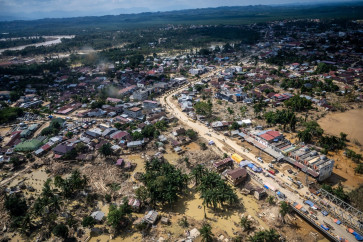
 An aerial photo shows Aceh Tamiang regency in Aceh on Dec. 4, 2025, one week after floods and landslides triggered by Tropical Cyclone Senyar made landfall on the northern part of Sumatra. Nearly 1.5 million people across 3,310 villages in Aceh province are affected by the disasters, according to official estimates. (Antara/Bayu Pratama S)
O
n Nov. 25, flash floods triggered by Cyclone Senyar struck Sumatra, severely damaging Aceh, North Sumatra, and West Sumatra. Two weeks later, more than 3 million people had been affected, with 1 million displaced, 836 dead, 518 still missing, and some 2,700 injured as of 16.00 Western Indonesia Time (WIB) on Dec. 4.
Yet, despite the rising death toll and massive displacement, by not declaring a national emergency, President Prabowo Subianto and his administration have hesitated to acknowledge the severity of the tragedy. By comparison, when Cyclone Senyar brought intense flooding to Thailand and Sri Lanka, both governments declared national emergencies within days.
On the ground in Aceh, local administrations have reached a breaking point. Three regents in Aceh publicly raised white flags, signaling their inability to handle the crisis as government facilities were swept away along with entire communities.
Aceh Governor Muzakir Manaf held back tears as he revealed that four villages in the region had been completely decimated. He described the flash floods as Aceh's "second tsunami", recalling the 2004 tragedy that claimed over 178,000 lives, an event he witnessed firsthand as a commander of the Free Aceh Movement.
Under Law No. 24/2007 on Disaster Management, a disaster may be elevated to national status when its scale exceeds local authorities' capacity to respond. These calls should have warranted greater consideration from the central government. Yet, when questioned by reporters, Prabowo said the situation on the ground was improving and did not warrant a state of emergency.
Reluctance aside, civil society groups and environmental analysts have criticized the government's reliance on an extractive economy for facilitating this tragedy. Environmental watchdogs Indonesian Forum for Environment (WALHI) and Greenpeace argue the flash floods were as much man-made as they were natural. They point to decades of mass deforestation, the unfiltered expansion of oil palm plantations, and excessive mining on Sumatra. This has left river basins in critical condition and reduced forest cover in the three affected regions to less than 25 percent.

Analysts have also noted that state losses caused by natural disasters now outweigh the dividends received from extractive activities. The Jakarta-based think tank Center of Economic and Law Studies (CELIOS) notes that a total of Rp 68.67 trillion (US$4.1 billion) was lost to floods and other natural disasters this year alone, compared to the Rp 16.6 trillion the state received in total mining revenue levy.