The Jakarta Post
Please Update your browser
Your browser is out of date, and may not be compatible with our website. A list of the most popular web browsers can be found below.
Just click on the icons to get to the download page.


Popular Reads
Top Results
No results found. Please check your search term and try again
Can't find what you're looking for?
View all search results
Popular Reads
Top Results
No results found. Please check your search term and try again
Can't find what you're looking for?
View all search resultsWho will benefit from a Grab-GoTo merger?
A merger between Grab and GoTo would result in significant market concentration, creating a new entity with up to 99 percent market share in Indonesia's ride-hailing and food delivery sectors
Change text size
Gift Premium Articles
to Anyone
Share the best of The Jakarta Post with friends, family, or colleagues. As a subscriber, you can gift 3 to 5 articles each month that anyone can read—no subscription needed!
 Set as preferred source
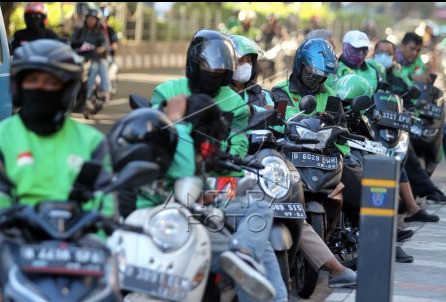 Digital workers: Ride hailing app drivers crowd along a roadside on March 20, 2024 as they wait for orders from customers on Jl. Margonda Raya in Depok, West Java.
(Antara/Yulius Satria Wijaya)
Digital workers: Ride hailing app drivers crowd along a roadside on March 20, 2024 as they wait for orders from customers on Jl. Margonda Raya in Depok, West Java.
(Antara/Yulius Satria Wijaya)
A
merger between Grab and GoTo in Indonesia would combine the country’s two largest ride-hailing and food delivery platforms, creating one of the most consequential deals for Southeast Asia’s economy.
Grab first explored this idea in early 2020 and is revisiting it now following years of expansion into overlapping verticals, rising capital costs and a tighter global funding climate. While past mergers that reduced competition in digital markets often slowed innovation and harmed consumers, adequate regulatory safeguards could mitigate these risks, potentially turning the deal into a success story for both Indonesian consumers and the wider economy.
Much discussion has focused on how this deal would improve efficiency and financial sustainability. However, the merger's impact on consumer welfare, worker outcomes and the broader economy has received less scrutiny. Depending on how the new ecosystem dynamics reshape the market, and the role regulators play in preserving competition, there is merit in considering several scenarios.
The business case for a Grab-GoTo merger is strong: Both companies face sustained investor pressure to demonstrate a credible path to profitability. Consolidation would allow them to access a larger user base while streamlining functions like consumer acquisition, marketing and engineering, alongside lowering infrastructure costs.
The ongoing financial sustainability of these two giants is a critical concern for the millions of gig economy workers in Indonesia who depend on the platforms for their livelihood. The country’s state asset fund, Danantara, could also be involved in the deal, providing funding by acquiring a minority stake in the merged entity.
Furthermore, the efficiencies from a unified platform could improve ride-hailing and delivery services through optimized logistics solutions and better trip matching. Strategically, this would position the region as home to a digital champion with scale comparable to global players like Meituan, Uber or DoorDash.

However, the potential risks mandate close scrutiny. Grab and GoTo are dominant players competing directly across ride-hailing, food delivery, digital payments and logistics. Bringing them together would result in significant market concentration, creating a new entity with up to 99 percent market share in Indonesia's ride-hailing and food delivery sectors (Grab currently holds roughly 63 percent and 47 percent respectively, while GoTo holds 36 percent and 52 percent).