TheJakartaPost
Please Update your browser
Your browser is out of date, and may not be compatible with our website. A list of the most popular web browsers can be found below.
Just click on the icons to get to the download page.


Popular Reads
Top Results
No results found. Please check your search term and try again
Can't find what you're looking for?
View all search results
Popular Reads
Top Results
No results found. Please check your search term and try again
Can't find what you're looking for?
View all search resultsfrontpage
Orient and his running mate won 48 percent of the vote in a three-horse race in December 2020. They were backed by three parties.
Change text size
Gift Premium Articles
to Anyone
Share the best of The Jakarta Post with friends, family, or colleagues. As a subscriber, you can gift 3 to 5 articles each month that anyone can read—no subscription needed!

E
lection officials found themselves in a quandary when they discovered that the recently elected regent of Sabu Raijua, a small regency in East Nusa Tenggara (NTT), is an American citizen.
NTT-born Orient Riwu Kore won the regental election in December last year but had failed to reveal that he had both an Indonesian and United States passport.
Indonesian law does not recognize dual citizenship.
According to media reports, the Elections Supervisory Agency (Bawaslu) Sabu Raijua office had suspected that Orient also held a foreign passport prior to the race but was unable to find evidence to confirm its suspicions. The Sabu Raijua General Elections Commission (KPU) declared Orient eligible to run for regent in late September 2020, after having only verified the documents Orient had submitted as requirements, which did not mention his foreign passport.
Orient and his running mate won 48 percent of the vote in a three-horse race in December 2020. They were backed by three parties: the ruling Indonesian Democratic Party of Struggle (PDI-P), the Gerindra Party and the Democratic Party. The KPU confirmed his victory on Jan. 23.
The regent-elect's dual nationality was revealed to the public by Bawaslu last week after it finally received confirmation about Orient’s US passport from the US Embassy in Jakarta. The news instantly drew nationwide attention and election authorities are now scrambling to solve the unprecedented problem.
Orient was recorded as having an Indonesian ID at the Home Ministry’s civil registry database as early as 1997 and holds an Indonesian passport dated April 2019, according to kompas.com.
“[He] somehow got a US passport without giving up his Indonesian citizenship," said population and civil registry director general Zudan Arif Fakrulloh as quoted by kompas.com.
Read also: In 2020, mixed-nationality families more eager to push for dual citizenship
Orient explained that he had resided and worked in the US, tempo.co reported. But he affirms that he is an Indonesian citizen who was born in NTT's provincial capital of Kupang.
He attended primary and secondary school in the city before completing his undergraduate studies in Nusa Cendana University, according to a profile on the KPU website he submitted as a requirement for the regental race.
"This has never happened before in the regional elections," Bawaslu national office commissioner Fritz Edward Siregar told The Jakarta Post.
“In principle, if he is stripped of his Indonesian citizenship, he can’t be inaugurated.”
He added that the decision lay with the Home Ministry.
Law and Human Rights Minister Yasonna Laoly reportedly considered issuing a citizenship revocation letter to Orient. As of Tuesday, Yasonna's office was still discussing the matter with related institutions.
Legal administration director general Cahyo Rahadian Muzhar said in a statement that the ministry was still "analyzing and collecting documents to be used as the basis of making any decisions”.
According to the country’s strict single-citizenship policy, any Indonesian found to hold a foreign passport will automatically lose their Indonesian citizenship, as regulated under the Citizenship Law. Other prevailing laws allow only Indonesian nationals to hold public office or work in civil service.
The only exception to the single-citizenship policy is children born to mixed-marriage couples. They are allowed dual citizenship until they turn 18, after which they have three years to choose between the two nationalities. This was introduced in the revision to the Citizenship Law in 2006.
Read also: Citizenship Law tears family apart
While Orient's case might be the first to involve an elected regional leader, there have been other cases of Indonesian dual-passport holders who were exposed in the media spotlight.
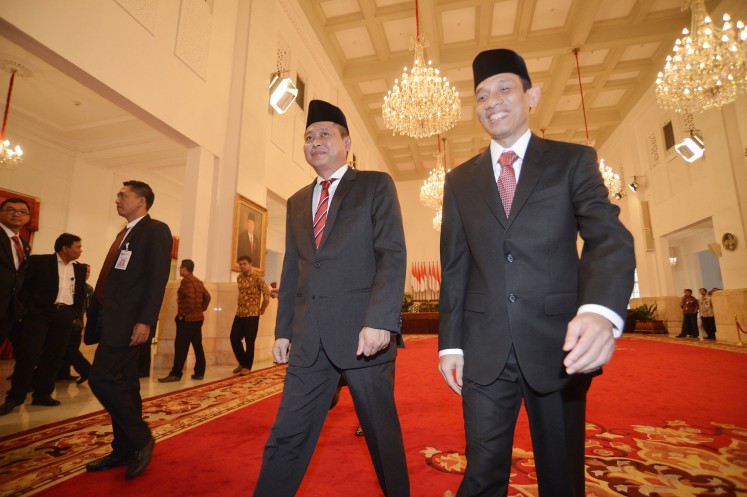
Perhaps the most notable case was that of Arcandra Tahar, who was dismissed from his job as energy and mineral resources minister because of his dual nationality in 2016, only less than three weeks taking office. He returned to the Cabinet as a deputy energy minister in the same year after renouncing his US citizenship and served until 2019.
Another example was a teenager who had been born to a French father before the revision to the Citizenship Law was made; she almost lost her membership in the prestigious Independence Day national flag-hoisting team at the Presidential Palace in 2016 after authorities found out about her French passport.
For years, Indonesian diaspora and mixed marriage families have been campaigning for another revision to the Citizenship Law to allow dual citizenship. They argue that the single citizenship policy often makes it hard to keep families together and undermines the well-being of families that have members of various nationalities – especially those who are still living in Indonesia.
Indonesians who hold foreign passports, for example, are prohibited from inheriting property such as land and houses from their Indonesian family members.
A bill to revise the single citizenship was included in the National Legislation Program (Prolegnas) at the House of Representatives and gained momentary traction in 2015 when President Joko "Jokowi" Widodo said he would back efforts to allow dual nationality. However, the bill has not made it to the Prolegnas’ priority list to date.
Christina Aryani, a Golkar Party lawmaker who represents constituents abroad and in some parts of Jakarta, told the Post that pushing for dual citizenship was not an easy task when many lawmakers were worried about potential compromises to national security.
Read also: Ministry wants diaspora to do more for dual citizenship
Foreign Policy Community of Indonesia (FPCI) cofounder and former deputy foreign minister Dino Patti Djalal said he had found that invalid, unreasonable arguments about security had dominated debates about dual citizenship, when in fact, they should focus on ways it could be used as an instrument of national development.
“It is about how [the government] can turn the diaspora into an extension of Indonesia's civilization abroad and how we accommodate Indonesians who have to live abroad but still want to be Indonesian citizens. These are not bad people,” he said.
Regardless, Dino regretted the controversy surrounding Orient, whom he deemed rather "dishonest" for not disclosing his US citizenship status in the first place.
“This [dual citizenship] is good for social, cultural and economic purposes, but when it comes to politics, you still have to choose,” Dino said. "Because in politics, you talk about loyalty, the flag, the potential conflict of interest and so on. So, I think [in this case], it is best to keep [election candidates] restricted to the single-citizenship policy.”