TheJakartaPost
Please Update your browser
Your browser is out of date, and may not be compatible with our website. A list of the most popular web browsers can be found below.
Just click on the icons to get to the download page.


Popular Reads
Top Results
No results found. Please check your search term and try again
Can't find what you're looking for?
View all search results
Popular Reads
Top Results
No results found. Please check your search term and try again
Can't find what you're looking for?
View all search resultsAUKUS and the potential for an Indo-Pacific Cold War
Indonesia and ASEAN must take a stronger stance, now that AUKUS has raised the possibility of Australia becoming a nuclear power in an Indo-Pacific face-off.
Change text size
Gift Premium Articles
to Anyone
Share the best of The Jakarta Post with friends, family, or colleagues. As a subscriber, you can gift 3 to 5 articles each month that anyone can read—no subscription needed!
T
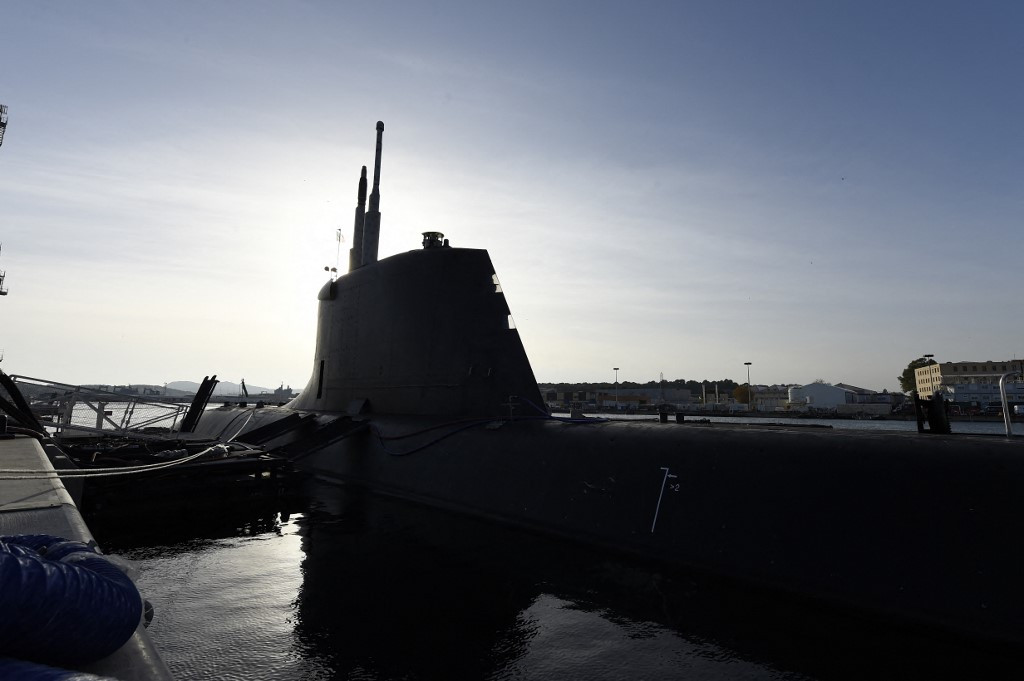
he binding trilateral security pact between Australia, the United Kingdom and the United States (AUKUS) that allows the development of nuclear submarines for Canberra has sparked concern over an arms race and the return of the Cold War era in the Indo-Pacific.
Not only will Australia receive nuclear submarine technology, it may also gain other strategic weapons, including ballistic missiles, long-range anti-ship missiles and the development of quantum and artificial intelligence technologies.
This significant effort to strengthen the Australian Defence Force (ADF) is believed to be another tool to address China’s assertiveness in the region. The theaters of conflict are the East China Sea and the South China Sea, of which the latter has seen a show of force by US and NATO aircraft carriers in recent months.
AUKUS has also ignited a diplomatic crisis between France on one side and the US and Australia on the other side, after Australia cancelled its US$90 billion order for 12 conventional submarines from France. Paris has even recalled its ambassadors from Canberra and Washington in response over the security pact.
Reactions from Indo-Pacific countries were inevitable. Indonesia’s Foreign Ministry expressed concern “over the continuing arms race and power projection in the region”. Furthermore, Jakarta called on Australia “to maintain its commitment towards regional peace, stability and security in accordance with the Treaty of Amity and Cooperation” in Southeast Asia.
China has also criticized the pact as potentially reverting the world to the Cold War era and igniting an arms race in the region. This would disrupt security and stability in the region, which has already reached a state vulnerable to potential armed conflicts in the East and South China seas.
AUKUS adds to the defense and security pacts that already exist as an effort to counter China’s growing power in the Indo-Pacific. The region is already familiar with the Five Eyes (FVEY) intelligence alliance between the US, the UK, Australia, New Zealand and Canada, as well as the Quadrilateral Security Dialogue (Quad) between the US, Australia, Japan and India.
But why would submarines trigger an arms race? Far from an ordinary sea vessel, a submarine is a highly strategic naval vessel of significant deterrence. It is feared because it is hard to detect and able to infiltrate the enemy’s core defenses, especially nuclear submarines, which can sail for months deep under the sea. On the other hand, the current revolution in military affairs (RMA) is entering the phase of using satellite technology, improving ballistic missile range and developing the technologies for unmanned systems and nuclear submarines.
As we anticipate possible conflict in the East or South China seas, submarines could be the most reliable platform for sea control, thanks to her stealth and long-distance cruising capabilities over an extended time, as well as offensive weapons systems. Submarines have long been the choice to not only eliminate but also deter the enemy.
As the history of global warfare shows, German submarines succeeded in sinking many Allied surface vessels during World Wars I and II. During the Pacific War, US subs shot down many Japanese warships, including five aircraft carriers. Pakistani submarines sank two Indian destroyers back in 1965 and 1971. During the 1982 Falklands War in Islas Malvinas, British submarines sank Argentinian destroyers.
With today’s technological advancements, nuclear submarines are faster and quieter, with increased endurance to stay beneath the sea surface, and are equipped with nuclear ballistic missiles as well as conventional missiles. In fact, as tensions escalate in the South China Sea, countries in the region, especially Southeast Asian states, have upgraded their submarine fleet.
Indonesia has enhanced its fleet with the KRI Nagapasa-403, KRI Ardadedali-404 and KRI Alugoro-405 submarines. It currently has four submarines in operation after the KRI Nanggala-402 sank in April of this year. Malaysia has procured two Scorpène-class submarines from France, while Singapore has six subs and plans to buy two German-built Type 218SG submarines.
Vietnam has signed a contract for six Russian Kilo-class subs, Thailand is considering procuring six U-206 subs from Germany. Last year, the Philippines revealed its plan to procure submarines while Myanmar currently operates a 110-ton Yugo-class and 370-ton Sang-O-class submarine, and has acquired two Vela-class subs from Moscow.
The submarines in Southeast Asia are all conventional. By 2040, Australia plans to operate eight nuclear subs as a result of AUKUS, which will make it the seventh country in the world to operate nuclear submarines after the US, the UK, France, China, Russia and India.
China has at least 12 nuclear submarines patrolling the South China Sea with the support of its military base on manmade Fiery Cross Reef as part of its effort to reinforce its claim over most of the disputed waters. China’s naval presence has also been strengthened with the publication of its new maritime safety law in September 2021 and the China Coast Guard Law in February 2021.
South China Sea tensions will remain warm for the unforeseeable future, since the claimant states are yet to reach an agreement as regards their respective territorial claims. US Navy warships continue to conduct Freedom of Navigation Operations to challenge China’s efforts to establish hegemony in the area. Moreover, the US naval presence ensures the country’s freedom of navigation as well as protection for its trade and investment interests in the region. China, on the other hand, has called the US military presence “illegal” and that it could easily provoke unwanted tensions.
The root of the South China Sea tensions is China’s claim over almost 90 percent of the sea as Chinese territorial waters, disregarding the claims of the other states: Vietnam, the Philippines, Brunei, Malaysia and Taiwan. China has also refused to accept the outcome of an UNCLOS-based arbitration decision that rejected China’s historical claim.
Now that AUKUS has entered the picture, it is evident that South China Sea tensions are again heating up as the world’s major powers face one another, and the world is bracing for a new Cold War. Indonesia, as well as ASEAN, should have a stronger stance and demeanor, as the regional arms race and tensions are rising toward a dangerous level.
***
The writer is a professor of Defense Sciences at the Indonesia Defense University and was chief of staff of the Indonesian Navy in 2012-2015.