TheJakartaPost
Please Update your browser
Your browser is out of date, and may not be compatible with our website. A list of the most popular web browsers can be found below.
Just click on the icons to get to the download page.


Popular Reads
Top Results
No results found. Please check your search term and try again
Can't find what you're looking for?
View all search results
Popular Reads
Top Results
No results found. Please check your search term and try again
Can't find what you're looking for?
View all search resultsContested histories: Soeharto and the March 1, 1949 attack on Yogyakarta
Presidential Decree (Keppres) No. 2/2022 has disappointed such hopes. It shows that the manipulation of history is still very much alive.
Change text size
Gift Premium Articles
to Anyone
Share the best of The Jakarta Post with friends, family, or colleagues. As a subscriber, you can gift 3 to 5 articles each month that anyone can read—no subscription needed!
I
ndonesians who lived through Soeharto’s New Order will be familiar with the way in which history was manipulated in the interests of the political elite. The still murky and terrible events of Oct. 1, 1965 spring readily to mind.
Students of the late Prof. Sartono Kartodirjo (1921-2007) will also remember how he withdrew from editing later editions of the sixth volume of the Indonesian National History to protest against the regime’s manipulation of history. De-Sukarnoization was then the order of the day.
So too was a pernicious ethnic bias in official histories. This saw Chinese Indonesians intentionally disappeared from the official record. Four prominent peranakan (Indonesian-Chinese) – Liem Koen Hian, leader of the Indonesian Chinese Party (PTI), Oey Tiang Tjoei, owner of the Hong Po daily, Oei Tjong Hauw (son of the sugar “king” Oei Tiong Ham, and Tan Eng Hoa, a Batavia-based lawyer – who played a role in the Agency for the Preparatory Work for Indonesian Independence (BPUPKI), were expunged from the record.
Regime ideologue and official historian Prof. Nugroho Notosusanto ordered their removal. They were replaced by fictitious Indonesian Arabs. In reality, only one such figure, the national hero grandfather of Jakarta Governor Anies Baswedan, AR Baswedan (1908-86), actually existed.
Despite numerous revised editions, the Sejarah Nasional or National History (1975) and its companion, Indonesia dalam Arus Sejarah or Indonesia in the stream of history (2011), the record has never been rectified.
In the current reformasi era, with President Joko “Jokowi” Widodo who was still in pre-school when the Indonesian Communist Party (PKI) was being hounded to destruction, one might have expected history writing to enter a new and more enlightened age. Sadly, Presidential Decree (Keppres) No. 2/2022 has disappointed such hopes. It shows that the manipulation of history is still very much alive.
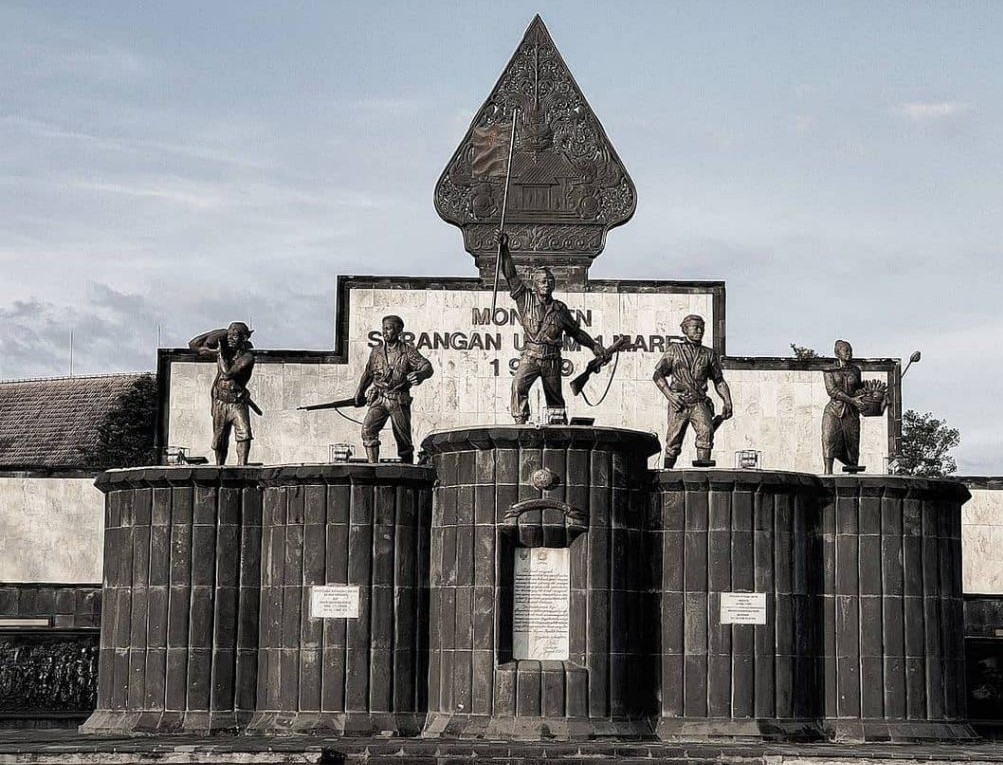
But now the record is twisted in the opposite direction. Instead of the nation’s tragic first president, his successor is the target of present regime ideologues. De-Soehartoization is the order of the day. The Keppres recognised the March 1 date (with reference to the General Offensive of March 1, 1949 in Yogyakarta) as the Day of the Upholding of National Sovereignty.
But those Indonesians who grew up watching the movie Janur Kuning (1980), screened annually on March 1 every year from 1980 to 1998, are in for a shock. Instead of acknowledging the role of Soeharto, Indonesia’s second president, as operational commander for the day-long reoccupation of the Republican capital under the noses of the Dutch Tiger Division, the accolades now go to the late Yogyakarta sultan Hamengku Buwono IX, Indonesian armed forces commander Gen. Sudirman, and founding president Sukarno and vice president Mohammad Hatta.
Soeharto's name is not even mentioned. And yet, the historical record does not lie. Soeharto was the operational commander of the Republican forces which saw troops from his Brigade 10 of Wehrkreise III occupy Yogyakarta for nine dramatic hours on that historic day.
In 1984-85 the BBC’s Indonesian Section prepared a 36-part radio program, in which I was involved as an historical consultant. This was later published by PT Gramedia as Gelora Api Revolusi; Sebuah Antologi Sejarah (Seething fire of Revolution: An anthology) in 1986, and will soon be reissued by Penerbit Buku Kompas in a revised online version.
Aired over nine months (April-December 1985) to celebrate the 40th anniversary of Indonesian independence, the 32nd broadcast on Nov. 25, 1985 featured an interview with the sultan. Titled The Republic under Blockade, it tells how the Yogyakarta ruler came up with the idea of an operation which would have maximum impact on world opinion. The imminent meeting of the United Nations Security Council at Lake Success (New York) in early March 1949, where the “Indonesian question” would be discussed, was especially in the sultan’s sights.
In early February, he wrote to Sudirman to suggest such an operation. The great commander accepted and designated the then Col. Soeharto as operational commander. Soeharto was chosen because his Brigade 10 troops were most strategically located close to the Republican capital. On Feb. 14 that year, the future second president met with the sultan incognito disguised as an abdi dalem (court servant). In a secret location to the rear of the sultan’s palace, the two men successfully planned and coordinated the operation.
All this was described and acknowledged by the sultan in his BBC interview conducted in London. There is no artifice or manipulation here.
Why then the reticence to acknowledge Soeharto’s contribution? His absence from the Keppres smacks of politics. This is short-sighted. History is not a zero-sum game. Just because one historical actor is given pride of place does not mean that others do not deserve their due. Soeharto should not be written out of history just because of changing political fashions.
Whatever happened in the New Order, his contribution during the Indonesian Revolution should be acknowledged. None more so than on that March 1, 1949 day. Furthermore, if honor is paid where honor is due, it is easier to insist on transparency in other far less salubrious contexts. These could include the Madiun affair of September 1948 and the Oct. 1, 1965 “coup” and its aftermath, where Soeharto’s role is still to be properly clarified.
History has many faces. There is no single truth. If Indonesian leaders want to keep the ship of state afloat, they need to act inclusively. Chinese Indonesians and other minorities deserve their honored place in Indonesian history. Their separate contributions to the nation are real and should be celebrated.
Indonesia is a rainbow nation not a mono-ethno-religious juggernaut. The Keppres was an opportunity missed. Instead of bringing the two sides of the historical divide (pro-sultan and pro-Soeharto) and the nation more widely together, it drove them further apart.
The bitter recriminations and rivalries aired on social media ever since are proof of that. It does not need to be this way. Let us learn the lessons of the past and move ahead to a more generous, tolerant and inclusive vision.
In such a perspective there are no perennial heroes nor still eternal villains. And where better place to start than a comprehensive review of the history of the day in the Indonesian Revolution (1945-49) which changed Indonesia’s destiny forever?
***
The writer is an historian specializing on Diponegoro (1785-1855).