TheJakartaPost

Please Update your browser

Your browser is out of date, and may not be compatible with our website. A list of the most popular web browsers can be found below.
Just click on the icons to get to the download page.


Jakarta Post

Longevity in question at US-ASEAN meet

Pundits are questioning the long-term reliability and vision of US-ASEAN cooperation, with the region often overlooked in the superpower's Indo-Pacific strategy.

A. Muh. Ibnu Aqil (The Jakarta Post)
Jakarta
Tue, May 17, 2022 Published on May. 16, 2022 Published on 2022-05-16T17:54:43+07:00

Change text size

Gift Premium Articles
to Anyone

Share the best of The Jakarta Post with friends, family, or colleagues. As a subscriber, you can gift 3 to 5 articles each month that anyone can read—no subscription needed!

E

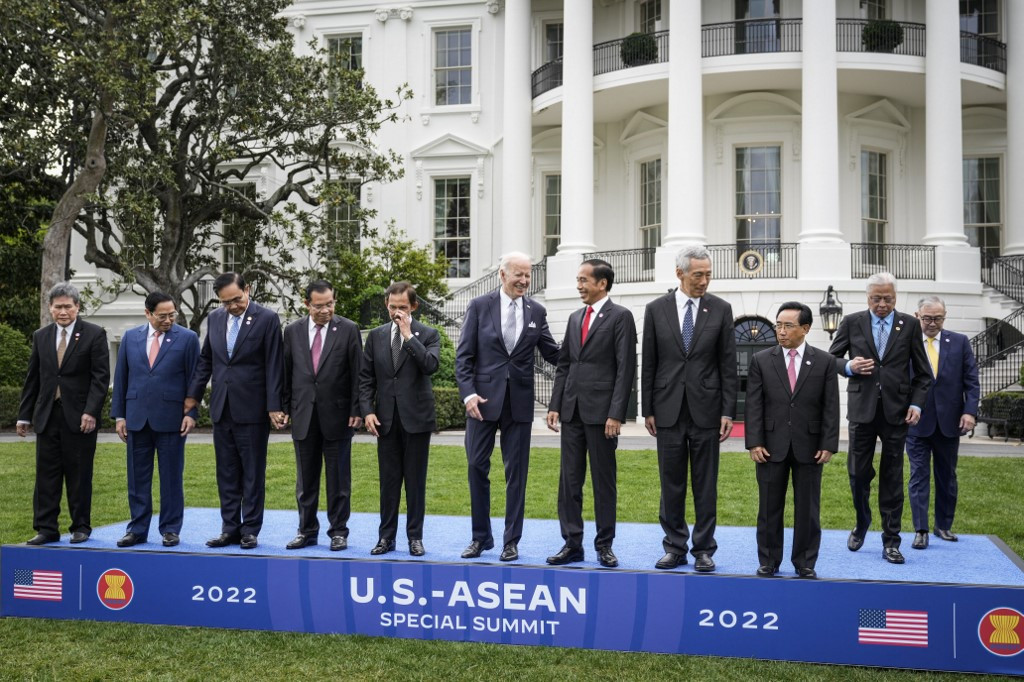
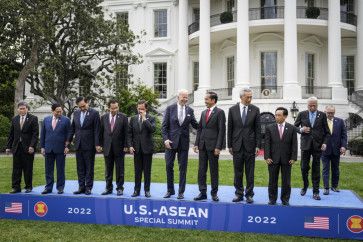
xperts are divided about the Joe Biden administration’s plan to usher in a “new era” of United States-Southeast Asia relations following the conclusion to last week’s US-ASEAN Special Summit in Washington, D.C.

President Biden hosted eight ASEAN leaders, including President Joko “Jokowi” Widodo, as well as the regional grouping’s secretary-general Lim Jock Hoi over two days of meetings that covered a broad range of issues, from health security to climate action, and from expanding education access to enhancing maritime cooperation.

The US-ASEAN summit was only the second meeting of its kind since February 2016, a year before Donald Trump ascended to the presidency and limited the scope of that country’s Asian interests to China and North Korea.

“I hope this meeting can build momentum for the return of the US presence in the region,” President Jokowi said on Thursday at a separate meeting with the US-ASEAN Business Council.

The US-ASEAN Special Summit produced a 28-point vision statement, which analysts hailed as a blend of ASEAN and US values, but it also prompted skepticism over the sustainability of Washington’s efforts to refocus on the region.

Despite 45 years of maintaining ties with Southeast Asia, the US continues to fall behind China, a strategic rival whose circle of influence it is seeking to limit by leveraging alliances in the Indo-Pacific. Meanwhile, Biden is set to travel to Japan in the coming weeks for another summit of the Quadrilateral Security Dialogue (Quad), which also includes Australia and India.

According to the US-ASEAN vision statement, the two sides are committed to upgrading the US-ASEAN relationship to a comprehensive strategic partnership (CSP) in November, which would buoy Washington’s status above the grouping’s other dialogue partners.

ASEAN previously granted CSP status to Australia and China, the latter of which is the region’s biggest trade partner.

The US-ASEAN statement also emphasized “the need to maintain and promote an environment conducive to the Code of Conduct in the South China Sea (COC) negotiations”.

The COC has thus far involved a prolonged and slow process of setting up protections against open conflict at sea among the multiple claimants of the South China Sea: China, Vietnam, Malaysia, Brunei, the Philippines and Taiwan, the latter of which China views as its own territory.

The statement also endorsed ASEAN’s Five-Point Consensus to address the crisis in Myanmar stemming from the Feb. 1, 2021 military coup, while it reaffirmed “respect for sovereignty, political independence and territorial integrity” as regards the war in Ukraine.

“ASEAN centrality is the very heart of my administration’s strategy in pursuing the future we all want to see,” Biden said at the summit on Friday.

In another clear sign of the US’ intent to reinvigorate ties with the regional grouping, Biden announced that he would nominate National Security Council chief of staff Yohannes Abraham as the US Ambassador to ASEAN, which had been left vacant since 2017 under the Trump adminitration.

But a US$150 million pledge in support of US programs for the 10-nation group has prompted more questions than answers, especially in light of the $40 billion US security package for Ukraine to expel Russian forces from its territory.

Mixed reception

Despite the so-called special summit, researcher Randy W. Nandyatama from Gadjah Mada University’s ASEAN Studies Center said there was a general sense that the US was looking to benefit from ASEAN without investing too much in the region.

“US investment in the Indo-Pacific seems to be mainly motivated by multilateralism outside of ASEAN,” he told The Jakarta Post on Sunday.

That said, Randy considered the relatively low US investment figure as indicative of a flaw in ASEAN’s organizational design and its focus on centrality, which often prompted other countries to view it as a forum with relatively low upkeep.

“I think the US is being rational by investing in institutions they deem to have higher levels of compliance, such as AUKUS [Australia-United Kingdom-US security pact] or the Quad,” he said.

Senior strategic and foreign affairs analyst Rizal Sukma said that while Biden was under pressure to make an impression that ASEAN remained important to US foreign policy, a single summit would not matter significantly in enhancing US cooperation with the region.

“I’m not sure if we can expect sustained engagement. Imagine what would happen if Trump makes a comeback in 2024,” Rizal said on Sunday, referring to growing concerns that Biden could lose support in the midterm elections, which could pave the way for a return of the divisive leader.

Rizal added it was still up for debate whether Indo-Pacific countries could rely on US presence in the region: “The US should really be playing the role of a permanent great power, not a part-time power.”

In contrast, Dewi Fortuna Anwar, a senior researcher of international politics at the National Research and Innovation Agency (BRIN), said the special summit was a significant occasion for ASEAN-US relations.

“The fact that the special summit took place at all is significant, especially considering that ASEAN had been marginalized [in US foreign policy] since the Trump administration,” Dewi told the Post on Saturday.

The vision document also managed to accommodate both ASEAN and US interests, Dewi said, with the former stressing the need for regional inclusiveness and a wish for concrete economic relations, and the latter wanting environmentally compliant development in the region.

“On the whole, I think this is a new chapter in the reinvigoration of ASEAN-US relations, which shows that the two sides are important to one another,” she said.

Your Opinion Matters

Share your experiences, suggestions, and any issues you've encountered on The Jakarta Post. We're here to listen.

Enter at least 30 characters
0 / 30

Thank You

Thank you for sharing your thoughts. We appreciate your feedback.

Share options

Quickly share this news with your network—keep everyone informed with just a single click!

Change text size options

Customize your reading experience by adjusting the text size to small, medium, or large—find what’s most comfortable for you.

Gift Premium Articles
to Anyone

Share the best of The Jakarta Post with friends, family, or colleagues. As a subscriber, you can gift 3 to 5 articles each month that anyone can read—no subscription needed!

Continue in the app

Get the best experience—faster access, exclusive features, and a seamless way to stay updated.