TheJakartaPost
Please Update your browser
Your browser is out of date, and may not be compatible with our website. A list of the most popular web browsers can be found below.
Just click on the icons to get to the download page.


Popular Reads
Top Results
No results found. Please check your search term and try again
Can't find what you're looking for?
View all search results
Popular Reads
Top Results
No results found. Please check your search term and try again
Can't find what you're looking for?
View all search resultsGovt should expect less from debt-laden SOEs: Analysts
The government will support "sick" SOEs, especially those handling key infrastructure projects, analysts expect, but the aid may not come in a timely manner.
Change text size
Gift Premium Articles
to Anyone
Share the best of The Jakarta Post with friends, family, or colleagues. As a subscriber, you can gift 3 to 5 articles each month that anyone can read—no subscription needed!
A
nalysts have advised that the government should lower its expectations for state-owned enterprises (SOEs) becoming profitable if it insists on burdening them with tasks that lack commercial viability.
Furthermore, the government may need to disburse more funds to tide over SOEs mired in financial difficulties.
Aside from their noncommercial function to provide public benefits and engage in businesses deemed unfeasible for the private sector, SOEs in Indonesia also have a commercial function to achieve profitability, according to Law No. 19/2003 on SOEs.
This dual function is stretching many SOEs, and not all should count on government help. Support is expected to be selective, and it may come too late for some.
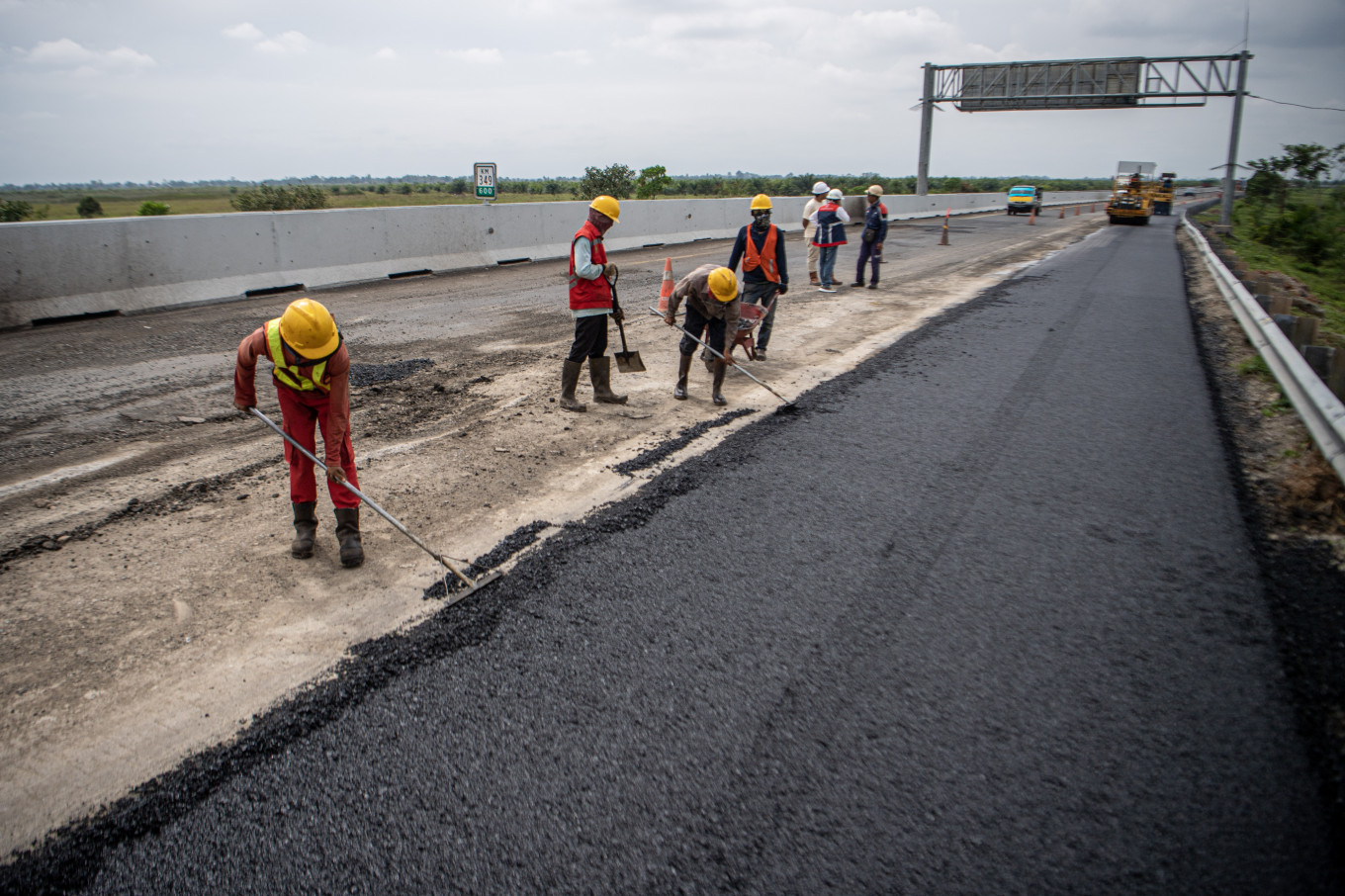
Two SOEs operating in the construction sector, PT Wijaya Karya and PT Waskita Karya, have announced postponed repayments on some of their obligations, prompting rating downgrades for those obligations by local credit rating agency Pefindo.
The news has raised concern about cash flows at other SOEs, especially those building infrastructure.
According to Abra Talattov, head of the Center of Food, Energy and Sustainable Development at the Institute for Development of Economics and Finance (Indef), the problem is rooted in the government's aggressive infrastructure push and in policies assigning SOEs to noncommercial projects.
"Due to limited state budget [funding], SOEs have to execute projects with alternative funding, which is quite limited. Thus, they are compelled to take out short-term loans with high interest, creating a mismatch with infrastructure projects that can only produce revenue on a long-term basis," Abra told The Jakarta Post on Friday.
The high debt-to-equity ratios of infrastructure SOEs show that those companies are burdened by the government projects, Abra added.
In a gathering of all SOE president directors in East Nusa Tenggara in 2021, President Joko "Jokowi" Widodo said he was aware of the dilemma faced by many SOEs, but he blamed SOE executives for failing to calculate projects properly.
Abra countered that view, saying the responsibility fell back on the government as the party responsible for overseeing SOEs through the SOEs Ministry and for choosing their commissioners. On top of that, SOEs discussed every strategic decision to be made with the government, including when state capital injections (PMN) were needed.
"Those projects are also discussed with the House of Representatives. So, they are also involved in monitoring whether it is feasible to continue a project or not," Abra said.
According to Abra, if projects earn SOEs no profits, the government should bear the consequences and not have too high expectations for the SOEs to make a profit.
Read also: Ministry seeks additional $1.68b for struggling construction SOEs
Toto Pranoto, an SOEs analyst from the University of Indonesia, said around 85 percent of all SOEs’ profits came from just a quarter of the companies, meaning most of them could be regarded as underperforming.
"That is caused by too many government projects [given to them] that are not managed well or by subpar corporate governance in the companies," Toto told the Post on Friday.
In the future, Indef's Abra said, the government could help infrastructure SOEs manage their cash flows by optimizing the role of the Indonesia Investment Authority (INA), Indonesia’s sovereign wealth fund, to attract potential investors.
Toto, however, contended that the INA may face challenges in supporting SOEs, as global investors were usually only attracted to projects that offered good returns and ticked environmental, social and governance (ESG) boxes.
"If those requirements are not met, it will be hard for a sovereign wealth fund [like the INA] to market local infrastructure projects," Toto said.
Respite for "sick" SOEs
Earlier this month, House lawmaker Amin Akram said infrastructure SOEs needed a time of "rest" from government projects.
"To prevent more financial bleeding, stop giving new projects to infrastructure SOEs for a while, especially big projects," said Amin, as quoted by Bisnis.
According to Indef's Abra, a moratorium on new projects might help alleviate SOEs' financial problems, but ongoing projects would need to continue.
"For example, the high-speed railway project is almost impossible to cancel. However, if it continues, the potential for losses is also big," Abra said.
Abra pointed to the Nusantara capital city as a new burden for infrastructure SOEs, especially if the private sector had little interest in investing in the megaproject.
Toto agreed that giving "sick" infrastructure SOEs rest from new projects was a good idea, so that companies could prioritize debt restructuring and balance their equity portion.
"If the government wants to continue big projects, including [Nusantara], the financing portion from the national budget should be increased," Toto opined.
Read also: Analysis: Jakarta-Bandung HSR rushes for commercial operation in August
In a public seminar on Tuesday, Pefindo's vice president of nonfinancial institutions ratings Yogie Perdana said the government would still rescue subpar SOEs, especially companies with major government projects. However, the support would be selective, and it may not come in a timely manner.
Furthermore, Yogie said the support would predominantly come in the form of debt restructuring or refinancing through SOE banks, because of reduced confidence in the sector among domestic bond investors.
Indef's Abra agreed that the government would still help key SOEs through subsidies, compensation or PMN schemes. However, he also said the government aid often came late, forcing companies to find other sources of capital to fill the gap.
"As corporations, SOEs nonetheless face bureaucratic processes in the context of financing disbursed from the government," Abra stated.