TheJakartaPost
Please Update your browser
Your browser is out of date, and may not be compatible with our website. A list of the most popular web browsers can be found below.
Just click on the icons to get to the download page.


Popular Reads
Top Results
No results found. Please check your search term and try again
Can't find what you're looking for?
View all search results
Popular Reads
Top Results
No results found. Please check your search term and try again
Can't find what you're looking for?
View all search resultsWhy Indonesian Tax Court reform matters to ASEAN integration
The Indonesian government should prioritize the Tax Court reform on the agenda of its ASEAN chairmanship since the court could be a role model for the national courts of other ASEAN member states.
Change text size
Gift Premium Articles
to Anyone
Share the best of The Jakarta Post with friends, family, or colleagues. As a subscriber, you can gift 3 to 5 articles each month that anyone can read—no subscription needed!
T
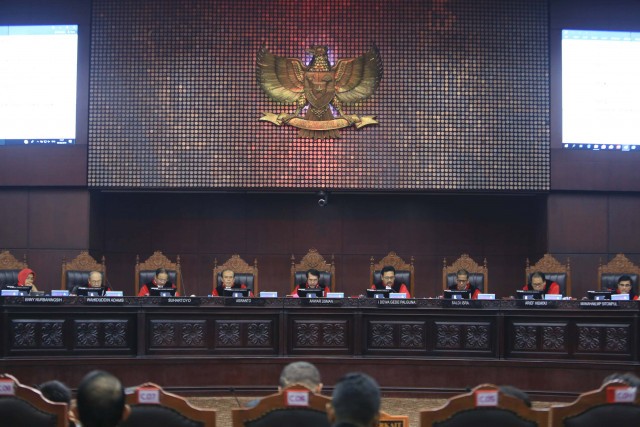
he Constitutional Court ruled under a May 25 decision regarding the reform of the Tax Court that “the organizational development, administration and financing of the Tax Court are carried out by the Supreme Court. The decree will be implemented in stages no later than December 31, 2026.”
Based on Law No. 14/2002 on Tax Court, the subject of the Constitutional Court’s judicial review, the authority to implement those three functions rests with the Finance Ministry.
The Constitutional Court ruling put an end to a long-standing debate over the position of the Tax Court, which has one leg under the Finance Ministry and the other at the Supreme Court. While the Finance Ministry is responsible for the Tax Court's organizational development, administration and financing, the appeal/cassation process against the Tax Court’s decision is entrusted to the Supreme Court.
Under the 2002 law the Tax Court does not act as a complete judicial institution. However, with the Constitutional Court's decision, it is hoped that by Dec. 31, 2026, the Tax Court will transform into an absolute and complete judicial institution like other types of courts within the framework of the rule of law. The reform will also give the Tax Court independence vis-à-vis the Finance Ministry.
So far, the role of the Tax Court has been significant in correcting the decision of the director general of Customs and Excise in setting tariffs. It becomes more critical since, currently, the Customs and Excise Directorate General is being exposed to allegations of corruption.
As part of the investigation into the alleged graft practices, the Attorney General's Office on May 28 searched the office of the director general of Customs and Excise.
Moreover, the reform of the Tax Court is much awaited not only by Indonesia but also ASEAN. In the last decade, the Tax Court has significantly contributed to ensuring that many ASEAN agreements, especially related to trade, can be enforced.
If we look into the existing law, the object of dispute in the Tax Court concerns only two issues: the decision of the director general of taxation and that of the director general of Customs and Excise.
My initial research found at least 100 Tax Court rulings on the decision of the director general of Customs and Excise related to ASEAN agreements since 2013. These cases related to major ASEAN agreements on trade, such as the ASEAN Trade in Goods Agreement (ATIGA), the ASEAN China Free Trade Agreement (ACFTA) and the ASEAN Australia New Zealand Free Trade Agreement (AANZFTA), which have been ratified into Indonesian national law.
The case pattern is mainly related to the determination of tariffs by the Indonesian Customs and Excise on importers who bring in goods from other countries within the framework of the ASEAN law instruments.
In many cases, importers, who should have not been subject to tariffs based on the ASEAN law instruments, were still charged by the Indonesian Customs and Excise. However, it was later corrected by the Tax Court, preventing ASEAN agreements from becoming paper tigers.
One of the newest cases is PUT-000297.47/2022/PP/M. XIXB 2023 relating to the importation of car wipers from China to Indonesia, which, in the beginning, was subject to a 5 percent tariff by Customs and Excise. The Tax Court amended the decision by setting a zero tariff within the ASEAN–China Free Trade Area (ACFTA) framework. As a result, the importer saved Rp 38.7 million (US$2,665)
The significant role of the Indonesian Tax Court also needs to be understood or transmitted to the national courts of other ASEAN member countries. Finally, it is to respond to criticism or doubts over the legal certainty of the ASEAN integration process.
So far, ASEAN has come under fire for promoting the “ASEAN way,” which prioritizes consensus and non-interference, rather than the rule of law. Nevertheless, the rule of law is imperative to make sure regional economic integration works well.
Unlike the European Union with its European Court of Justice, ASEAN has chosen not to create a regional court. However, the decision taken by the Indonesian Constitutional Court should lead ASEAN to the creation of a new ASEAN way by involving and maximizing the role of the domestic courts of member countries. With this, ASEAN continues to adhere to its non-interference principle while encouraging settlement through domestic courts and implementing ASEAN legal instruments in actual cases.
Therefore, the Indonesian government should prioritize the Tax Court reform as the agenda of its 2023 ASEAN Chairmanship since the court could be a role model for the national courts of other ASEAN member states. It means the Finance Ministry and the Supreme Court should immediately respond to the Constitutional Court's decision to immediately process the reform and the transfer of authority mandated by the Constitutional Court. There is no need to wait for the end of the 2026 deadline.
To conclude, while the Indonesian government has chosen “ASEAN Matters” as the theme of its ASEAN chairmanship, it is also important to remember that the reform of the Tax Court matters to ASEAN.
***
The writer is a lecturer at the Banten Public Administration School (STIA) and the founder and executive director of the ASEAN Law Observers.