TheJakartaPost
Please Update your browser
Your browser is out of date, and may not be compatible with our website. A list of the most popular web browsers can be found below.
Just click on the icons to get to the download page.


Popular Reads
Top Results
No results found. Please check your search term and try again
Can't find what you're looking for?
View all search results
Popular Reads
Top Results
No results found. Please check your search term and try again
Can't find what you're looking for?
View all search resultsSupport local small businesses: Citizens Coalition for Jakarta
Jakarta should include a fair economic policy for local small business players in the 2030 Spatial Planning bylaw, as the city now houses large businesses, a discussion concludes
Change text size
Gift Premium Articles
to Anyone
Share the best of The Jakarta Post with friends, family, or colleagues. As a subscriber, you can gift 3 to 5 articles each month that anyone can read—no subscription needed!

J
akarta should include a fair economic policy for local small business players in the 2030 Spatial Planning bylaw, as the city now houses large businesses, a discussion concludes.
Suryono Herlambang, Citizens Coalition for Jakarta 2030 member, said if there was no policy supporting small businesses, people with large capital would capitalize on everything.
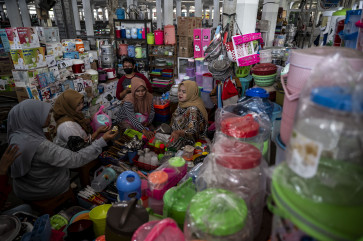
There is ample evidence of the prevailing phenomenon of the "city of big businesses". For example, big businesses' property construction often at the cost of small local businesses losing their land and moving to the city's outskirts, he said.
"There should be a mutual beneficial connection between small business players and big players. The city must integrate *the two*. For example, small business players should be trained so they can supply products to big retail companies," Suryono told The Jakarta Post at the sideline of a discussion titled, "The strategy of economic development in city sustainability" on Thursday.
Hendro Sangkoyo of the School of Democratic Economics highlighted the need to understand that economically disadvantaged residents had a pattern of production and consumption.
"The city administration often simplifies the complexity of social and economic problems," he said, citing a phenomenon that authorities simply evicted residents and street vendors for the sake of public order.
"What are the prospects for people living in poverty?"
The Thursday discussion also presented head of the Planology Master Study Program at Tarumanegara University, Jo Santoso, who said that the small local economy would provide a solid contribution if it was well developed.
"We have many original creative industries in a number of communities. They have a large potential to contribute to the city's economy," he said.
He said the number of florists in Rawa Belong, West Jakarta, for example, could drastically decline if the administration did not protect and support their businesses.
"When business slows, local people will sell their houses and move to the city's outskirts," Jo said.
He suggested that in order to empower local residents, the administration should develop business centers such as traditional markets in communities so that small businesses had places to distribute their products.