TheJakartaPost
Please Update your browser
Your browser is out of date, and may not be compatible with our website. A list of the most popular web browsers can be found below.
Just click on the icons to get to the download page.


Popular Reads
Top Results
No results found. Please check your search term and try again
Can't find what you're looking for?
View all search results
Popular Reads
Top Results
No results found. Please check your search term and try again
Can't find what you're looking for?
View all search resultsEnergy-thirsty firms must undergo auditing: Ministry
The Energy and Mineral Resources Ministry is encouraging companies to cut their energy consumption, amid fears that the country is too dependent on non-renewable energy
Change text size
Gift Premium Articles
to Anyone
Share the best of The Jakarta Post with friends, family, or colleagues. As a subscriber, you can gift 3 to 5 articles each month that anyone can read—no subscription needed!

T
he Energy and Mineral Resources Ministry is encouraging companies to cut their energy consumption, amid fears that the country is too dependent on non-renewable energy.
Maryam Ayuni, director of energy conservation at the ministry, said that a 2009 government regulation required high energy-consuming enterprises to perform regular audits of their energy consumption.
The ministry said that 600 companies were high-energy consumers, meaning that they consumed 6,000 tons of oil equivalent per year.
The firms account for 60 percent of all of the energy consumed by all companies in Indonesia.
“As of 2010, we had audited the energy consumption of 452 buildings, owned by the industry and commercial sectors. The results were varied; some good, some bad,” she said, adding that not all of the high consumers had conducted audits.
Maryam said that her office had introduced a program to encourage industries and companies to be more energy efficient.
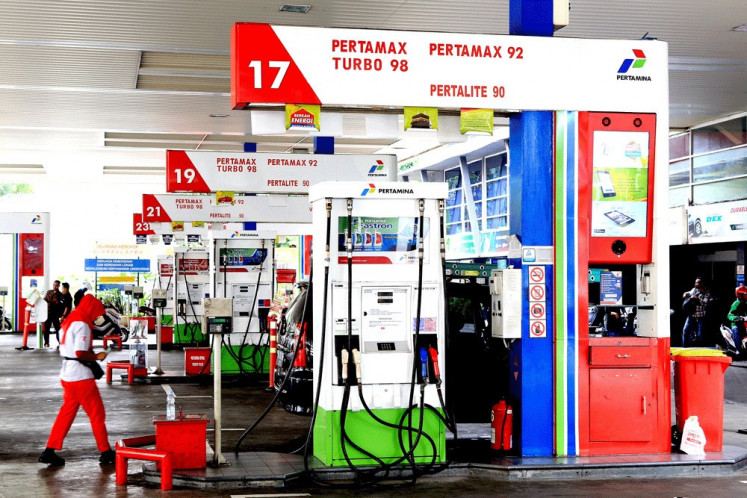
Indonesia is heavily dependent on fossil fuels for energy, and is burdened by fuel and electricity subsidies.
Indonesia has targeted to reduce its total emissions by 26 percent by 2020 on its own, or by 41 percent if it receives international support.
Of Indonesia’s energy sources, 95.21 percent is fossil fuel-based, with oil the most used (46.93 percent), followed by coal (26.38 percent), and gas (21.9 percent).
Indonesia draws 3.29 percent of its energy from hydroelectric power and 1.5 percent from geothermal.
The energy is used in four major sectors: Industry (51.86 percent), transport (30.77 percent), household (13.08 percent) and commercial (4.28 percent).
Maryam said that because energy auditing was expensive, the government had been slow to enforce the regulation.
“We have tried to ask banks to provide loans for companies to carry out the energy audit. As a result, there were several banks, private and state-owned, which agreed to give loans for energy auditing,” she said.
To set an example to encourage industries and companies to conserve energy, the ministry has renovated one of its building’s floors to be energy efficient.
The renovation was conducted by a partnership between the ministry, the government of Denmark and Denmark aid agency Danish International Development Assistance.
The cooperation with Denmark also helped set up an information center on energy efficiency, which can be accessed online, and certification for energy auditors for industries.
The renovation of the ministry’s office included raising the room’s ceiling, creating wall partitions and using glass to optimize natural lighting.
Maryam said that the renovation of the floor had decreased its energy consumption to 100 kilowatt hour per square meter from 170 kilowatt hour per square meter.
“The renovation used materials we can find here. We will replicate the model on other floors,” she said.
Totok Sulistiyanto, founder of Green Building Council Indonesia, said that many companies assumed that converting their buildings to energy-efficient designs would be costly, and were therefore reluctant to take the step.
He said it cost 10 percent more to build an energy efficient building, and 40 percent more to convert a building to an energy efficient design compared to refurbishing it according to a standard design.
“There are additional costs to switch to energy efficient systems, but the benefits lasts for the long-term,” he said.