TheJakartaPost
Please Update your browser
Your browser is out of date, and may not be compatible with our website. A list of the most popular web browsers can be found below.
Just click on the icons to get to the download page.


Popular Reads
Top Results
No results found. Please check your search term and try again
Can't find what you're looking for?
View all search results
Popular Reads
Top Results
No results found. Please check your search term and try again
Can't find what you're looking for?
View all search resultsJakarta pursues to secure its food supply
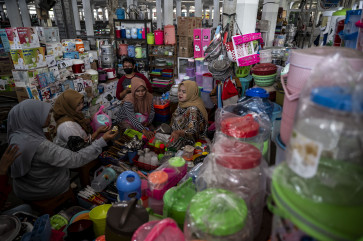
The Jakarta administration is seeking to strike a deal with eight regional provinces in a bid to secure food supply for the city, which is dependent on other provinces for 95 percent of its food supply
Change text size
Gift Premium Articles
to Anyone
Share the best of The Jakarta Post with friends, family, or colleagues. As a subscriber, you can gift 3 to 5 articles each month that anyone can read—no subscription needed!

T
he Jakarta administration is seeking to strike a deal with eight regional provinces in a bid to secure food supply for the city, which is dependent on other provinces for 95 percent of its food supply.
The administration’s assistant for economic and administrative affairs, Hasan Basri Saleh, said Friday that the capital was very vulnerable to disruption in the food supply chain.
“The city has no other choice but to secure its food supply,” Hasan said. “We aim to sign agreement with a number of regional provinces to guarantee the supply.”
Hasan said officials of the Jakarta Economic Bureau and Maritime, Husbandry and Agricultural Affairs Agency would meet with representatives of the regional provinces, which include Central Java, East Java, Yogyakarta and West Nusa Tenggara.
The meeting will be held in Yogyakarta on June 16.
He said one main commodity that would highly affect the city economy was rice.
“Sudden change in rice price will easily affect the city’s inflation rate,” Hasan said.
Central Statistics Agency (BPS) data shows that food price is the main factor controlling the inflation rate.
In March, Jakarta saw a deflation rate of 0.01 percent following a decrease in prices of staple food commodities.
BPS Jakarta recorded that only the food group saw a price decrease in March, which includes rice, chicken and fresh fish, but it affected the other groups.
The increase of prices in other consumer expense groups such as health, transportation, communications and financial services, housing, clean water, electricity and fuel, were a smaller influence in the city inflation rate.
Hasan said Jakarta would request a guarantee on stock, transportation and distribution of food supply to the city.
“In exchange, the city is offering a big and steady market for the food commodities,” he said.
Hasan said food supply was largely driven by a business-to-business relationship.
“But the administration feels it is necessary to secure food supply for the city population,” he said.
Separately on Friday, Hariyadi Sukamdani, deputy chairman of the Indonesian Chamber of Commerce and Industry (Kadin), said the city effort to secure food supply was positive.
“The city definitely knows exactly how much food supply is needed. It knows better than the central government or the Trade Ministry,” Hariyadi said.
He said data accuracy remained a problem in food distribution and transportation in Indonesia.
“It is good to see that Jakarta compiled enough data of its own need and decided to get commodities from those areas,” he said.
Hariyadi also said that a proposal to set up a special coordination body for rice supply in the city should be considered.
“Calculating rice supply in Jakarta is different from other regions in Indonesia, because rice is not only consumed by the citizens but also traded by businesspeople in the city,” he said.
Indonesia is lagging behind in securing its agricultural land and improving food supplies to ensure food security, compared to its regional counterparts such as Thailand and Japan.
According to a report released by the research and development agency of the Agriculture Ministry, 27,000 hectares of agricultural land were lost or converted for other purposes every year.
Indonesia is targeting to produce 70.6 million tons of rice in 2011.
Several state-owned enterprises have allocated Rp 4.1 trillion (US$ 479.7 million), including Rp 1 trillion in 2011, to reach food security by 2014.