TheJakartaPost
Please Update your browser
Your browser is out of date, and may not be compatible with our website. A list of the most popular web browsers can be found below.
Just click on the icons to get to the download page.


Popular Reads
Top Results
No results found. Please check your search term and try again
Can't find what you're looking for?
View all search results
Popular Reads
Top Results
No results found. Please check your search term and try again
Can't find what you're looking for?
View all search resultsThe new Indonesian economy
Contrary to popular notion, Indonesia now has a “service” economy
Change text size
Gift Premium Articles
to Anyone
Share the best of The Jakarta Post with friends, family, or colleagues. As a subscriber, you can gift 3 to 5 articles each month that anyone can read—no subscription needed!

C
ontrary to popular notion, Indonesia now has a “service” economy. This brings unique challenges and opportunities.
Folklore may not have caught up, but the 2011 numbers point to almost half of GDP coming from tertiary activities which lump together utilities (electricity, gas and water), trade, transportation, financial and general services. This group usually develops after the primary sector (agriculture and mining) and the secondary sector (manufacturing and construction).
The tertiary sector’s output is mostly the product of the intellect. Hence, it is highly dependant on quality of education, legal certainty, regulatory transparency and the availability of financing. It is also the largest sector in most modern economies.
Apart from its overall size, the Indonesian tertiary sector also grew faster than the other two. In 2011 it accounted for 54 percent of our overall GDP growth, compared with 8 percent and 32 percent contributed by the primary and secondary sectors, respectively. In the last three years the tertiary sector contributed two-thirds of GDP growth and, therefore, deserves to be called our economic engine of growth.
But what about the people in each sector?
The primary, secondary and tertiary sectors employ 37 percent, 19 percent and 43 percent out of the 110 million-strong workforce. The striking thing here is how many workers are in the laggard primary sector.
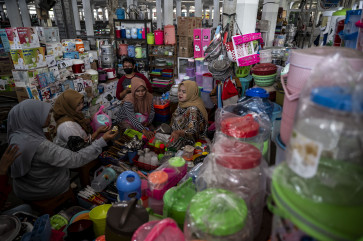
But the tertiary sector also contains its own issues. There is a wide gap between profitable large firms in transportation and modern traders employing small numbers of workers versus large numbers of small traders and food sellers who are barely making ends meet.
The rise of the tertiary sector was also unplanned. In the 1980s, the secondary sector successfully replaced the primary sector as the main engine of economic growth and job creation.
This continued until the 1997 crisis which cut short its growth. In the next decade it had scarcely recovered when it was pushed aside by cheap imports mainly from China.
In the meantime the financial, telecommunications, transportation and services sectors all continued their recovery and in the last decade really picked up speed.
The pullback of manufacturing is most felt through its shedding of workers. Aside from its inability to compete in terms of price with imports, it is also burdened by cumbersome regulations, legal uncertainty and poor infrastructure.
Although mostly unplanned, we should, nevertheless, take advantage of the rise of the tertiary sector.
First, we need to decide if this is the sector we want to pin our hopes on, although there might not seem to be much choice.
Second, the government should smooth out the ongoing structural transformation.
Third, we must prepare for and transform this sector into a sustainable growth- and job-creation engine. It is also important to minimize the productivity gap between large and the small firms by providing training and generally moving more activities into the formal sphere.
Apart from the necessary hard infrastructure like a telecommunications backbone, transportation and power, it is essential to provide soft infrastructure like legal and regulatory certainty, an excellent education system as well as easy and cheap financing.
The bottom line is the Indonesian economy has now entered a new and significant phase. Accordingly, our thinking, the policy framework and how players behave will also need to adjust.
The writer teaches at the University of Indonesia’s School of Economics, Jakarta. This is a personal opinion.