The Jakarta Post
Please Update your browser
Your browser is out of date, and may not be compatible with our website. A list of the most popular web browsers can be found below.
Just click on the icons to get to the download page.


Popular Reads
Top Results
No results found. Please check your search term and try again
Can't find what you're looking for?
View all search results
Popular Reads
Top Results
No results found. Please check your search term and try again
Can't find what you're looking for?
View all search resultsRI eyes strong partnership with Germany
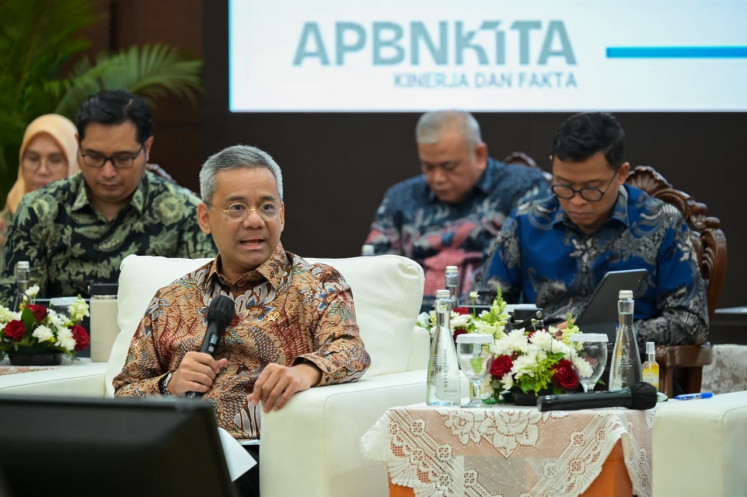
Indonesian Ambassador to Germany Eddy Pratomo, has been hosting a public forum called Sarasehan (forum) of German-Indonesian people in Berlin every month
Change text size
Gift Premium Articles
to Anyone
Share the best of The Jakarta Post with friends, family, or colleagues. As a subscriber, you can gift 3 to 5 articles each month that anyone can read—no subscription needed!
 Set as preferred source

I
ndonesian Ambassador to Germany Eddy Pratomo, has been hosting a public forum called Sarasehan (forum) of German-Indonesian people in Berlin every month. The Jakarta Post's contributor Christina Scott, who attended one of these forums, talked to Ambassador Eddy about relations between Indonesia and Germany. The following are the excerpts from the interview.
Christina Scott: Voters in Indonesia and Germany went to the polls this year to elect new parliaments and heads of states. How did you start your mission as an ambassador in Berlin amid this changing situation?
Eddy Pratomo: Of course, I have to consider the political situation in both countries. But my first task as an Ambassador was to support a successful election in Indonesia by ensuring 1,500 Indonesian citizens living in Berlin were able to vote. It is very important for all Indonesians to exercise their right to vote and thus become an engaged people, which decide about their own future.
At the same time, I followed closely the elections of the president of Germany and now of the German parliament and chancellor. It is very important to understand the direction of Germany's future foreign policy, since my primary objective is to turn Indonesia into one of Germany's most important, strategic partners in Asia.
What is so important about this partnership?
Germany is a large economy with an important history and it is also the strongest country in the European Union. Therefore, it is crucial for Indonesia to have a good relationship with Germany and understand its political course to be able to follow the development of European politics. Besides, we can learn a lot from Germany by understanding how it coped with its past after World War II, how it went about not repeating mistakes made in the past, and how quickly the country emerged again as an economic power.
In what fields could Indonesia become Germany's strategic partner?
In all important fields actually, be it in investment, good governance and the role of law, tourism, climate change or development projects. Hopefully a closer cooperation will become concrete, after both countries inaugurate their newly elected heads of state.
An Indonesian President and a German Chancellor have not met directly for a long time. SBY had planned a visit to Germany, but had to cancel it several times due to unforeseen events. After the elections have been completed in both countries, we will try to schedule a visit as soon as possible with the aim to set up a partnership agreement. High-level decisions are only agreed at high-level meetings.
What kind of cooperation already exists between both countries? When German foreign minister Frank-Walter Steinmeier visited Indonesia in February 2008, he was very impressed by the variety of cultures and religions. Following his visit, a more detailed dialogue between high-ranking commissioners from both countries started, which is why we are seriously considering setting up Indonesian-German cooperation mechanisms for an interreligious and intercultural dialogue.
These dialogues are crucial for a mutual understanding between our peoples. Germany is very open to this process, because it has many Muslim citizens as well, and is interested in learning about our experiences as the country with the biggest Muslim population in the world. I think this is very important, because only by understanding the true teachings of Islam - tolerance, humanity and unity - will people in the West become sympathetic to it.
They have to learn that there is no Islam that teaches violence and terror, but that there are only a few people who misuse Islam as a political means.
Even US President Barrack Obama and his Secretary of State Hillary Clinton mentioned in their speeches that Indonesia was a very good example of a democracy in a Muslim-dominated country, where people from different religions could live peacefully together.
Another common interest is climate change, where Germany and Indonesia both play strategic roles in international negotiations. How do the two countries work together?
Germany plays an important role in international diplomacy when it comes to the environment. The secretariat of the UNFCCC (United Nations Framework Convention on Climate Change), for example, is located in the former West-German capital Bonn.
With the upcoming 15th UN Climate Conference in Copenhagen in December, Indonesia wants to make the Bali Road Map layed out two years ago into a new pact ruling in favor of developing countries. Therefore, we have already submitted a new proposal concerning oceans in the climate change negotiations and Germany wants to support this.
Indonesia also organized the World Ocean Conference in Manado last May to bring to the limelight the effect of climate change on oceans, including rising sea levels, dying coral and depleting stocks of fish. We would like to learn from Germany in this area, as it already has a national action plan for oceans that determines how to preserve maritime ecosystems.
If we don't start looking after our oceans, a big part of the world's system will be severely damaged. People living close to the sea will experience the problems first, especially in an archipelago like Indonesia.
Do you have a personal target for your mission in Berlin?
I wish to build a forum where we create a fellowship between our peoples. Between our countries, we have always had first-track diplomacy carried out between government officials. I would like to implement an additional second track *or level* of diplomacy by building a forum where German people can meet Indonesian people and forge strong relationships.