The Jakarta Post
Please Update your browser
Your browser is out of date, and may not be compatible with our website. A list of the most popular web browsers can be found below.
Just click on the icons to get to the download page.


Popular Reads
Top Results
No results found. Please check your search term and try again
Can't find what you're looking for?
View all search results
Popular Reads
Top Results
No results found. Please check your search term and try again
Can't find what you're looking for?
View all search resultsEditorial: A must-do car restriction
The wise man does at once what the fool does eventually,” said Niccolo Machiavelli
Change text size
Gift Premium Articles
to Anyone
Share the best of The Jakarta Post with friends, family, or colleagues. As a subscriber, you can gift 3 to 5 articles each month that anyone can read—no subscription needed!

T
he wise man does at once what the fool does eventually,” said Niccolo Machiavelli. Jakarta Governor Joko “Jokowi” Widodo might not have read the works of the Renaissance Italy political philosopher. However, one thing is certain: Jokowi knows what he must do to address the problems facing the capital city.
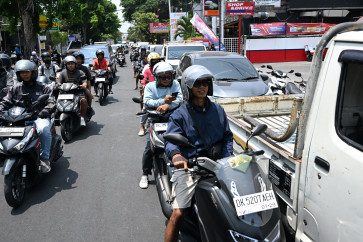
The newly elected governor knows full well, for example, that he must take immediate action to resolve the horrendous traffic problems that the residents of Jakarta endure on daily basis. He has taken seriously the studies compiled by transportation experts that have predicted total gridlock in 2014 unless there is significant improvement in the city’s transportation system.
Jokowi is right when expressing his commitment to improving public transportation. Although he has taken guarded stance on the development of an expensive Mass Rapid Transit (MRT) system, the governor has vowed to improve the Transjakarta Bus Rapid Transit (BRT) fleet, improve the service of the inner-city railway system, provide 1,000 new minibuses to replace decades-old Metromini and Kopaja public minibuses and to integrate the public minibuses into Transjakarta.
The governor was also right when he recently announced the plans to impose a traffic restriction scheme to limit vehicle access to the city’s streets based on license plate numbers, beginning in March 2013, at the latest. To implement the scheme, cars with odd-numbered license plates will be banned on even dates, and vice versa. Vehicles would be marked with stickers, red for odd numbers and green for even numbers.
The Jakarta City Transportation Agency has calculated that the car restriction policy would significantly increase the average speed on Jakarta’s roads from 16.8 kilometers to 47 kilometers per hour. It is also expected to save up to
Rp 8.85 trillion (US$920 million) in man hours while reducing vehicle operational costs. The policy would also mean 345,000 liters less subsidized fuel would be required each year.
The policy, which would be effective from 6 a.m. to 8 p.m. on weekdays, would affect roads used by the BRT and a number of other main roads. Introduction of the license-plate scheme will allow a transition from 3-in-1 carpool zones to Electronic Road Pricing (ERP), which is scheduled to be implemented next year, pending approval from the central government.
We fully support the measures offered and undertaken by Jokowi. He has shown seriousness both in statements and in action in tackling Jakarta’s acute traffic jams. However, the governor must also thoroughly consider the details for implementing the car restriction policy, especially when it will involve a different institution, the Jakarta Police Traffic Directorate, which is effectively not under his supervision.
Apart from issuing clear and legally-binding regulations, Jokowi must take the police’s readiness to support the policy into consideration. Do Jakarta Police have enough officers to implement and supervise the policy in designated areas? Can the officers ensure that the license plates used by the motorists are not fake? What punitive measures will be taken against offenders? If violators are to be fined, how can the city administration be sure that the money will go to the city’s coffers and not into the pockets of some less-than-scrupulous officers on the scene as “settlement fees”?
Those are basic questions that the governor must answer in order to make his policy a success. These questions must also be answered in order to win the support and respect of motorists by ensuring that the policy is fairly and truly implemented.
Jokowi must answer these questions before moving forward with his bold policies in the weeks to come.