TheJakartaPost
Please Update your browser
Your browser is out of date, and may not be compatible with our website. A list of the most popular web browsers can be found below.
Just click on the icons to get to the download page.


Popular Reads
Top Results
No results found. Please check your search term and try again
Can't find what you're looking for?
View all search results
Popular Reads
Top Results
No results found. Please check your search term and try again
Can't find what you're looking for?
View all search resultsMore park-and-ride facilities in outskirts to lure commuters
Commuters expect proper facilities before entering JakartaFor her daily morning commute from her house in Bekasi, West Java to her office in Kuningan, South Jakarta, Tri Wahyuni regularly parks her motorcycle near Cakung Station in East Jakarta to continue her trip with the commuter train
Change text size
Gift Premium Articles
to Anyone
Share the best of The Jakarta Post with friends, family, or colleagues. As a subscriber, you can gift 3 to 5 articles each month that anyone can read—no subscription needed!

Commuters expect proper facilities before entering Jakarta
For her daily morning commute from her house in Bekasi, West Java to her office in Kuningan, South Jakarta, Tri Wahyuni regularly parks her motorcycle near Cakung Station in East Jakarta to continue her trip with the commuter train.
“[They are] not official park-and-ride facilities; just plots of land within a residential area near the station that belong to some residents. Some are just open spaces beneath a flyover. They use the land to offer parking services,” she said, adding that she pays Rp 5,000 (35 US cents) per day for the service.
“I think there are about 1,000 motorcycles there every day.”
She added that she could not wait until the administrations of cities in Greater Jakarta built more park-and-ride facilities near stations and bus stops on the city’s outskirts, believing that the demand for them is high.
Tri’s wish could soon materialize as Jakarta Transportation Agency head Syafrin Liputo said the Jakarta administration plans to construct many park-and-ride facilities next year.
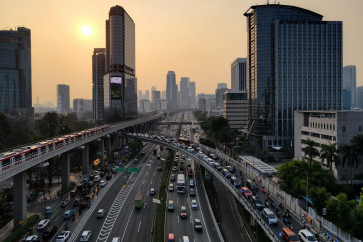
The plan was vital as more than 1 million private vehicles from satellite cities such as Bogor, Depok, Tangerang and Bekasi are reportedly entering the capital every day.
“In 2020, we will build many more [park-and-ride facilities] in Jakarta’s satellite cities like Bekasi, Depok and Bogor,” he said recently without revealing further details of the plan.
The facilities in the buffer areas are expected to encourage residents to park their vehicles and get on public transportation to Jakarta, helping to alleviate the notorious traffic congestion caused by more than 17 million registered private vehicles roaming the city streets.
Syafrin added that the plan is part of the program of the Greater Jakarta Coordination Board (BKSP), on which Jakarta Governor Anies Baswedan serves as the head.
BKSP secretary Tri Kurniadi previously said the board would complete the detailed engineering designs this year and proceed with construction in 2020.
The funding, which would be allocated by the Jakarta administration, would depend on specific aspects of the park-and-ride facilities.
A facility that could accommodate 1,000 vehicles would cost at least Rp 1 billion.
In collaboration with other offices, Jakarta already has a number of park-and-ride facilities across the city. Some are located near bus shelters like one in South Jakarta that is next to the Transjakarta bus stop in Ragunan and others in East Jakarta at the Pulo Gebang bus terminal, at PGC Cililitan and in Pinang Ranti.
Some of the existing ones are located near commuter train stations like in Bogor and Depok.
A new park-and-ride facility was just officially opened on Aug. 15 in the South Quarter of Cilandak, South Jakarta, as a result of a partnership between PT MRT Jakarta and a private developer, PT Intiland Development Tbk.
The facility is situated 1.3 kilometers from the Fatmawati MRT station, some 15 minutes away on foot.
It could accommodate up to 100 cars and 30 motorcycles, charging the vehicle owners Rp 5,000 for cars and Rp 2,000 for motorcycles per day.
To provide convenience for commuters, city-owned bus operator Transjakarta has also offered a new feeder bus route, code MR9, connecting the park-and-ride with the station. Fifteen buses operate from 6 a.m. to 10 p.m.
MRT Jakarta president director William Sabandar said Intiland was the first private company that had cooperated in the establishment of a park-and-ride facility.
“Once again, I call on the private sector to support our mission to increase people’s interest in using public transportation,” William said.
Another park-and-ride facility was built in Cilandak some 500 meters to the south of the Lebak Bulus MRT station. The facility is able to accommodate up to 150 cars and 500 motorcycles.
In the future, the MRT and the city administration plan to develop Lebak Bulus into a transit-oriented development area that focuses on the comfort of pedestrians.
Among the frequent users of the Lebak Bulus park-and-ride facility is Fikri, who at least four days a week parks his car there and switches to an MRT train to reach his workplace on |Jl. Sudirman.
“As I see that the parking area is almost full every day, I think park-and-ride is quite effective for making people leave their vehicles and ride on public transportation,” he said on Friday.
“Adding more park-and-ride facilities should go hand in hand with improvements to the public transportation service itself. If, for example, a commuter train is as comfortable as an MRT train, I believe people will be willing to fight to get a parking spot,” he added.
Despite the growing demand, a park-and-ride facility located downtown on Jl. MH Thamrin in Central Jakarta experiences the opposite. Because of its lack of customers, the city is planning to demolish it and replace it with a culinary center. A huge banner installed on its fence announces that "The parking facility will be closed soon".