TheJakartaPost
Please Update your browser
Your browser is out of date, and may not be compatible with our website. A list of the most popular web browsers can be found below.
Just click on the icons to get to the download page.


Popular Reads
Top Results
No results found. Please check your search term and try again
Can't find what you're looking for?
View all search results
Popular Reads
Top Results
No results found. Please check your search term and try again
Can't find what you're looking for?
View all search resultsCity deserted as lockdown begins
A quiet place: The Jakarta-Tangerang toll road is seen unusually empty on Friday, after Jakarta Governor Anies Baswedan announced that large-scale social restrictions (PSBB) would be in place until April 23 to curb the spread of COVID-19
Change text size
Gift Premium Articles
to Anyone
Share the best of The Jakarta Post with friends, family, or colleagues. As a subscriber, you can gift 3 to 5 articles each month that anyone can read—no subscription needed!

A
quiet place: The Jakarta-Tangerang toll road is seen unusually empty on Friday, after Jakarta Governor Anies Baswedan announced that large-scale social restrictions (PSBB) would be in place until April 23 to curb the spread of COVID-19. (JP/Donny Fernando)
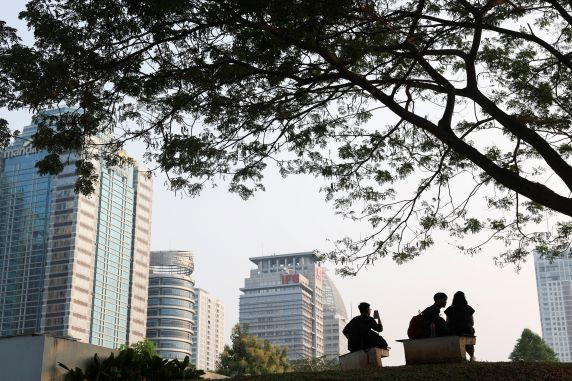
An uneasy calm has blanketed much of Jakarta as the city began its large-scale social restrictions (PSBB) policy on Friday.
Activity in and around the metropolis was visibly reduced, with roads emptying out and people choosing to remain at home despite the long weekend.
The first day of restrictions in Jakarta coincides with the Christian celebration of Good Friday, which typically sees heavy traffic on the city’s toll roads, as people seek to travel out of town with friends and family.
The Jakarta Traffic Police reported via its Twitter account @TMCPoldaMetro that traffic was light on several roads in the city as well as the Cikampek toll road in West Java and Bumi Serpong Damai toll road in South Tangerang, Banten.
It has been just over a month since Indonesia announced its first two cases of COVID-19, with the nation’s capital becoming the first region to impose a partial lockdown.
Jakarta Governor Anies Baswedan officially imposed the PSBB status at midnight in a bid to slow the spread of COVID-19, after the city became the national epicenter of the outbreak.
As of Friday, Jakarta has recorded 1,753 confirmed COVID-19 cases, almost half of the country’s official tally of 3,512 cases. The capital also has 154 of the 306 fatalities nationwide.
The policy, laid out in Gubernatorial Regulation No. 33/2020, stipulates that firms operating in Jakarta should cease all office activities and that residents are not allowed to go out except to procure basic necessities. Food vendors are allowed to remain open but only to serve takeaway, while public transport services will operate on a limited schedule.
Anyone who violates the regulation will be subject to disciplinary action by the police.
Jakarta’s PSBB status will be enforced until midnight on April 24 and is open to extension.
Based on The Jakarta Post’s observations, police officers and transportation agency officials have already begun enforcing the restrictions.
At the Lebak Bulus traffic checkpoint in South Jakarta, 10 police officers and five agency officials were questioning drivers to ensure they were complying with the rules. Drivers who fail to wear a protective mask are asked to turn back, while passengers of four-wheeled vehicles are asked to keep a safe distance from the driver by sitting in the back seat.

Jakarta Police spokesman Sr. Commr. Yusri Yunus said the police were ready for the possibility of social unrest during the two-week period, with all police officers undergoing training on Thursday to prepare for all possible incidents.
“The public is now more aware of the risks of the disease, so we think they will stay home,” Yusri told the Post. “After all, this is not a total lockdown, as minimarkets are still operating and the transport of goods will continue, so we believe there will be no unrest.”
The sight of the city’s empty streets is a stark contrast to the unease felt by many observers who fear the government is not doing enough to prevent social unrest from erupting in response to the long-term restrictions.
The COVID-19 outbreak has dealt a devastating blow to many workers across the country. More than 1.2 million employees from 74,439 companies in both the formal and informal sectors have either been told to stay home or have been laid off as a result of the outbreak, Manpower Ministry data showed on Tuesday.
To anticipate a possible backlash, the Jakarta administration has prepared a social assistance scheme through which 1.52 million households will receive groceries once per week until the policy ends.
President Joko “Jokowi” Widodo has also announced that the government will provide direct cash payments of Rp 600,000 (US$40) per month to 1.2 million registered poor and vulnerable households in the capital from April until June.
Critics have warned, however, that the hasty decision could blow up in the government’s face if it is not carried out prudently.
Jealousy and resentment among those who do not qualify for assistance, especially if others deemed underserving do qualify, could lead to social unrest, said Nia Elvina, a sociologist at Jakarta’s National University.
Nia applauded the efforts to set up the social assistance program, arguing it could help prevent the kind of conflicts seen in India in the early days of its total lockdown, which stemmed from a failure to calculate the economic woes citizens might endure during large-scale restrictions.
She warned, however, that there was still a risk for social friction in Jakarta, especially stemming from inaccurate data on who should qualify for assistance, which even Anies had complained about.
“The administration also needs to speed up the distribution of aid to ensure the PSBB policy is effective,” she told the Post on Friday.
Gugun Muhammad, a community organizer at the Urban Poor Coalition (UPC), expressed a similar sentiment about the lack of clarity surrounding the social assistance scheme.
A lack of public awareness about program, especially among less fortunate households, could brew resentment if questions about its mechanisms are left unanswered, he said.
— Donny Fernando and Dhoni Setiawan contributed to the story.