The Jakarta Post
Please Update your browser
Your browser is out of date, and may not be compatible with our website. A list of the most popular web browsers can be found below.
Just click on the icons to get to the download page.


Popular Reads
Top Results
No results found. Please check your search term and try again
Can't find what you're looking for?
View all search results
Popular Reads
Top Results
No results found. Please check your search term and try again
Can't find what you're looking for?
View all search resultsASEAN and East Asia’s response to a fragmenting global economy (1 of 2)
Trade and investment are no longer about exchange of goods and services, but also about strategic tools being used for geopolitical and geo-economic purposes.
Change text size
Gift Premium Articles
to Anyone
Share the best of The Jakarta Post with friends, family, or colleagues. As a subscriber, you can gift 3 to 5 articles each month that anyone can read—no subscription needed!
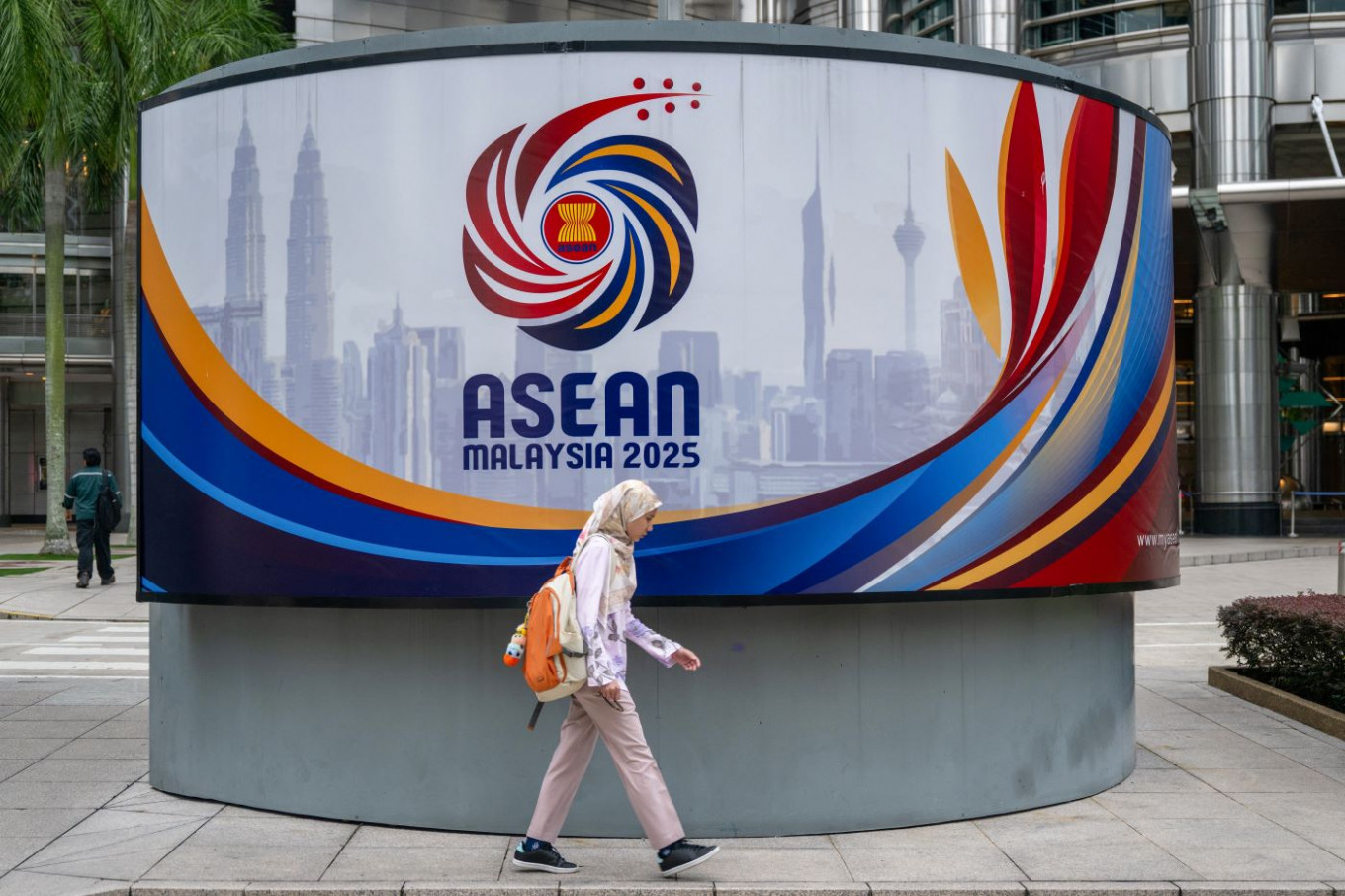 A woman walks past a promotional display for ASEAN Malaysia 2025 on Oct. 23 in front of the Petronas Twin Towers in Kuala Lumpur. (AFP/Mohd. Rasfan)
I
n the last several years, we have witnessed the sharpest realignment of the global economy that would shape our future. Trade and investment are no longer about exchange of goods and services, but also about strategic tools being used for geopolitical and geo-economic purposes.
We see higher tariffs, export controls, investment screening and large subsidy programs to pursue strategic aims. At the same time, supply chains are being rewired for resilience and security, risking the fragmentation of the world economy into several blocks.
The United States–China rivalry is the central axis of this change. It has spread from technology to industry and trade more broadly. To make the situation even worse, early this year the US, under President Donald Trump’s administration, has applied new “reciprocal” tariffs and is negotiating bilateral deals that set different terms country by country. This action has already produced differentiated tariff outcomes across ASEAN members. China and others are also adjusting policies to protect or promote their own industries, risking the world economy for being fragmented even more.
For ASEAN, this matters because our development model relies on open markets, integration into global value chains and predictable rules. Export to the US amounts up to more than 25 percent of gross domestic product (GDP) for certain countries. Sectors like electronics, automotive industries, textiles, agro-processing, and services depend on access to supply chain and markets. They also need clear standards at the border and behind the border.
When large economies like the US change the rules quickly, ASEAN economies face uncertainty about demand, compliance and investment. Trade diversion also follows: goods blocked in one market look for another. That can trigger trade remedies, which if uncontrolled, could lead to second round impacts of any trade war.
Modeling from CSIS shows how outcomes depend on our choices. Under a contagion scenario where tariff walls rise everywhere, ASEAN GDP could fall by about 11 percent. But if we coordinate, avoid retaliation and integrate even further under Regional Comprehensive Economic Partnership (RCEP), those losses can flip into gains as intra-regional trade deepens.

There is also a political risk. If each ASEAN member negotiates alone and accepts different conditions, we lose leverage and coherence. That weakens ASEAN unity and centrality. It also raises costs for business, which then faces different rules in each ASEAN market. In short, in order to respond to the ongoing dynamics, ASEAN needs coordination and implement various initiatives for ASEAN integration.