TheJakartaPost
Please Update your browser
Your browser is out of date, and may not be compatible with our website. A list of the most popular web browsers can be found below.
Just click on the icons to get to the download page.


Popular Reads
Top Results
No results found. Please check your search term and try again
Can't find what you're looking for?
View all search results
Popular Reads
Top Results
No results found. Please check your search term and try again
Can't find what you're looking for?
View all search resultsThe new KUHAP: A digital code with an analogue mindset
Recognizing electronic evidence in name only, without embedding it in a coherent framework of powers and safeguards, invites challenges to the integrity and reliability of digital findings.
Change text size
Gift Premium Articles
to Anyone
Share the best of The Jakarta Post with friends, family, or colleagues. As a subscriber, you can gift 3 to 5 articles each month that anyone can read—no subscription needed!
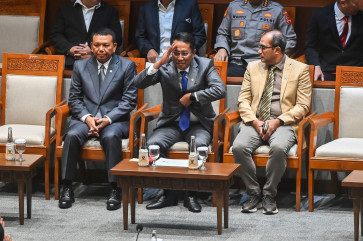
 Law Minister Supratman Andi Agtas (center), seated between Deputy State Secretary Bambang Eko Suhariyanto (left) and Deputy Law Minister Edward Omar Sharif Hiariej, gives a salute ahead of the House of Representatives plenary session at the Senayan legislative complex in Central Jakarta on Nov. 18, 2025. During the session, the House passed a revision of the Criminal Law Procedures Code (KUHAP). (Antara/Rivan Awal Lingga)
T
he House of Representatives has passed the long-awaited amendment to the Criminal Law Procedures Code (KUHAP). Substantively, the reform was overdue; procedurally, however, the final stages were compressed in a manner that suggests haste rather than care.
After a prolonged drafting process, the closing phase appeared driven by a political desire to synchronize the enactment of the new Criminal Code (KUHP) and the KUHAP in early January 2026. This rushed timeline seems to have come at the expense of measured consideration regarding procedural safeguards.
In practice, the new KUHAP will become operative in a matter of months. This leaves law enforcement institutions with a dangerously narrow window, around two months, to adapt their practices and training to a fundamentally reconfigured procedural framework.
Together with several Indonesian PhD candidates from universities in the United Kingdom, I submitted a written response to the House’s inquiry at a hearing on Sept. 23. I highlighted in this commentary a crucial flaw in this hurried enactment: the structuring of legal facts through electronic evidence within what is now a hybrid procedural system.
The new KUHAP represents an ambitious modernization. It moves the procedural landscape toward greater technological integration, introduces mechanisms such as plea bargaining and restorative justice and seeks to clarify accountability with regard to coercive state powers. Yet, the framework remains conceptually fragile, particularly regarding the definition, seizure and authentication of electronic evidence.
Although the code recognizes "electronic evidence" as a distinct category, the supporting legal architecture is not fully integrated. The definition does not clearly encompass analogue or traditional objects that have been digitized.

From the perspective of procedural legality, the scope of "electronic evidence" must be precisely delineated to determine what may be searched, seized, processed or presented at trial. Without such clarity, investigators and courts are left to improvise, creating the exact legal uncertainty a modern code is designed to prevent.