TheJakartaPost
Please Update your browser
Your browser is out of date, and may not be compatible with our website. A list of the most popular web browsers can be found below.
Just click on the icons to get to the download page.


Popular Reads
Top Results
No results found. Please check your search term and try again
Can't find what you're looking for?
View all search results
Popular Reads
Top Results
No results found. Please check your search term and try again
Can't find what you're looking for?
View all search resultsFrom print to platforms: What holds nations together now?
The increasingly virtual world has made digital platforms the central stage of democracy.
Change text size
Gift Premium Articles
to Anyone
Share the best of The Jakarta Post with friends, family, or colleagues. As a subscriber, you can gift 3 to 5 articles each month that anyone can read—no subscription needed!
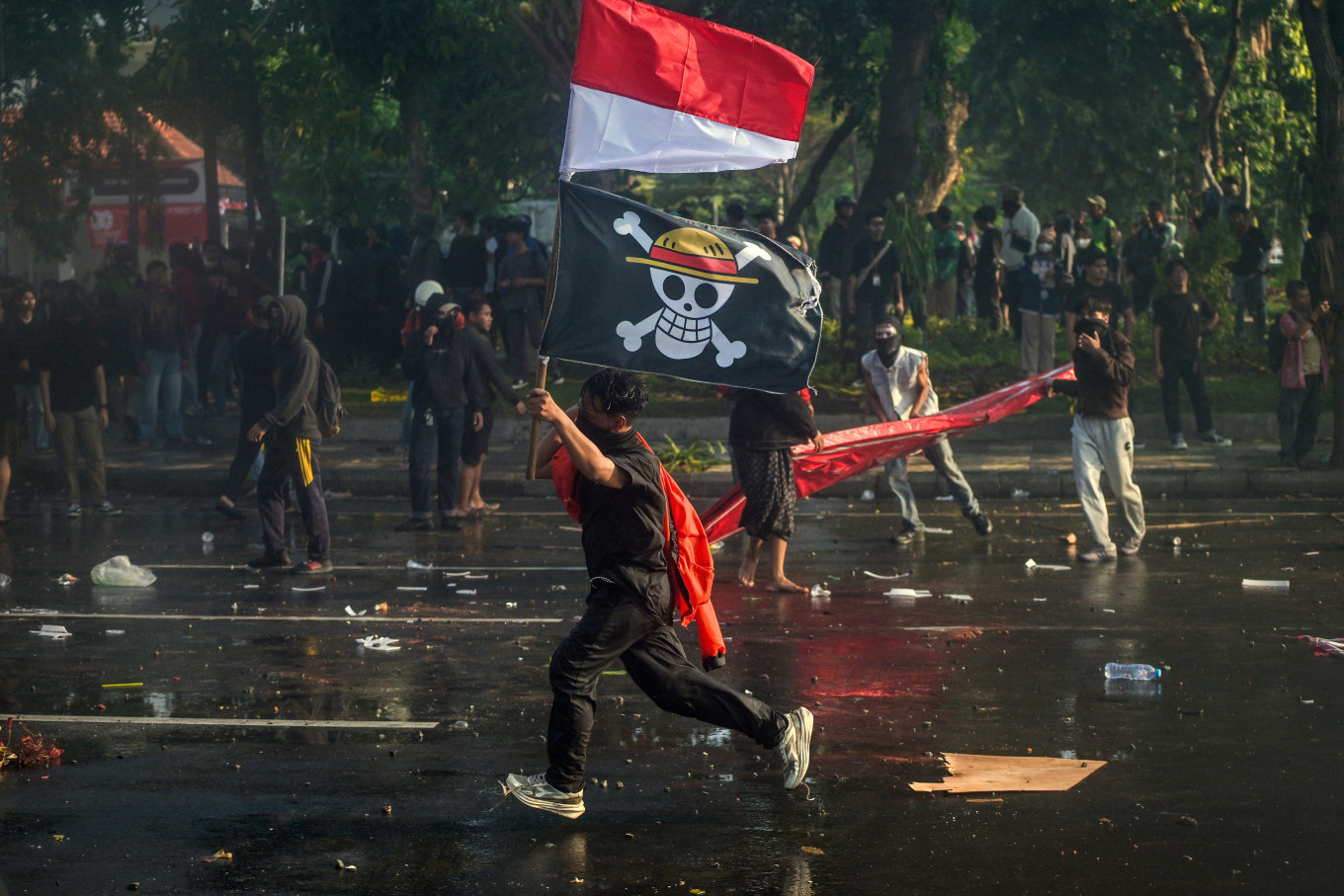 A demonstrator carries Indonesia’s national flag alongside a pirate flag from the Japanese anime One Piece, an internet symbol of protest against government policies, during a rally on Aug. 29, 2025, outside the residence of the Governor of East Java, in Surabaya. (AFP/Juni Kriswanto)
I
f we must choose a defining memory of 2025, the wave of social media-driven Gen Z protests worldwide come to mind. From Southeast Asia to Eastern Europe, young people facing deteriorating living conditions amid a global economic downturn poured into the streets, mobilized less by political parties or labor unions than by viral moments online.
What appears to be a global surge of unrest may signal a shift in the political foundations that hold nations together. Public space has become increasingly virtual and fragmented, shaped by sentiments of multiple and less predictable actors.
The increasingly virtual world has made digital platforms the central stage of democracy. People voice opinions and grievances on social media, a role once held by print and broadcast media. Unlike the older institutions, these platforms operate beyond borders, editorial norms or shared narratives.
Expressions of discontent, regardless of the cause, are amplified by platform algorithms that prioritize engagement. What begins as a post or short video can snowball into actions on the streets and be replicated across countries through viral moments. These eruptions often unfold instantly before governments can anticipate or respond.
In 2025, a nationwide protest that rocked Indonesia in August was followed by the collapse of the Nepal government in September, Madagascar’s in October and Bulgaria’s in December. While political dynamics and actors in each country differ, what is consistent is how easily people are mobilized through social media. Amid deep-seated dissatisfaction with their governments, crowds flood the streets, often without clear leadership or coherent political agenda.
The Arab Spring of 2010 offered an early and hopeful glimpse of this phenomenon. A regionally concentrated wave of pro-democracy protests brought down dictators in Egypt, Libya, Tunisia and Yemen. At the time, digital platforms appeared to empower citizens and accelerate democratic reform.

Last year, the pattern evolved. Civic eruptions are increasingly simultaneous and unpredictable, linked less by ideology or leadership than by shared grievances and anger. To expect democratic reform as an outcome is, at this stage, cautious optimism at best.