The Jakarta Post
Please Update your browser
Your browser is out of date, and may not be compatible with our website. A list of the most popular web browsers can be found below.
Just click on the icons to get to the download page.


Popular Reads
Top Results
No results found. Please check your search term and try again
Can't find what you're looking for?
View all search results
Popular Reads
Top Results
No results found. Please check your search term and try again
Can't find what you're looking for?
View all search resultsFirst mover or fast follower? ASEAN’s readiness for global methane rules
Major natural gas exporters in ASEAN face an urgent need to align with emerging methane standards to ensure long-term market access.
Change text size
Gift Premium Articles
to Anyone
Share the best of The Jakarta Post with friends, family, or colleagues. As a subscriber, you can gift 3 to 5 articles each month that anyone can read—no subscription needed!
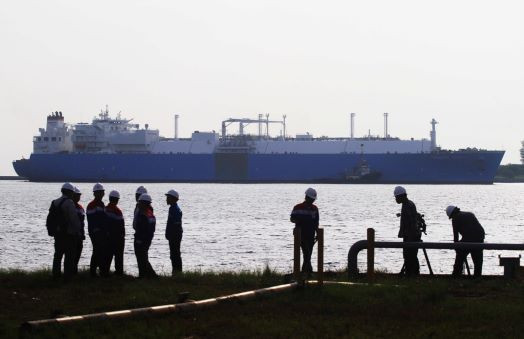 Workers at the Arun storage and regasification facility in Lhokseumawe, Aceh, prepare mooring equipment on Jan. 19, 2015, as liquefied natural gas (LNG) tanker Tangguh Towuti arrives offshore, carrying 119,000 cubic meters of the fossil fuel from Tangguh, West Papua. (Antara/Akbar Nugroho Gumay)
S
outheast Asia remains a pivotal player in regional natural gas dynamics. By 2024, ASEAN’s production hovered around 19.8 billion standard cubic feet per day, a slight recovery from years of decline, with incremental increases led by Indonesia, Malaysia and Thailand.
Today, roughly 80 percent of ASEAN’s gas supply is exported, while only 20 percent serves internal consumption. Japan, China and South Korea remain the top destinations for ASEAN’s natural gas. In 2024, Southeast Asia supplied around 22 percent, 16 percent and 13 percent of Japan, South Korea and China’s total gas imports, respectively.
From this production, annual methane emissions from the region’s oil and gas sector were estimated at around 9 million tonnes of carbon dioxide equivalent (MtCO2e), with approximately 94 percent originating from upstream operations. These emissions also represent a missed economic opportunity, equivalent to around 7 percent of Singapore’s total liquefied natural gas (LNG) imports in 2023.
A similar situation has been the status quo on the global stage, which encouraged the European Union to come up with the EU Methane Regulation (2024/1787), mandating fossil fuel imports adhere to measurement, reporting and verification (MRV) protocols and meet methane intensity thresholds by 2030.
This evolving regulatory landscape matters for ASEAN, not because Europe is the region’s primary consumer but because ASEAN's major trading partners can follow suit and demand greater accountability on methane emissions.
One significant example is the Coalition for LNG Emission Abatement toward Net-zero (CLEAN), a joint initiative launched by JERA Co., Inc. and the Korea Gas Corporation in 2023 to promote methane transparency and certification in the LNG value chain. With participation now exceeding 25 companies, CLEAN reflects a growing push from buyers in East Asia for verifiable low-methane LNG.

In South Korea, a recent analysis by Solutions for Our Climate (SFOC) and Carbon Limits also outlines opportunities for introducing a methane import standard in the country, showing a growing interest in East Asia on reducing the greenhouse gas (GHG) footprint of energy value chains.