TheJakartaPost
Please Update your browser
Your browser is out of date, and may not be compatible with our website. A list of the most popular web browsers can be found below.
Just click on the icons to get to the download page.


Popular Reads
Top Results
No results found. Please check your search term and try again
Can't find what you're looking for?
View all search results
Popular Reads
Top Results
No results found. Please check your search term and try again
Can't find what you're looking for?
View all search resultsQuestioning the KPK's credibility
To avoid the perception that it is being used for political witch hunts, the KPK must build watertight cases backed by compelling evidence.
Change text size
Gift Premium Articles
to Anyone
Share the best of The Jakarta Post with friends, family, or colleagues. As a subscriber, you can gift 3 to 5 articles each month that anyone can read—no subscription needed!
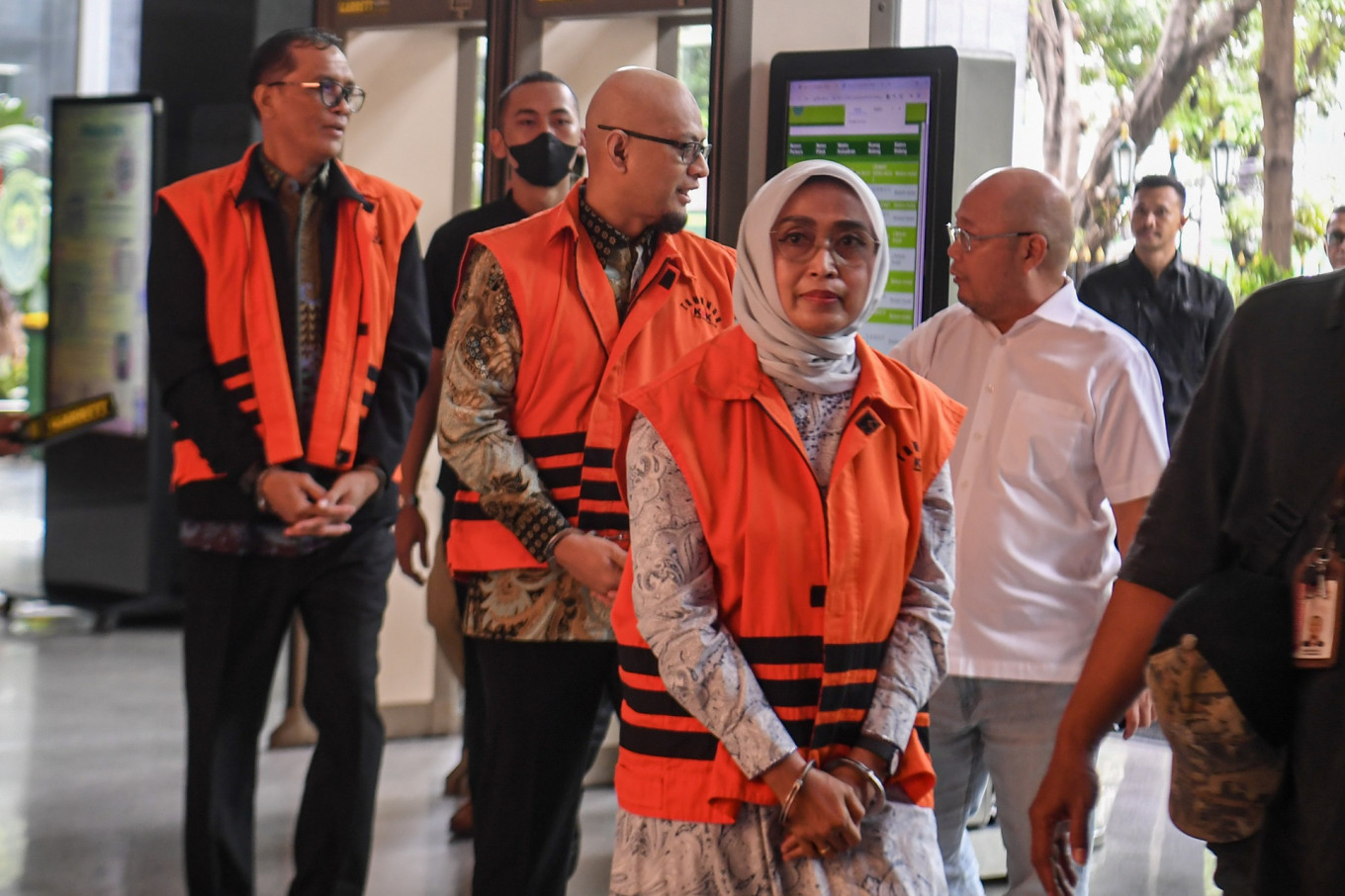 Former executives of state-owned ferry operator PT ASDP Ferry Indonesia, president director Ira Puspadewi (second right), planning and development director Harry Muhammad Adhi Caksono (third left) and commercial and service director Muhammad Yusuf Hadi (left), walk into the courtroom of the Jakarta Corruption Court in Jakarta ahead of their Nov. 20 verdict hearing. The three defendants, indicted for corruption that caused Rp 1.25 trillion (US$75 million) in state losses in the acquisition of PT Jembatan Nusantara, were found guilty by the court. Ira was sentenced to 4.5 years in prison and Harry and Yusuf to four years. (Antara/Muhammad Adimaja)
A
bout a year ago, in September, the Corruption Eradication Commission (KPK) appeared confident in its investigation of three former executives of the state-owned ferry operator, PT ASDP Indonesia Ferry. The suspects had filed a pretrial motion claiming they were charged without due process, but the single judge at the South Jakarta District Court dismissed their petitions, citing a lack of evidence.
The victory allowed the KPK to proceed. Consequently, former ASDP president director Ira Puspadewi and directors Harry Muhammad Adhi Caksono and Muhammad Yusuf Hadi remained suspects. Ten months later, in June of this year, the KPK brought the three to the Jakarta Corruption Court. They were accused of causing state losses with a 2022 decision to acquire a private ferry operator, despite the lack of evidence proving they received illicit funds or acted with criminal intent.
Last month, the court convicted the defendants, sentencing Ira to four and a half years in prison and the former directors to four years. However, the court acknowledged that there was no evidence the defendants had personally enriched themselves, the policy was enacted solely to expand ASDP services.
Notably, one judge dissented, arguing that the acquisition was a commercial move protected under the "business judgment rule" rather than a criminal act.
Days later, President Prabowo Subianto pardoned Ira and her colleagues amid a public outcry against the KPK’s prosecution. Critics, however, argue that such executive intervention would have been unnecessary had the country’s justice system functioned fairly
This is where the KPK has failed to perform. There are obvious reasons to question its credibility in pursuing such cases. In the ASDP case the KPK appears unable to differentiate between a rational business decision and a crime.

This is fueling allegations that the agency has become more political and less professional in recent years, a decline often attributed to the controversial amendment to the KPK Law that systematically defanged what was once the country’s most effective and feared antigraft body.