TheJakartaPost

Please Update your browser

Your browser is out of date, and may not be compatible with our website. A list of the most popular web browsers can be found below.
Just click on the icons to get to the download page.


Jakarta Post

The rise, fall and resurgence of Indonesia’s railroad system

Mardika Parama (The Jakarta Post)
Jakarta
Wed, August 19, 2020 Published on Aug. 17, 2020 Published on 2020-08-17T09:10:20+07:00

Change text size

Gift Premium Articles
to Anyone

Share the best of The Jakarta Post with friends, family, or colleagues. As a subscriber, you can gift 3 to 5 articles each month that anyone can read—no subscription needed!

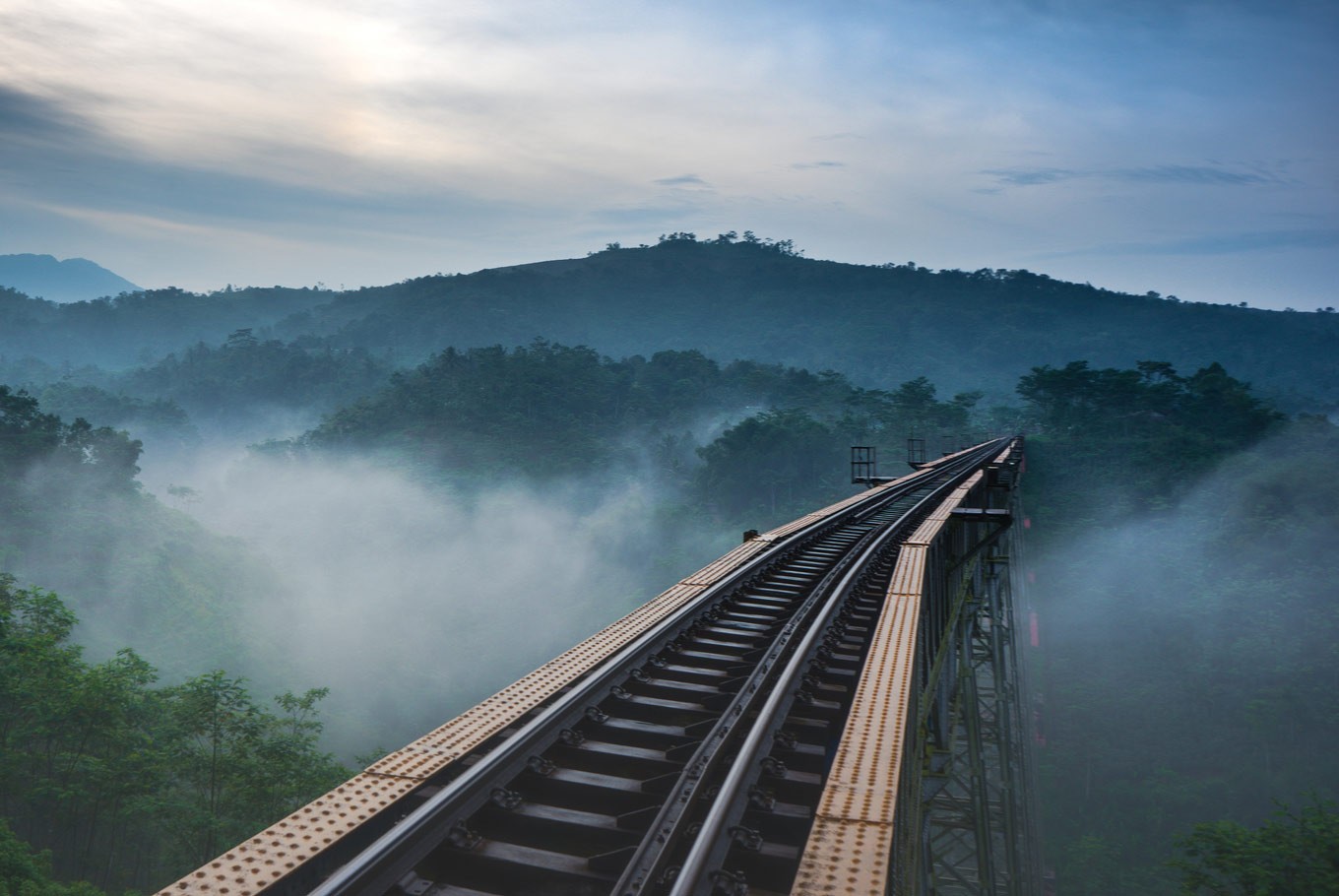
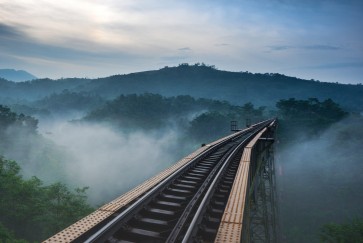
Older than the republic itself, Indonesia’s railroads have had a long and tumultuous history.

The majority of the country’s railroad infrastructure was constructed during the Dutch colonial era. Construction of the first railroad system in Indonesia, which was then called the Dutch East Indies, began in 1864, under the auspices of the Nederlandsche Indische Spoorweg Maatschappij (NIS) company.

The first railroad connected Semarang with Tanggung village, both in Central Java, spanning 25 kilometers. The construction was finished in 1867, according to railroad historian Tjahjono Rahardjo from Soegijapranata Catholic University.

The country then saw a railroad construction boom between the late 19th century and the early 20th century amid rising freight transportation demand from agricultural businesses, Tjahjono said.

“Indonesia’s railroad system was first built to carry agricultural products from the plantations to port cities following the economic liberalization policy undertaken by the Dutch government. So, it initially wasn’t designed for passengers,” Tjahjono told The Jakarta Post on July 29.

By 1939, a total of 8,157 km of train and tram tracks had been built over the islands of Java and Sumatra and in Kalimantan, which is longer than Indonesia’s current active rail network of around 6,000 km, government data show.

The downfall

The rapid growth of Indonesia's railroad system, however, ended when Japanese troops ousted Dutch colonial forces and then occupied the country in the early 1940s. The Japanese troops dismantled up to 473 km of rail tracks and shipped them to Burma, now Myanmar, for their territorial defense.

When Indonesia declared its independence in 1945, and subsequently nationalized the railroad company as Djawatan Kereta Api Republik Indonesia (DKARI), 901 km of rail tracks had vanished.

Under the leadership of Soekarno, Indonesia’s first president, tram tracks in cities like Jakarta, Semarang, and Surabaya, East Java, were also torn up, as he believed that urban rail transportation hurt becak (three-wheeled pedicab) drivers, according to transportation expert Djoko Setijowarno.

Meanwhile, Tjahjono stated that Soekarno had tried to modernize the rail system by ordering 127 new locomotives in 1953 and 1954, despite his decision to shut down trams.

However, the government could not continue its railroad revitalization program following the hyperinflation and economic demise that occurred from 1963 until Soekarno’s downfall in 1965.

Stagnation during the era of development

Railroad development took a back seat during the leadership of Suharto, who came to power in 1967. Soeharto’s first five-year development plan (Repelita), which ran from 1969 to 1974, explicitly stated that the Indonesian railroad system did not need to be revitalized and even needed to be cut in size.

“In the next five years, there is no reason to expand the railroad network. Networks that aren’t important and profitable should be closed if there are other transportation systems,” the document reads.

Suharto was keener on developing road infrastructure instead, partly as a result of lobbying from the Japanese automotive industry, according to Djoko.

“President Suharto was more focused on developing the automotive industry and therefore many railroad networks were closed while road networks expanded,” Djoko said.

The Indonesian Railroad Company (PJKA), established in 1988 as the successor to DKARI and later Perusahaan Negara Kereta Api (PNKA), was also poorly managed during Suharto’s era, and had an abysmal safety record. Notable train accidents include the Bintaro accident in South Jakarta in 1987, which killed 139 people.

PJKA’s poor financial management also led the company to suffer years of financial losses.

Revival of railroad development

The years after 2008 saw an overhaul in railroad infrastructure development, as well as an increase in demand.

State railroad operator PT Kereta Api Indonesia (KAI), PJKA’s successor, managed to overturn its losses following the appointment of then-transportation minister Ignasius Jonan as president director in 2009.

“We implemented online ticket purchasing to prevent fare evasion, which had previously impacted our revenue,” PT KAI spokesperson Joni Martinus said on July 28.

The company posted a profit of Rp 154.8 billion (US$10.5 million) in 2009 after posting a loss of Rp 83.4 billion in 2008, with profits continuing to increase in the following years.

Meanwhile, the number of passengers in Java and Sumatra more than doubled between 2000 and 2019, clocking in at 428 million people by 2019, Statistics Indonesia (BPS) data shows.

The newly elected President Joko “Jokowi” Widodo also made infrastructure development the flagship program of his term of office. Under the 2015-2019 National Medium-Term Development Plan (RPJMN), he aimed to build 3,258 km of additional rail tracks.

Under his administration, notable railroad infrastructure projects have included LRT systems in Jakarta and Palembang, South Sumatra, the MRT in Jakarta, as well as the China-backed high-speed railroad project connecting Jakarta and Bandung, West Java. The study for a Japan-backed medium-speed railroad connecting Jakarta and Surabaya has also begun.

The MRT, the first underground metro system in Jakarta, was inaugurated in 2019 after decades of construction delays, stretching 15.7 km.

“President Jokowi is serious about developing Indonesia’s rail infrastructure,” Djoko said.

The ratification of Law No. 23/2007 on the railroad system that ended the monopoly of KAI as the sole train operator and provided a single legal umbrella for railroad stakeholders, was also seen to help the emergence of new train operators, according to Djoko.

However, like Suharto, in practice, Jokowi’s administration built more roads than it did railroad tracks. The country could only build and reactivate 853.65 km of rail tracks between 2015 and 2018. In comparison, the government built 1,500 km of new toll roads and 3,867 km of new roads between 2015 and 2019, surpassing its target, according to government data.

“The main issue with building railroads is funding,” Djoko said. “Private companies are reluctant to invest in railroad projects, as they’re less profitable than toll road projects. Therefore, the government must be the one that foots the bill,” he added.

The National Development Planning Agency (Bappenas) has estimated that the country will need $429.7 billion in infrastructure investment between 2020 and 2024, with the government only able to finance 30 percent of the projects using state funds.

Institute for Transportation Studies (Instran) director Darmaningtyas echoed this sentiment, adding that the potential recession caused by the COVID-19 pandemic could threaten Jokowi's infrastructure ambitions going forward, including his railroad development projects.

“It will ultimately affect the funding and development of railroad projects," he said, referring to the 3.8 percent contraction in the economy in the second quarter and the government’s projection for a further 1 percent contraction in the third quarter of this year.

Despite the setback, rail historian Tjahjono expressed hope the government would continue the railroad infrastructure development projects, as he said railroads were central to Indonesia’s history and helped it gain its independence.

“The Indonesian railroads helped Soekarno and vice president [Mohammad] Hatta escape the Dutch forces from Jakarta to Yogyakarta back in 1946. Without the railroad system, we would probably have a different history,” he said. 

Your Opinion Matters

Share your experiences, suggestions, and any issues you've encountered on The Jakarta Post. We're here to listen.

Enter at least 30 characters
0 / 30

Thank You

Thank you for sharing your thoughts. We appreciate your feedback.

Share options

Quickly share this news with your network—keep everyone informed with just a single click!

Change text size options

Customize your reading experience by adjusting the text size to small, medium, or large—find what’s most comfortable for you.

Gift Premium Articles
to Anyone

Share the best of The Jakarta Post with friends, family, or colleagues. As a subscriber, you can gift 3 to 5 articles each month that anyone can read—no subscription needed!

Continue in the app

Get the best experience—faster access, exclusive features, and a seamless way to stay updated.