TheJakartaPost
Please Update your browser
Your browser is out of date, and may not be compatible with our website. A list of the most popular web browsers can be found below.
Just click on the icons to get to the download page.


Popular Reads
Top Results
No results found. Please check your search term and try again
Can't find what you're looking for?
View all search results
Popular Reads
Top Results
No results found. Please check your search term and try again
Can't find what you're looking for?
View all search resultsCorruption’s costly slide
While the Prabowo Subianto administration has intensified its campaign against white-collar crime, these efforts have failed to improve the global perception of Indonesia as a nation entrenched in corruption.
Change text size
Gift Premium Articles
to Anyone
Share the best of The Jakarta Post with friends, family, or colleagues. As a subscriber, you can gift 3 to 5 articles each month that anyone can read—no subscription needed!
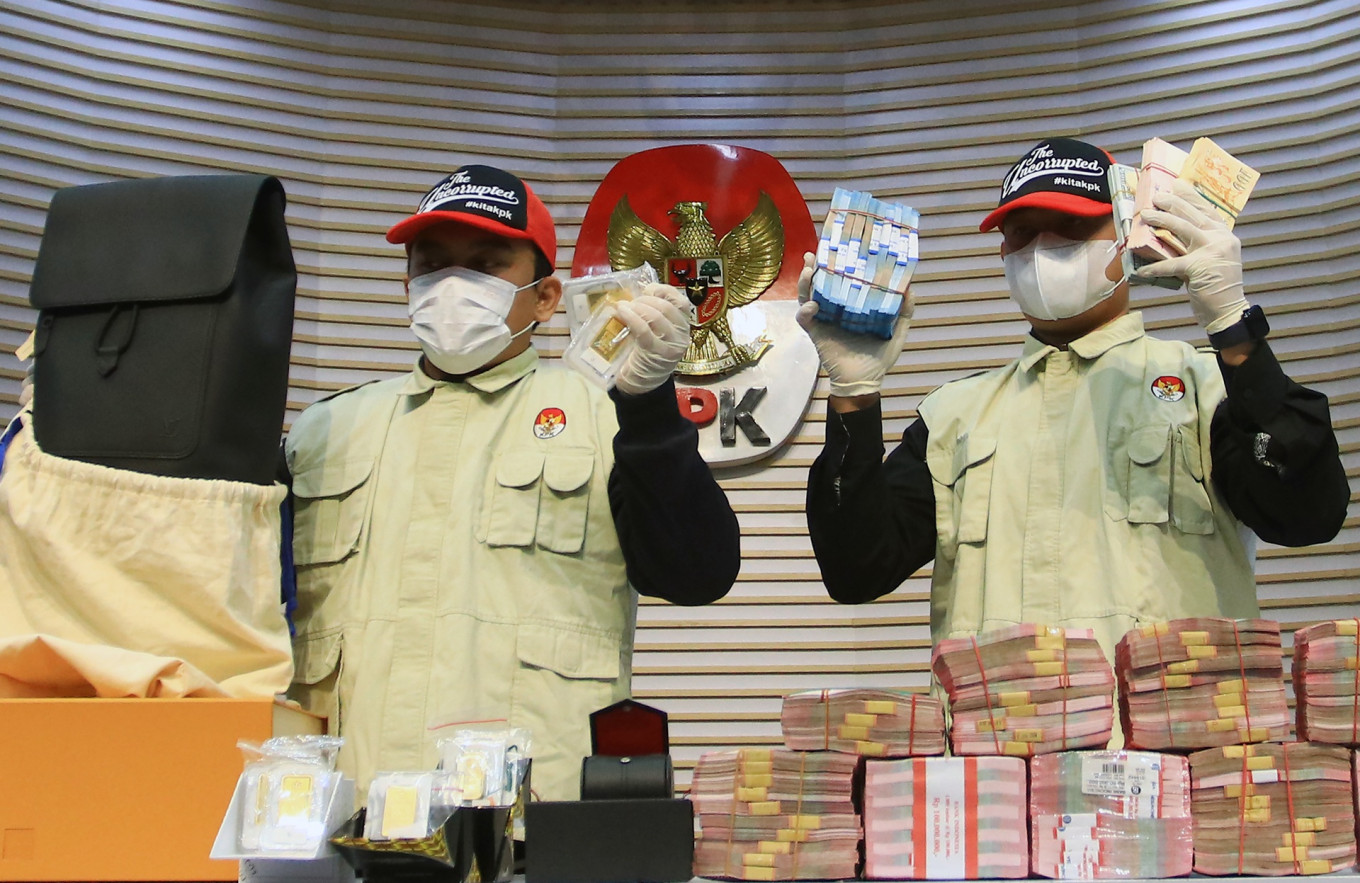 Corruption Eradication Commission (KPK) investigators hold up cash and gold bars on Feb. 5, 2026 seized during the arrest of Finance Ministry's customs and excise directorate general officials at a press briefing at the antigraft body headquarters in Jakarta. The KPK named six suspects in a bribery case pertaining to import duties involving several officials from the customs and excise office. (Antara/Muhammad Iqbal)
T
he Prabowo Subianto administration’s crackdown on white-collar crime has ensnared numerous officials and businessmen, returning trillions of rupiah to the state coffers. However, these high-profile seizures have had little impact on the international perception of widespread corruption in the country.
In fact, Indonesia saw its performance slip on the 2025 Corruption Perception Index (CPI), published last week by the Berlin-based Transparency International. The country fell 10 places in the annual global ranking, landing at 109th out of 182 countries surveyed. Its score dropped from 37 in 2024 to 34 during the first full year of the Prabowo administration.
Since hitting a high-water mark of 40 in 2019, the country’s anticorruption efforts have largely plateaued or backslid, culminating in a disappointing score this year.
This decline places Indonesia well below the global average score of 42, on par with countries such as Nepal, which faced significant political instability following youth-led protests in late 2025. Transparency International Indonesia attributed this regression to a declining quality of democratic leadership, weakened oversight institutions, eroding judicial independence and shrinking civic spaces.
Indonesia, a major regional democracy, now lags behind several neighbors, including Timor-Leste at 52, Malaysia at 44 and Vietnam at 41. Singapore remains the gold standard in Southeast Asia, ranking third globally with a score of 84.
Since taking office just over a year ago, President Prabowo has repeatedly reasserted his commitment to combating graft, even threatening unpopular measures to protect national resources. Just last week, he suggested that the country might need a more "authoritarian" approach to effectively eliminate corruption.

He may have been joking at the time, but an effective antigraft campaign does not require authoritarian governance. The regular top 10 in the Transparency International’s list, perhaps except for Singapore, are known for their fully fledged democracy.