TheJakartaPost
Please Update your browser
Your browser is out of date, and may not be compatible with our website. A list of the most popular web browsers can be found below.
Just click on the icons to get to the download page.


Popular Reads
Top Results
No results found. Please check your search term and try again
Can't find what you're looking for?
View all search results
Popular Reads
Top Results
No results found. Please check your search term and try again
Can't find what you're looking for?
View all search resultsIndonesians enjoy long weekend, meaningful celebrations amid pandemic
As Indonesian people took advantage of the celebratory week by enjoying leisure time, many also spent quality time with family and friends, strengthening their sense of nationalism and connection to their roots, as well as remembering those who have passed away.
Change text size
Gift Premium Articles
to Anyone
Share the best of The Jakarta Post with friends, family, or colleagues. As a subscriber, you can gift 3 to 5 articles each month that anyone can read—no subscription needed!

I
ndonesians enjoyed a week of celebrations in the third week of August, beginning with the commemoration of the country’s 75th Independence Day anniversary on Aug. 17 and continuing on Aug. 20 with Islamic New Year. On top of that, the government also declared Aug. 21 a collective leave day.
The COVID-19 pandemic aside, Jakartans took advantage of the long weekend, with more than 150,000 vehicles reportedly leaving the capital, according to The Jakarta Post.
Kompas.com quoted Jasa Marga’s corporate communications and community development group head Dwimawan Heru, who said the number of vehicles that departed Greater Jakarta was up 39.2 percent during the holiday, compared to regular days.
Dea, not her real name, a mother of two grown-up children who lives in Bandung, West Java, went to Magelang, Central Java, and Yogyakarta on Aug. 20 to 23. She said she saw many cars from Jakarta during her trip, although there was no traffic congestion in the cities she visited. Only on her way back to Bandung on Sunday was the road crowded with vehicles returning to Jakarta.
Dea said the resort where she stayed in Magelang was quiet, with only one of the five cottages occupied. Meanwhile, only a few other rooms closer to Borobudur temple were occupied.
“The resort arranged for us to have breakfast in a space overlooking Borobudur temple, and then we went cycling around the temple. It was quite busy, but visitors are only admitted to the park surrounding the temple,” said Dea in a telephone interview.
She went on to say that visitors were not allowed to enter the temple, let alone take the stairs to reach its upper level, as the limited space at the top of the structure would make it difficult for visitors to maintain a safe distance from others.
Dea said the places she visited in Central Java were not overwhelmed with crowds, but she heard that people, including Jakartans, had flocked to her hometown of Bandung.
“I saw in the news that many people were heading to Lembang [subdistrict in West Bandung regency],” Dea told the Post.
Among the Jakartans who spent the long weekend in Lembang was Arista Dharsono, an architect in her early 30s. She went with her parents and extended family to celebrate Indonesia’s Independence Day at her aunt's house in Wangunsari village, Lembang.
“This is a family tradition. Our big family always gathers to celebrate Aug. 17, [but] this is the first time [we have gathered] in Wangunsari [village in Lembang],” said Arista in a WhatsApp message.
Three generations of Arista’s family gathered for their recent Independence Day celebration, in which they held a flag-hoisting ceremony and sang national songs in a spacious backyard overlooking the sprawling hills of Lembang.
“During Independence Day celebrations, we look forward to singing national songs,” Arista told the Post.
A tearful moment came when the family sang the national song ‘Mengheningkan Cipta’ (Moment of Silence) as tribute to the national heroes.
“We just lost our uncle two weeks ago, so we are still in mourning,” said Arista, adding that she also prayed for her late grandparents.
The event continued with fun games and eating tumpeng, a traditional cone-shaped rice dish usually served during celebratory moments.
Tumpeng was also among the dishes served by Indonesian culinary expert Santhi Serad for the celebration of Islamic New Year on Thursday.
Santhi, who observed the holiday in Jakarta, said that serving tumpeng and bubur suro (rice porridge with coconut milk) was a common tradition in Java for Islamic New Year.
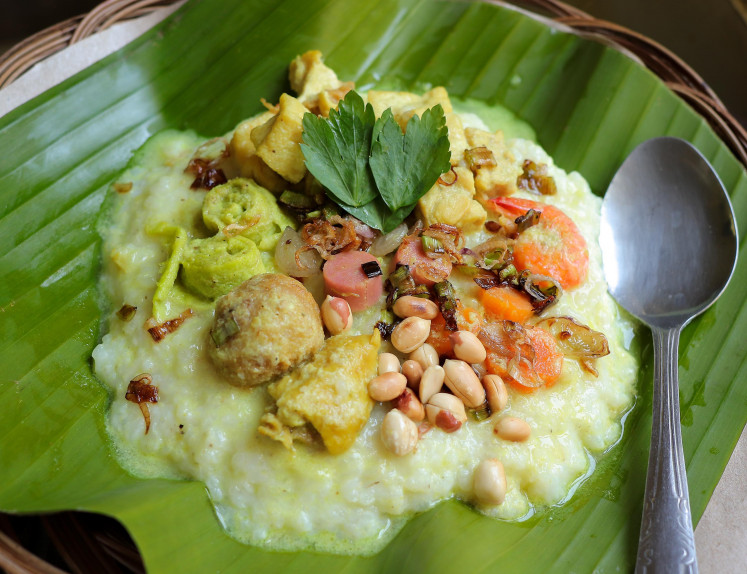
“[We] inherited the tradition of serving bubur suro from my grandparents, […], and there also has to be perkedel (fried potato patties), shredded omelet and fried soybeans, and sometimes chicken or tofu curry,” said Santhi.
Aside from bubur suro, they also enjoyed bubur sengkolo merah putih (red and white porridge made of rice flour with coconut sugar and coconut milk).
“Bubur sengkolo symbolizes that all people originate from the earth, from a mother’s red blood and a father’s white blood, and [the color] also resembles our country’s national flag,” wrote Santhi in an Instagram post.
As Indonesian people took advantage of the celebratory week by enjoying leisure time, many also spent quality time with family and friends, strengthening their sense of nationalism and connection to their roots, as well as remembering those who have passed away. A meaningful break well-deserved by those who are striving to keep on going during this trying time.