TheJakartaPost
Please Update your browser
Your browser is out of date, and may not be compatible with our website. A list of the most popular web browsers can be found below.
Just click on the icons to get to the download page.


Popular Reads
Top Results
No results found. Please check your search term and try again
Can't find what you're looking for?
View all search results
Popular Reads
Top Results
No results found. Please check your search term and try again
Can't find what you're looking for?
View all search resultsFair play: behind Indonesia’s push for global digital royalty reform at WIPO
Change text size
Gift Premium Articles
to Anyone
Share the best of The Jakarta Post with friends, family, or colleagues. As a subscriber, you can gift 3 to 5 articles each month that anyone can read—no subscription needed!
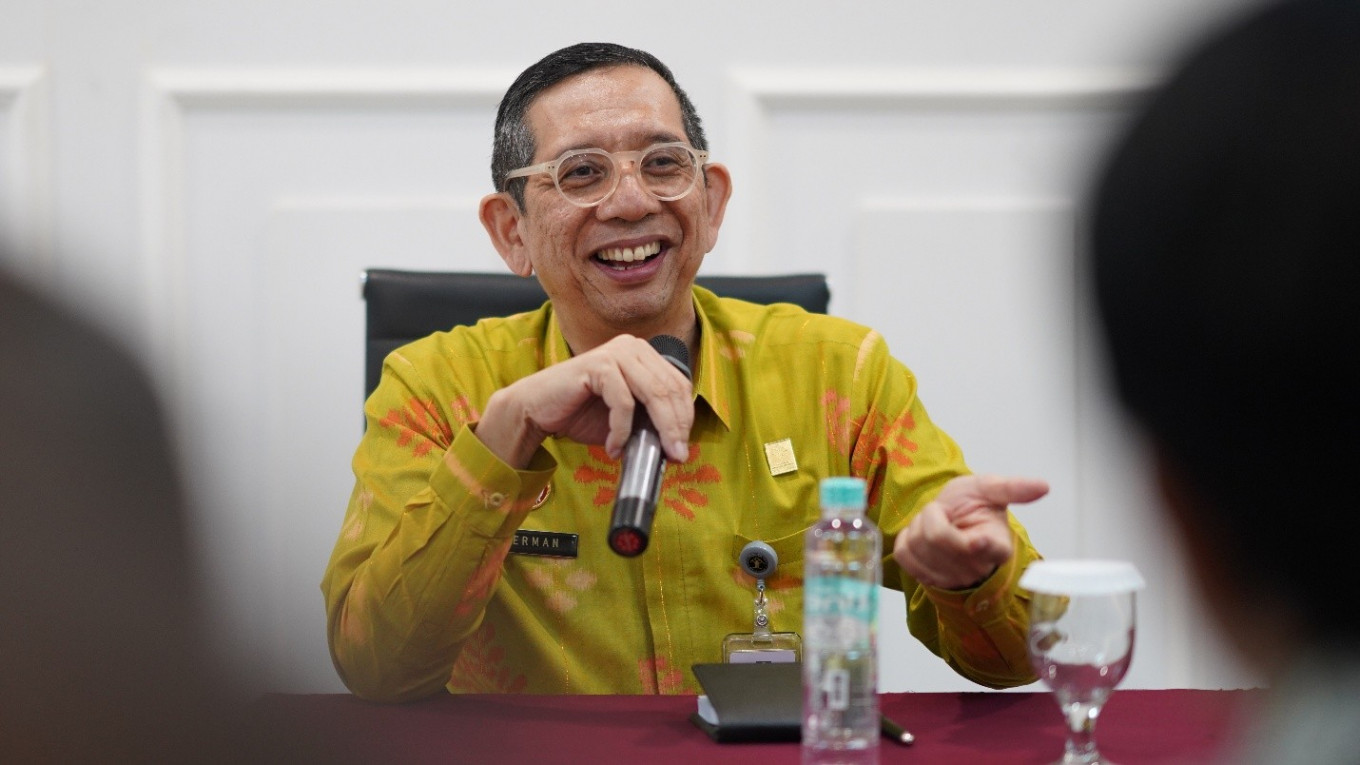 (Images courtesy of The Directorate General of Intellectual Property (DGIP))
F
rom the latest album release listening party to surprise music video drops, the economic value of the global creative industry has reached US$2.3 trillion annually, making up 3.1 percent of the global GDP.
As songs cross continents at the touch of a screen, music streaming has surged to 67.3 percent of the global music market, while digital royalties have become the largest source of global royalty collections for the first time, accounting for 35 percent of the total global royalty collection.
Despite these seemingly positive progress, a major paradox exists where creators, performers and producers who underpin this creativity receive only a fraction of this economic value.
UNESCO and the World Bank estimate that $55.5 billion in music and audiovisual royalties evaporate each year, never collected, never recorded and never received by their creators.
To that end, Indonesia, which is home to millions of creators, has challenged the global architecture of royalty governance through a formal proposal to the World Intellectual Property Organization (WIPO), titled the “Indonesian Proposal for a Legally Binding International Instrument on the Governance of Copyright Royalties in the Digital Environment.”
At the center of it is the harsh inequality between creators and giant digital companies, explains Hermansyah Siregar, the director general of intellectual property at the Law Ministry. In an interview with The Jakarta Post, he noted that the system that supports the growth of the global music industry does not provide adequate transparency for creators.

“Therefore, Indonesia feels the need to propose a legally binding international instrument capable of reversing this structure of inequality. This is not a technical issue, but rather about the dignity of creators and the sovereignty of the cultural economy,” he said.
Challenging platform hegemony
Hermansyah spotlighted the near-absolute dominance of global digital platforms, who control recommendation algorithms, licensing models, metadata standards, the valuation of a single stream and the way an income statement is displayed.
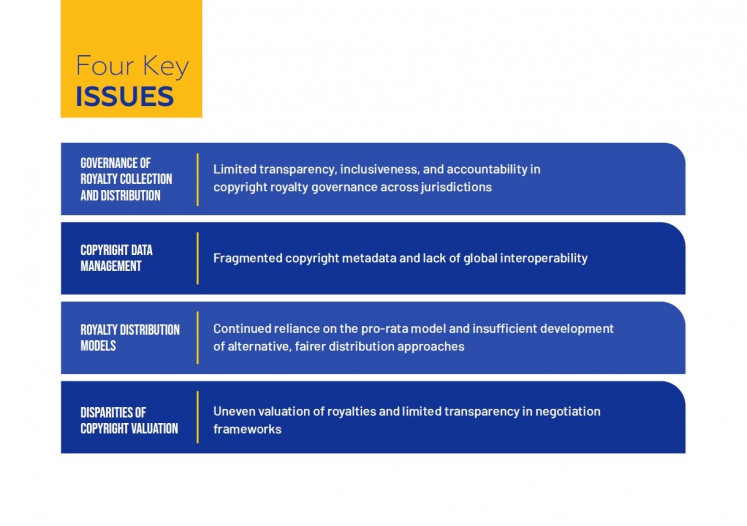
Indonesia’s proposal to WIPO identified four structural issues that directly impact the value of global creator royalties: fragmented metadata, reliance on an unfair pro-rata model, inconsistent royalty assessments across countries and non-transparent royalty distribution governance.
This platform dominance, he continues, is what is widening the value gap. As platforms grow into global giants, creators remain small as they are excluded from the data architecture that determines the economic value of works.
“Indonesia isn't offering a slogan. We're offering a new, concrete, operational and technical architecture for global royalty governance.”
The proposal is built on three pillars: global standardization of phonogram and audiovisual documentation; transparency in licensing, use and royalty distribution across countries; and global oversight and accountability.
The first pillar centers on metadata, which is analogous to the DNA of a work. Without uniform and interoperable metadata, the world will continue to fail to map ownership of works, resulting in cross-border plagiarism, duplicate claims, unrecorded works and royalties that are never distributed.
Under the second pillar, the proposal highlighted how countries and creators currently receive one-sided reports from platforms, which has partial and un-auditable transparency. Thus, Indonesia proposes requiring platforms to provide cross-border consumption data, disclose the economic value per use and provide real-time royalty reports.
Meanwhile, the third pillar proposes an international audit mechanism, protection of the interests of developing countries and the development of alternative, fairer distribution models for emerging musicians and independent creators.
“Global standardization is needed to ensure that no work is ‘lost’ from the system, as without transparency, royalties are just numbers on paper. We aim to create a system where creators are not mere spectators in the digital creative industry, but owners of real value,” says Hermansyah, expressing his hopes that WIPO would be able to bridge and accommodate these needs.
The decision to propose a binding instrument as opposed to soft law is also deliberate, he explains, as soft law never works in a situation where negotiating power is imbalanced.
“Global platforms have no incentive to disclose their data because there are no sanctions for failure to do so. If the digital world is to be fair, it must be governed by tools that have real power. Without them, inequality will continue to widen.”
To date, WIPO member states’ response to Indonesia’s proposal is likely to be divided into two camps.
Strong support is likely to come from African, South Asian, ASEAN and Latin American countries who experience similar issues. In their view, Indonesia stands as a country with diplomatic capacity, a burgeoning creative economy and the moral legitimacy to lead the discussion.
On the other hand, developed countries are likely to be critical on technical aspects, including metadata interoperability, the economic impact to the digital industry as well as the audit mechanism.
According to Hermansyah, these are valid concerns as the instrument will impact the large tech companies based in their respective countries. He also highlighted the cautious response of major platforms such as Spotify, YouTube and TikTok, though he clarified that Indonesia is not antagonizing these platforms.
“We want them to grow, but we cannot allow the global industry to operate on mechanisms that ignore creators' rights. We will continue to foster dialogue, but we will also remain firm in our belief that data on the use of works belongs not to platforms, but to creators and governments.”
A pursuit of just and fair royalty
Should the proposal succeed and the instruments are adopted, Indonesian creators will, for the first time, gain access to comprehensive global streaming data, information on which countries consume their works the most, the true economic value of their work and access to royalties that they are entitled to.
For Indonesia, this potentially means trillions of rupiah annually, driven by increasing global consumption of Indonesian works as well as global data that has been kept under wraps.
If this data set is made accessible, Hermansyah said Indonesia’s Collective Management Organization (CMO) can collect royalties from hundreds of countries with an accuracy never seen before, with Indonesia’s music and audiovisual economic value rising sharply.
He acknowledged the valid criticism over Indonesia’s CMOs, but noted that the push for global reform stands on its own. Regardless, he outlined several improvements to the CMOs, including standardizing reporting, interoperability of metadata, strengthening audits and integrating national data systems.
“However, the fundamental fact remains that the majority of consumption of Indonesian creators' works occurs on global platforms. No matter how good the domestic system is, the CMO remains in the dark without global data.”
Thus, Indonesia’s stance at the WIPO is not as a country demanding, but as a country inviting. The negotiating table will encourage an inclusive technical dialogue, aiming to bridge differing views and offering a model for cross-border collaboration that respects the diversity of each country's national systems.
To Indonesian creators, Hermansyah’s message is that the country is fighting for their rights not only in Jakarta, but across the world.
“Behind every melody, every phonogram, every audiovisual work is hard work that embodies human dignity. That value should not be diminished by structural inequality. Indonesia wants to ensure that when your work is heard on other continents, its economic value returns to you, rather than evaporating in the dark chambers of the global digital industry.”