TheJakartaPost
Please Update your browser
Your browser is out of date, and may not be compatible with our website. A list of the most popular web browsers can be found below.
Just click on the icons to get to the download page.


Popular Reads
Top Results
No results found. Please check your search term and try again
Can't find what you're looking for?
View all search results
Popular Reads
Top Results
No results found. Please check your search term and try again
Can't find what you're looking for?
View all search resultsJakarta braces for post-Idul Fitri virus surge
As concerns loom over a possible spike in COVID-19 cases after Idul Fitri, Jakarta is redoubling its efforts to limit the spread of the illness.
Change text size
Gift Premium Articles
to Anyone
Share the best of The Jakarta Post with friends, family, or colleagues. As a subscriber, you can gift 3 to 5 articles each month that anyone can read—no subscription needed!
A
s concerns loom over a possible spike in COVID-19 cases after Idul Fitri, Jakarta is redoubling its efforts to limit the spread of the illness.
At least 1.5 million people traveled to their hometowns for the holiday last week despite a government mudik (exodus) ban. Crowds flocked to a number tourist locales, adding to contagion worries.
To counter the anticipated rise in cases in the coming weeks, the Jakarta Health Agency said it had "prepared health facilities and increased the capacity of isolation and intensive care beds".
More than 6,600 hospital beds have been allocated for the treatment of COVID-19 patients in the city, with 1,724 occupied as of Monday. The agency has also designated 1,007 intensive care unit (ICU) beds for virus patients, 669 of which remain available.
“Both capacity rates stand above 50 percent,” Jakarta Health Agency head Widyastuti said in a statement.
Read also: COVID-19 case spike looms as millions skirt 'mudik' ban
Stickers have been placed on the houses of many residents who traveled outside of the city recently, indicating that they must self-isolate for five days upon return, as ordered by the national COVID-19 task force. Local officials claim that these stickers are intended to inform nearby residents to stay alert.
“There has to be some frankness. We can’t just think about ourselves,” Jakarta Deputy Governor Ahmad Riza Patria said on Tuesday, as reported by kompas.com, adding that people who returned to their hometowns for Idul Fitri had to be responsible citizens.
The Jakarta COVID-19 task force, in coordination with neighborhood unit (RT) and community unit (RW) heads, said it would keep records of returning travelers, monitor their health and have them tested for COVID-19.
Governor Anies Baswedan has authorized district heads to impose what he described as “micro lockdowns” in RTs where COVID-19 cases have been found in more than five households.
These lockdowns are part of Jakarta’s micro-scale mobility restrictions (PPKM Mikro), which have been extended for another two weeks, until May 31.
The micro lockdowns will involve the closure of public areas and an 8 p.m. curfew. Residents will also be barred from gathering in groups of more than three people. RTs in Jakarta commonly have 80 to 130 households.
Coordinating Economic Affairs Minister Airlangga Hartanto, who is also the head of the COVID-19 mitigation and national economic recovery committee, reiterated on Monday that mudik travelers who wished to enter Jakarta would be subject to random antigen tests and mandatory document checks.
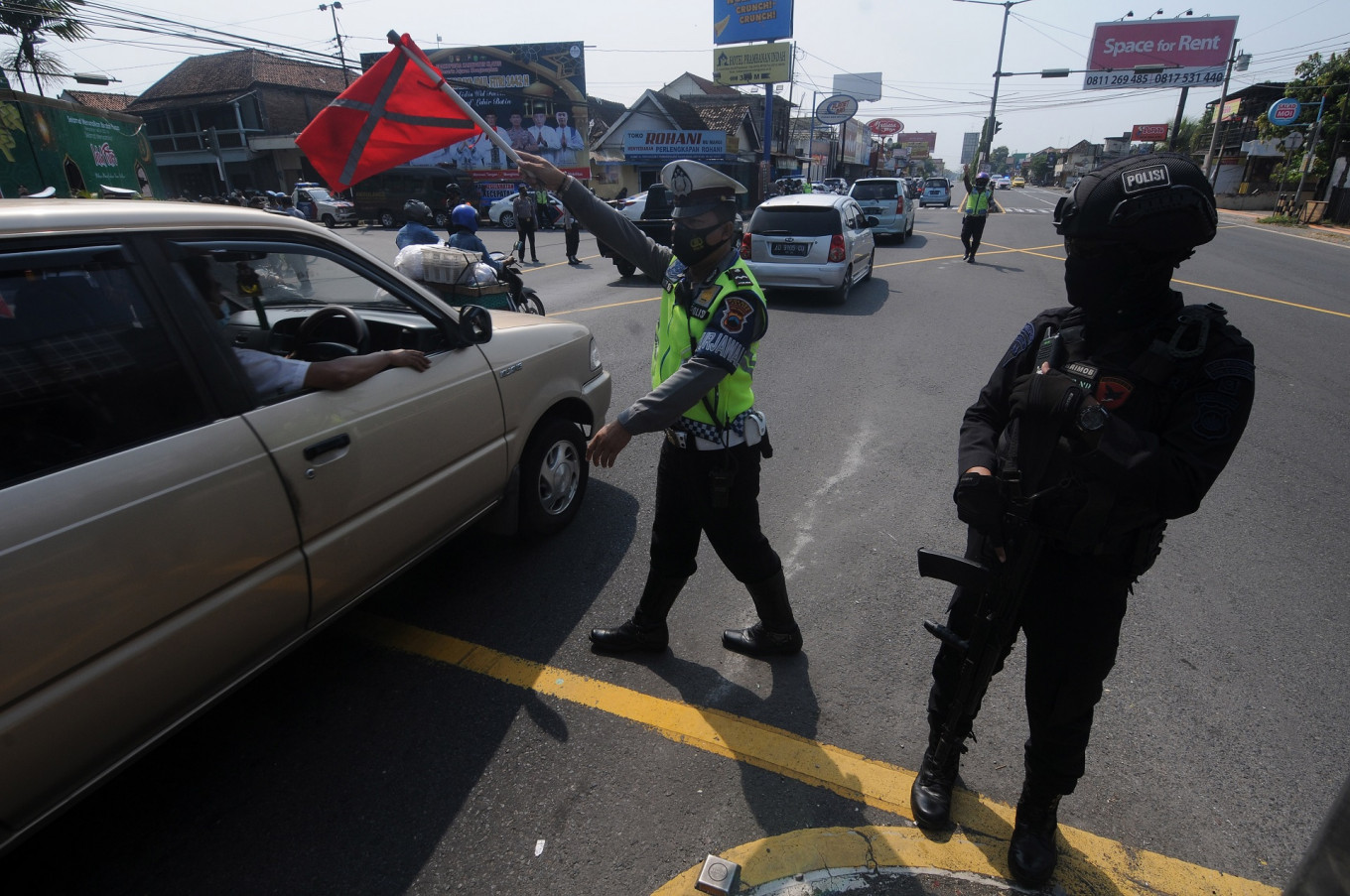
Jakarta Police spokesman Sr. Comr. Yusri Yunus said these measures would be carried out at 14 points across Greater Jakarta, including on arterial roads and at bus stations, until May 24.
As of Wednesday, checkpoint officials had recorded nearly 150 cases of COVID-19 out of 22,900 travelers, and more than 5,900 vehicles without exit and entry permits (SIKM) were made to turn around, according to the Jakarta administration.
Read also: More tests, local monitoring: Authorities step up virus prevention as ‘mudik’ travelers return
Masdalina Pane of the Indonesian Epidemiologists Association (PAEI) said the mandatory five-day self-isolation was not ideal and that a 14-day quarantine would have been better. She also said the antigen tests used at checkpoints would likely not be able to detect the virus in its early incubation period.
"Our failures fall in the poor standards of COVID-19 controls," Masdalina said.
High mobility during holiday breaks has been blamed for the increase in COVID-19 cases in Jakarta in the past, for instance, after last year’s Idul Adha and year-end holidays and a long weekend in October.
Jakarta remains one of the country’s COVID-19 epicenters although it has yet to see a surge in cases after Idul Fitri in mid-May. Jakarta recorded 895 new cases on Thursday, bringing the total tally to 421,354 cases since the pandemic hit the city last year.
The number of daily cases in Jakarta has decreased since January, when it recorded daily highs of more than 3,700 cases, to an average of 2,500 daily cases in February, 1,300 in March, 880 in April and 630 this month so far.
This, however, came when the number of people PCR tested per day steadily decreased, from an average of 18,000 people per day in January to 9,500 in April, although daily antigen tests increased from 495 people tested in January to 3,600 in April.
Active cases and deaths in Jakarta also remain high, with an average of 7,300 daily active cases recorded this month so far, half of which saw people hospitalized, increasing from 6,700 cases in April, and an average of 21 daily deaths in May, an increase from 13 in April.
Read also: Some Jakartans stay put over Idul Fitri
President Joko “Jokowi” Widodo warned of a second wave of COVID-19 on Tuesday and called for local governments, regional police forces and agencies to work together to address the potential spike in new cases in the coming weeks.
“We must be able to endure, because this [pandemic] cannot possibly end in one or two months,” Jokowi said in a briefing with regional heads aired on YouTube.
Last year, Indonesia saw a spike in infections across the country after the Idul Fitri holidays, when thousands of people violated the mudik ban. In the weeks following the holiday, nationwide cases rose 68 to 93 percent, while fatalities climbed 28 to 66 percent.