TheJakartaPost
Please Update your browser
Your browser is out of date, and may not be compatible with our website. A list of the most popular web browsers can be found below.
Just click on the icons to get to the download page.


Popular Reads
Top Results
No results found. Please check your search term and try again
Can't find what you're looking for?
View all search results
Popular Reads
Top Results
No results found. Please check your search term and try again
Can't find what you're looking for?
View all search resultsEased curbs in Blitar mark Indonesia’s first step toward living with COVID-19
Across the city, cafes and restaurants can be seen accepting more customers — almost like before the pandemic — and crowds are gradually returning to recently reopened tourist spots.
Change text size
Gift Premium Articles
to Anyone
Share the best of The Jakarta Post with friends, family, or colleagues. As a subscriber, you can gift 3 to 5 articles each month that anyone can read—no subscription needed!
L
ife is slowly returning to normal in Blitar, East Java, after the government relaxed coronavirus curbs in the small city last week, making it the first region in the country to impose level 1 public activity restrictions (PPKM), the lowest in the four-tiered system.
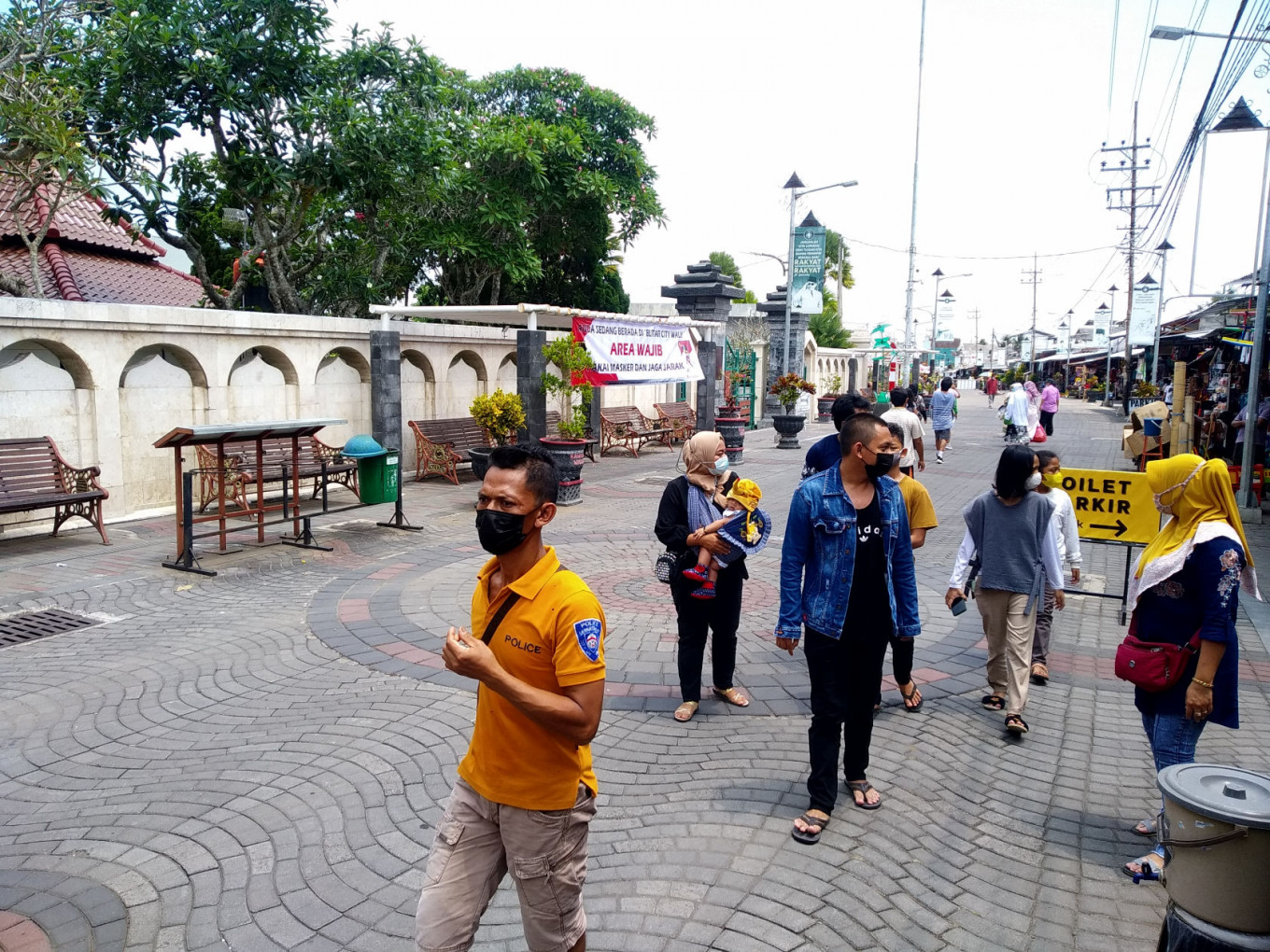
Across the city, cafes and restaurants can be seen accepting more customers — almost like before the pandemic — and crowds are gradually returning to recently reopened tourist spots.
The only signs of the ongoing pandemic are residents wearing masks while going about their daily activities and showing proof of their vaccination status before entering public spaces.
The relaxation was a relief to Respati Agus Nugrahanto, a 45-years-old souvenir seller at the grave of first president Sukarno, a popular attraction that is now officially open to visitors after a trial run in mid-September.
"I'm glad that I can sell souvenirs again, even though my income is still quite low. I hope the number of visitors will increase in the future," Respati told The Jakarta Post on Thursday.
Under the eased curbs, schools can reopen at 50 percent capacity and offices in non-essential sectors at 75 percent. Supermarkets, shops, restaurants and cafes can now operate for longer hours at 75 percent capacity; places of worship, parks, entertainment venues and sports halls at 75 percent capacity; and wedding receptions at 50 percent.
"Under the level 1 restrictions, public activities will almost return to what was normal before the pandemic," Coordinating Maritime Affairs and Investment Minister Luhut Pandjaitan, who leads the COVID-19 response in Java and Bali, said last week when announcing the decision.
Read also: Indonesia is now relying on a COVID-19 app, but does it actually work
Blitar Mayor Santoso warned people not to lower their guard even after restrictions were relaxed.
"People are still required to follow health protocols. The local COVID-19 task force will work together with the national task force to ensure public compliance with health protocols across the city," he said on Tuesday.
Living with COVID-19
Curbs easing in Blitar marks Indonesia's shift toward living with COVID-19 in the long term, instead of a zero-sum fight against a disease that has infected over 4.2 million people and killed more than 142,000 across the country.
The central government is closely monitoring how Blitar applies PPKM level 1 for two weeks, which is expected to serve as an example of a "new normal policy" to other regions.
"If the pilot project is successful, we will impose it in other regions as well," Luhut said.
Read also: Indonesia to reopen Bali for foreign tourists
National COVID-19 task force spokeswoman Siti Nadia Tarmizi told the Post that the government would continue to implement the PPKM system as long as the World Health Organization still characterized COVID-19 as a pandemic.
"PPKM is a part of our vigilance in facing COVID-19. So, as long as COVID-19 is still a pandemic, the PPKM stays — although the level will be adjusted based on the situation in each region and city," she said.
A small city’s success story
Nadia said that Blitar — home to 152,000 people in an area of 32 square kilometers — had been chosen for the level 1 PPKM pilot project because of its high vaccination rate and that it had “checked all indicators for low COVID-19 incidence from the WHO”.
Blitar currently records five cases per 100,000 population per week, with a hospitalization rate of around 3.5 and a 0.7 fatality rate per 100,000 population per week, according to Nadia. The numbers are lower than the WHO's benchmarks for low incidence: 20 cases, five hospitalizations and one death per 100,000 people per week.
Blitar’s bed occupancy ratio is at 5.58 percent, while its positivity rate, or the proportion of people tested who are positive, is currently at 0.5 percent, indicating that the outbreak is under control.
Some 98 percent of people in Blitar have received at least one shot and 62 percent are fully vaccinated, twice as high as the nationwide vaccination coverage for the first dose and almost three times for the second dose.
But what made Blitar stand out from other regions with similar vaccination rates, Nadia said, was the fact that 67 percent of the city's 15,000 elderly population have received their first shots, more than double the national average of 32 percent.
Read also: Indonesia sets new daily jabs target. But experts spotlight lingering issues
Blitar mayor attributed the city’s success to the excellent coordination between local health authorities with the Indonesian Military (TNI) and the National Police, especially in helping to speed up the vaccine rollout.
"Besides that, we also took the initiative to deploy mobile vaccination units and have workers go door to door vaccinating elderly people," Santoso said.
Blitar was also able to increase its testing rate to above the WHO benchmark through random testing in public spaces and vaccination centers.
Not risk-free
An epidemiologist from Airlangga University, Windhu Purnomo, said that even though the COVID-19 situation in Blitar was currently under control, it was not completely safe from COVID-19 risks.
"Blitar has a high risk [of virus transmission], as thousands of people across the country visit the city every day to go to Sukarno’s grave," Windhu said.
Read also: Indonesia braces for the third wave of COVID-19 infections
He also pointed to the high mobility between Blitar city and the neighboring Blitar regency, where the COVID-19 response was not as good.
With a population of 1.3 million people, the regency is one of the regions with the highest COVID-19 overall case fatality rate in East Java, at 15.06 percent. This is far higher than Blitar city’s 3.5 percent.
The vaccination rate in the regency — at 48 percent for the first dose — is two times as low as the rate of the city.