TheJakartaPost
Please Update your browser
Your browser is out of date, and may not be compatible with our website. A list of the most popular web browsers can be found below.
Just click on the icons to get to the download page.


Popular Reads
Top Results
No results found. Please check your search term and try again
Can't find what you're looking for?
View all search results
Popular Reads
Top Results
No results found. Please check your search term and try again
Can't find what you're looking for?
View all search resultsMilitary reserve program feared to cause horizontal conflicts, violate human rights
Change text size
Gift Premium Articles
to Anyone
Share the best of The Jakarta Post with friends, family, or colleagues. As a subscriber, you can gift 3 to 5 articles each month that anyone can read—no subscription needed!
A
ctivists have slammed the government for pressing ahead with installing the first batch of military reservists despite the law that regulates the controversial program still being reviewed by the Constitutional Court.
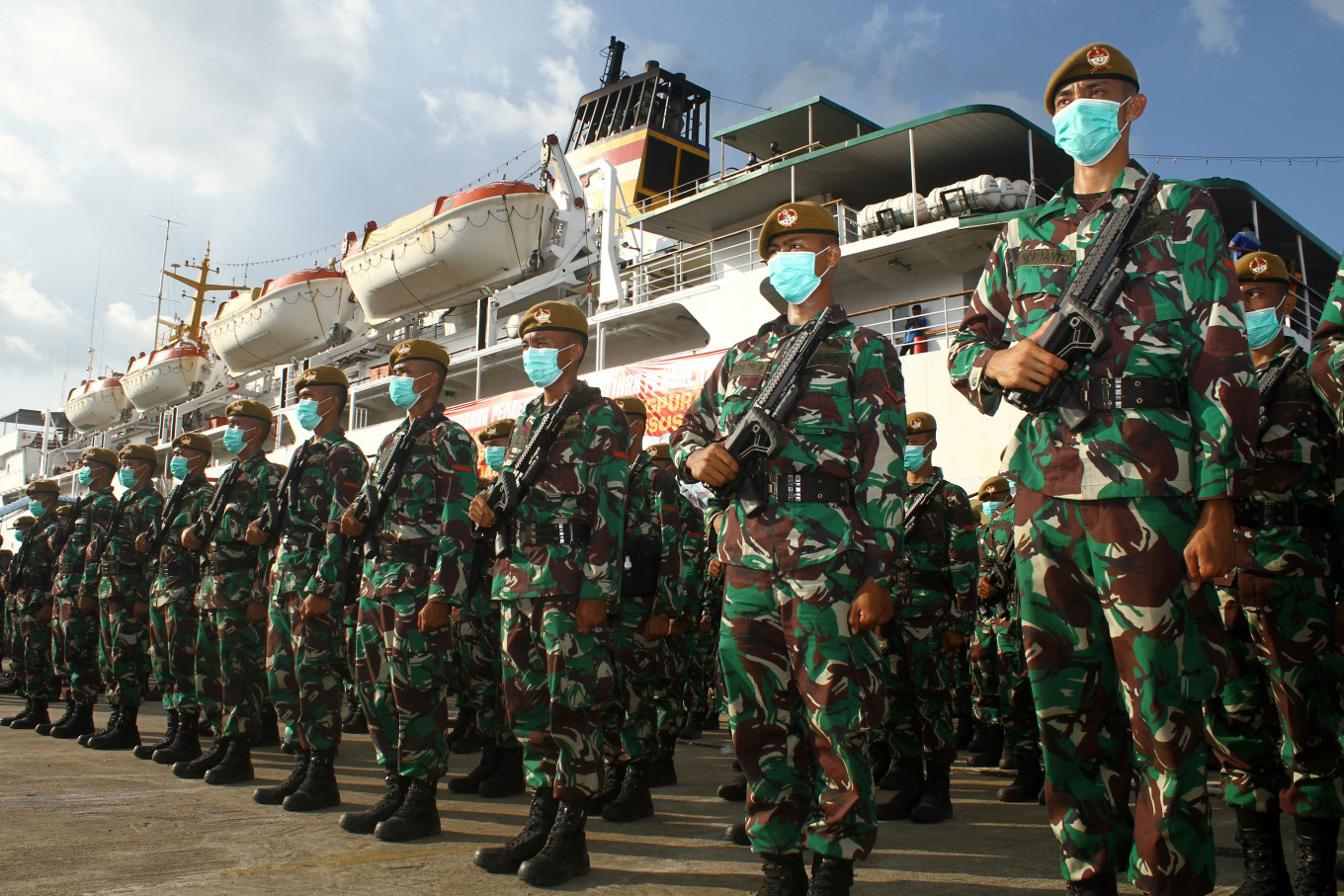
President Joko “Jokowi” Widodo inaugurated last week some 3,100 civilians as military reservists, marking the establishment of military reserves (Komcad).
The reservists had undergone three month-long basic military training periods at the Army's Special Forces training center in Batu Jajar, West Java after passing the selection process held by the Defense Ministry in June.
The government began recruiting reservists in early May despite concerns from activists and experts about potential civil militarization. This prompted a coalition of some civil groups, activists and a student to turn to the Constitutional Court later in the same month to challenge provisions regulating military reserves in the 2019 law on the management of national resources for state defense.
They demand the court annul some provisions, from those regulating reservist deployment for nonmilitary threats to imprisonment for reservists who refuse to answer a call to service, on the grounds that it may cause conflict in the community and violate the right to conscientious objection to service.
They have also requested an injunction to postpone the recruitment until the court issues a ruling. The court has yet to decide on the injunction, but the coalition said nevertheless the government should have respected their request and delayed the inauguration of reservists.
“We have demanded [at court] that [the government] not recruit military reservists while the judicial review is ongoing,” Adelita Kasih of Kontras, a civil coalition member, told The Jakarta Post on Monday. “But that does not seem to be heard [by the government] and the program continues.”
One of the provisions in question says reservists can be mobilized in instances when the country faces military, nonmilitary and hybrid threats including separatism, communism, terrorism, aggression, natural disasters and chemical and biological attacks, among other issues.
Such a wide range of deployment cases made critics worried that reservists could potentially harm civilians if they were deployed, for example, to handle rallies related to separatism or communism issues, looking back at the deployment of the civilian security guard (Pam Swakarsa) during the New Order era.
“The formation of military reserves should only be in a state of emergency, we strongly reject [how the program] is being carried out now,” Busyrol Fuad of the Institute for Policy Research and Advocacy (ELSAM), who is one of the lawyers representing the plaintiffs, told the Post.
They also said the establishment of military reserves was unnecessary when the country was still dealing with the pandemic, instead the government should focus on strengthening the Indonesian Military (TNI) as the main component of the country's defense system.
Same old concerns
Outside the court petition, military expert Khairul Fahmi of the Institute of Security and Strategic Studies (ISESS) said the government should pay attention to monitoring inactive reservists to avoid the worsening of the horizontal conflict in the community, particularly because reservists have been trained in basic military skills.
"[The Defense Ministry] has to be careful not to let their presence in the community become a problem," Khairul said. "The involvement of military reserves must be done carefully so that there is no misuse."
Rights activists and some defense experts have long criticized the idea of recruiting civilians as reservists since the idea emerged in 2010, when the Defense Ministry, on behalf of the government, submitted the draft bill to the lawmakers.
When lawmakers began deliberating the bill in 2019, activists again raised concerns about civil militarization that could threaten democracy, an argument rather similar to the current concern.
The implementation of military reserves officially started after Jokowi signed in January of this year a government regulation -- as an implementing regulation for the 2019 law -- covering the formation of the new defense scheme, the admission process and the education program.
The ministry initially planned to find 25,000 reservists to form 100 reserve battalions this year but pushed back this plan to next year due to state budget constraints as the country focused on the pandemic response.
Civilians aged 18 to 35 are allowed to enlist as military reservists, who will be trained for three months in basic military skills and later will be called every year for 12 days of training. They are under the command of the TNI during training and mobilization, and will be subject to military law during mobilization.
Because the law says so: Ministry
The Defense Ministry insists that the establishment of military reserves is to fulfill the 2019 law that requires the country to have reservists as one of the three components of the national defense system. The two others are the TNI as the main component and the police as a supporting component.
Ministry spokesperson Air Cdre. Penny Radjendra told the Post that reservists were different from Pam Swakarsa and compulsory conscription and that they were under the command of the TNI and could only be mobilized by the President with approval from the House of Representatives.
Tiered surveillance by regional military commands (Kodam) and subdistrict military commands (Koramil) will be imposed on inactive reservists.
"The gradual and continuous monitoring is to prevent negative impacts," Penny said, adding that inactive reservists who were not mobilized nor on duty, were bound by any prevailing civilian laws, not military laws, like common civilians.