TheJakartaPost
Please Update your browser
Your browser is out of date, and may not be compatible with our website. A list of the most popular web browsers can be found below.
Just click on the icons to get to the download page.


Popular Reads
Top Results
No results found. Please check your search term and try again
Can't find what you're looking for?
View all search results
Popular Reads
Top Results
No results found. Please check your search term and try again
Can't find what you're looking for?
View all search resultsIs a just and green recovery affordable for Indonesia?
These new pledges will cost more money. The cost of climate inaction to the global economy, however, is greater still.
Change text size
Gift Premium Articles
to Anyone
Share the best of The Jakarta Post with friends, family, or colleagues. As a subscriber, you can gift 3 to 5 articles each month that anyone can read—no subscription needed!
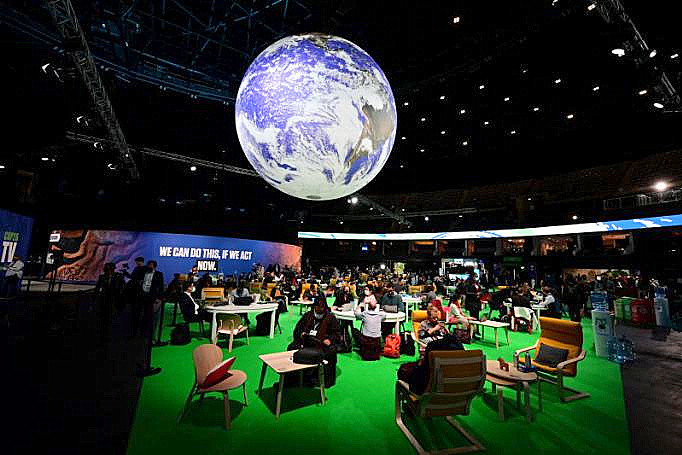

The United Nations climate change conference (COP26) has just concluded, and already world leaders have come together to make several major pledges. Indonesia proudly joined more than 100 nations agreeing to reach a net sink by 2030. We are also part of a coalition of more than 80 countries pledging to cut methane emissions by at least 30 percent by 2030. Notably, we are just one of some 20 countries committed to phasing out coal power.
These new commitments dovetail with our Long-Term Strategy for Low Carbon and Climate Resilience (LTS-LCCR) submission earlier this year. The LTS document outlines Indonesia’s plan to reach peak emissions by 2030 and achieve net-zero emissions (NZE) by 2060 or sooner, making us one of only two countries in Southeast Asia to have done so. This aspiration indicates our commitment to climate action, that despite being battered by COVID-19, we seek to project a confident and proud 2021.
Notwithstanding the above, COP26 negotiations also made clear that major sticking points remain, particularly around financing to support countries of the Global South.
Climate action costs money. These new pledges will cost more money. The cost of climate inaction to the global economy, however, is greater still. In 2019, a World Economic Forum report warned that failure to act on climate change would bring considerable physical and transition risks to the global economy over the next 10 years. Some estimates suggest that the global gross domestic product (GDP) forgone due to climate change could range between 15 percent and 30 percent – far worse than the Great Depression at 15 percent or the Global Financial Crisis at merely 1 percent.
Then, there is also the ongoing global pandemic to consider. As countries continue to prioritize their response to COVID-19 – and reasonably so – the goodwill of countries to work together on other global concerns will remain weak. Already we see how issues like vaccine equity have polarized many. So the question is, is a just and green recovery affordable?
Macroeconomic, fiscal and monetary issues will be key topics of both the Coalition of Finance Ministers of Climate Action and the Group of 20. Indonesia cochairs the Coalition and is about to assume the G20 presidency for the first time. This puts us in a good position to raise such difficult issues. Indeed, many countries, not only those in the Global South, are grappling with how to manage the economic recovery while juggling the ever-growing cost of the pandemic and climate commitments. It is therefore even more vital that the global community works together to “build back better”.
As we see it, there are several key fiscal hurdles to overcome. The first and foremost is the tighter fiscal space countries are currently experiencing due to the COVID-19 pandemic. While Indonesia’s economy managed to maintain a relatively small contraction of 2.07 percent in 2020 with a moderate fiscal deficit of 6.07 percent, the pandemic response continues, and we are in no way out of the woods. The IMF estimates that low-income countries alone would need an estimated US$200 billion from 2021 to 2025 to respond to and recover from the pandemic.
Second, as the global economy restarts, higher commodity and energy prices will also kick into gear. Since early this year, crude oil prices have almost doubled. For net energy importers like Indonesia, this adds even more fiscal and economic pressure.
Third, the risks and costs associated with climate action represent a significant trade-off for all economies. According to the UN Conference on Trade and Development, the costs of addressing climate change in the Global South could reach $800 billion annually.
Lastly, we must contend that the funding and financing of the post-COVID-19 economic recovery will also compete with the growing cost of climate adaptation, which has received less attention. In 2020 alone, various disasters exacerbated by climate change cost the world economy $210 billion. According to Joseph Stiglitz and Hamid Rashid, such costs, coupled with the high cost of building back better, will be a major contributor to public debt.
Back in June 2021, the UN Framework Convention on Climate Change executive secretary, Patricia Espinosa, called for the Global North to honor their promise of making $100 billion available for long-term climate adaptation financing in the Global South. This month, COP26 delegates agreed to deliver the pledged amount. This is also an agenda that Indonesia will closely monitor as cochair of the Coalition of Finance Ministers for Climate Action and during our G20 presidency.
More broadly, Indonesia will use our global platform to champion an affordable just and green recovery under the principle of common but differentiated responsibilities. Understanding the inextricable link between our post-pandemic economic recovery and our capacity to deliver on climate commitments, more than ever, countries in the Global South know we cannot only rely on our own national budgets. A coordinated flow of private funding and financing from philanthropic and financial institutions in the Global North, combined with assistance from bilateral and multilateral development cooperation, will be crucial.
Indonesia is walking the talk by leading efforts to develop and attract innovative approaches to finance a just and green transition with the help of international partners and the private sector.
At the national level, Indonesia has rolled out the Climate Change Fiscal Framework (CCFF), which has allowed us to integrate “green budgeting”, i.e. “green tagging” in our national budgeting and planning processes. These efforts have been crucial to inform tax and spending decisions and are part of broader efforts to design comprehensive climate funding and financing strategies.
Indonesia has also recently passed the Tax Harmonization Law, which implements a carbon tax – starting with coal power plants. A recently signed Presidential Decree on carbon pricing has also allowed for the design of a carbon trading mechanism to finance our transition.
At the international level, Indonesia will promote the harmonization of green taxonomies across countries, as this will play a key role in mapping out and bringing together the large number of relevant international initiatives from international finance institutions, multilateral development banks, the private sector and public sector agencies.
Never has Indonesia been in a better position to demonstrate leadership on the global stage. We will use our presidency of the G20 and our role as cochair of the Coalition of Finance Ministers for Climate Action to continue addressing the immense challenges of a just and green global recovery. Indeed, to recover stronger, we must recover together – which should and can be affordable if we intently collaborate to balance environmental sustainability and wealth creation.
We look forward to leading by example and working together with our international partners to build back better.
***
The writer is a special advisor to the finance minister on macroeconomics and fiscal topics and a sherpa for the Coalition of Finance Ministers for Climate Action.