The Jakarta Post
Please Update your browser
Your browser is out of date, and may not be compatible with our website. A list of the most popular web browsers can be found below.
Just click on the icons to get to the download page.


Popular Reads
Top Results
No results found. Please check your search term and try again
Can't find what you're looking for?
View all search results
Popular Reads
Top Results
No results found. Please check your search term and try again
Can't find what you're looking for?
View all search resultsUndoing democratic reform
Indirect elections through local councils offer no guarantee of cleaner or cheaper politics, if they go ahead they may be composed of political party representatives who are often no less corrupt than elected officials.
Change text size
Gift Premium Articles
to Anyone
Share the best of The Jakarta Post with friends, family, or colleagues. As a subscriber, you can gift 3 to 5 articles each month that anyone can read—no subscription needed!
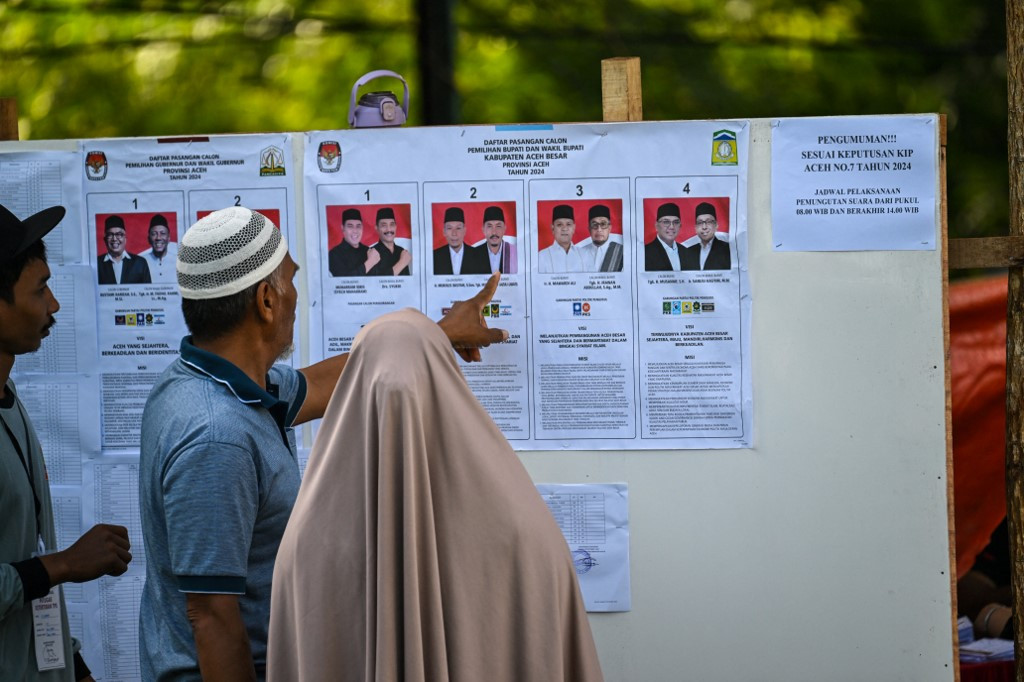 People check election candidate profiles on a signboard before casting their ballots on Nov. 27, 2024, during the 2024 regional head elections in Banda Aceh, Aceh. Indonesians voted on Nov. 27 to pick local leaders in the country's biggest simultaneous regional elections. (AFP/Chaideer Mahyuddin)
I
n yet another blow to the country’s democracy, the Democratic Party, founded by former president Susilo Bambang Yudhoyono, has thrown its weight behind the government-led motion to abolish direct regional elections. The proposal, which seeks to transfer the selection of regional leaders from the voting public to local legislatures (DPRD), marks a significant retreat from one of Indonesia’s most consequential democratic reforms.
Given the current political climate, where both the legislative and executive branches are firmly under President Prabowo Subianto’s control, the party’s move is hardly surprising. The Democrats have pledged allegiance to the president, and their chairman, Yudhoyono’s son, Agus Harimurti, serves as a senior cabinet member. Yet, it is difficult to shake the disappointment or ignore the bitter irony: the party of Yudhoyono has joined the systemic rollback of the very post-Soeharto reforms its founder once championed.
Highly regarded as a progressive military general, Yudhoyono emerged as a key figure of the Reform Era and became Indonesia’s first directly elected president. It was under his stewardship that the country fully embraced direct regional elections, a system designed to dismantle the centralized, authoritarian machinery inherited from Soeharto’s New Order.
This decentralization did more than just distribute power; it strengthened political institutions. The Reform Era paved the way for a robust fight against graft under the Corruption Eradication Commission (KPK) and established vital checks and balances through new judicial bodies like the Constitutional Court. It also allowed for the rise of political figures outside the Jakarta establishment, notably Joko “Jokowi” Widodo, the former Surakarta mayor who skyrocketed to the national elite.
History, however, will record that it was Jokowi who initiated the current wave of democratic regression during his second term. His administration presided over the curtailing of the KPK’s powers, effectively turning the antigraft body into a politicized instrument of the executive. Jokowi is also widely perceived as having orchestrated the premature elevation of his son, now Vice President Gibran Rakabuming Raka, to become Prabowo’s running mate before the 2024 election.
Proponents of the new bill argue that direct elections are too expensive and prone to vote buying practices. However, it is intellectual laziness to blame the election format for these shortcomings.

Indirect elections through local councils, composed of political party representatives who are often no less corrupt, offer no guarantee of cleaner or cheaper politics. The New Order experience proved that indirect elections merely entrench patronage networks, reduce transparency and diminish incentives for good governance.