TheJakartaPost
Please Update your browser
Your browser is out of date, and may not be compatible with our website. A list of the most popular web browsers can be found below.
Just click on the icons to get to the download page.


Popular Reads
Top Results
No results found. Please check your search term and try again
Can't find what you're looking for?
View all search results
Popular Reads
Top Results
No results found. Please check your search term and try again
Can't find what you're looking for?
View all search resultsNew Army chief wants to wage war on terror, New Order-style
“If there is any information, I will carry out measures taken during pak Harto’s time. Babinsa [non-commissioned officers] even have to know if a needle falls,” he said as quoted by Kompas daily, referring to former strongman Soeharto.
Change text size
Gift Premium Articles
to Anyone
Share the best of The Jakarta Post with friends, family, or colleagues. As a subscriber, you can gift 3 to 5 articles each month that anyone can read—no subscription needed!
N
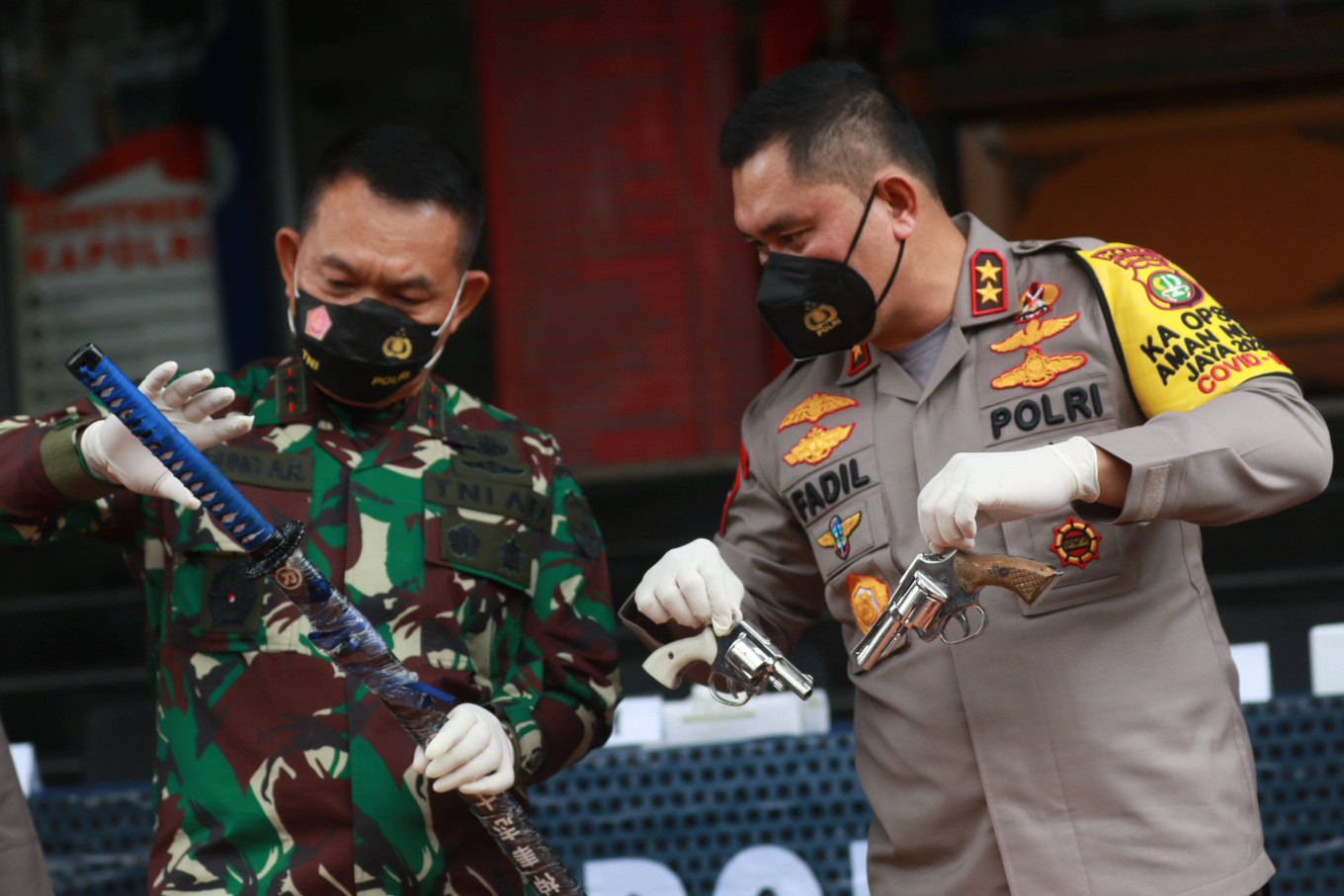
ewly inaugurated Army chief of staff Gen. Dudung Abdurachman has said he wanted to reinstate New Order-style public security monitoring by the military, sparking fears that it might limit civic space.
Speaking to Kompas daily during his visit to Papua on Nov. 19, Dudung instructed the Army to be sensitive to the development of extreme left and right, especially any groups that are trying to carry out radical acts.
“If there is any information, I will carry out measures taken during pak Harto’s time. Babinsa [non-commissioned officers] even have to know if a needle falls,” he said as quoted by Kompas daily, referring to former strongman Soeharto.
He added that the move was part of the Army's seven daily orders and instructed Babinsa at the village level to immediately coordinate with the police and take decisive action if they encounter such information.
"So, if there are organizations that try to disrupt the unity and integrity [of the nation], don't discuss too much, don't think too much, but do it," said the former Army Strategic Reserve commander (Pangkostrad).
His instructions have garnered criticism from civil groups, with many arguing that scaling up the Army's involvement in civilian affairs by encouraging Babinsa to collect intelligence and take action at a village level against extremism would betray the spirit of the 1998 political Reform era.
The Commission for Missing Persons and Victims of Violence (Kontras) urged Dudung to scrap his plan to deploy armed forces to confront radicalism, as this was the task of the police and National Counterterrorism Agency (BNPT).
Kontras’ Rivanlee Iskandar said such remarks ignored the consequence of stigmatization of certain groups and further increased repression by the Army.
“The Army chief’s instruction could be used by soldiers in the field as justification to stigmatize various groups that are considered radical; not to mention, the definition and standard of what constitutes as radicals have been based solely on the government’s interpretation."
During the New Order regime, Babinsa were deployed as a political tool to keep an eye on groups and individuals deemed to be subversive, as well as to make sure the public voted for the regime’s political machine Golkar Party.
Political connection
Dudung was inaugurated in mid-November by President Joko “Jokowi” Widodo as the new Army chief of staff, replacing Gen. Andika Perkasa, who was installed as the new Indonesian Military (TNI) commander on the same day.
Read also: Jokowi swears in new TNI commander, Army chief of staff
Dudung has links to the elite, like Andika, who is the son-in-law of AM Hendropriyono, a former State Intelligence Agency (BIN) chief who was involved in Jokowi's 2014 presidential campaign.
Dudung's father-in-law, late Maj. Gen. (ret.) Cholid Ghozali, was on the supervisory board of Baitul Muslimin Indonesia, ruling Indonesian Democratic Party of Struggle’s (PDI-P) umbrella organization to reach Islamic voters, in 2011.
Dudung, as the then-Military Academy governor, built a statue of founding president Sukarno inside the academy’s premises in early 2020, thus reportedly grabbing attention from the PDI-P and chairwoman Megawati Soekarnoputri.
“It became a turning point, in which [the perception that] bung Karno [Sukarno] was not a friend of the Army changed,” PDI-P senior politician Utut Adianto told Kompas TV on Nov. 17.
Dudung’s maneuvers continued with the renovation of the Military Academy hospital, which was later named after Defense Minister and Gerindra Party chairman Prabowo Subianto’s uncle, Soebianto Djojohadikusumo. Prabowo inaugurated the hospital in July 2020.
Antiextremist
While analysts have said he checked all the boxes needed to be the Army chief of staff, it is not the only reason his name made rounds, especially among the public.
Dudung is known for his tough moves against the now-defunct Islam Defenders Front (FPI) in November last year when he served as the Jakarta Military Command (Kodam Jaya) chief. He called for the dissolution of the FPI, which had yet to be disbanded at the time because it often skirted the law. He also ordered his men to take down FPI banners and billboards and openly confronted the radical group. As a show of force, he deployed military vehicles to patrol in front of the FPI's headquarters. Dudung later clarified that his calls for the dissolution of the FPI were his personal opinion, and not the military’s official stance.
While the move garnered a chorus of criticism from civil groups, it reportedly rewarded him the Pangkostrad position in June of this year.
Read also: Jakarta military commander says he ordered removal of banners depicting Rizieq Shihab
In September, Dudung made waves again after saying that “all religions are true in the eyes of God” and avoided fanaticism toward any religion when instructing the forces to be wise in using social media, causing a stir with the Indonesian Ulema Council (MUI).
Military analyst Khairul Fahmi from the Institute of Security and Strategic Studies (ISESS) said Dudung’s tendency to make controversial comments and overstep his authority could pose a problem within the Army.
“He needs to be able to support the commander in carrying out his duties by strictly adhering to the laws and regulations,” Khairul said. “Focusing on building the capacity and integrity of the service should be his main priority.”
Military expert Anton Aliabbas said that while he seemed to show the same commitment as the President to fighting radicalism, this should not mean that the military should get autonomously, actively involved.
“There needs to be a political consensus between the executive and legislative to carry out such a [counterterrorism] measure, as it falls under non-war military operations,” he said.
Echoing Khairul, Anton added that Dudung needed to refrain from making remarks that could potentially become controversial, as it would only disrupt and overshadow his work.