TheJakartaPost
Please Update your browser
Your browser is out of date, and may not be compatible with our website. A list of the most popular web browsers can be found below.
Just click on the icons to get to the download page.


Popular Reads
Top Results
No results found. Please check your search term and try again
Can't find what you're looking for?
View all search results
Popular Reads
Top Results
No results found. Please check your search term and try again
Can't find what you're looking for?
View all search resultsWinning the hearts and minds of Papuans
We should make it clear that we have zero tolerance for any form of violence against Papuan civilians.
Change text size
Gift Premium Articles
to Anyone
Share the best of The Jakarta Post with friends, family, or colleagues. As a subscriber, you can gift 3 to 5 articles each month that anyone can read—no subscription needed!
T
hroughout this year violence has escalated in Papua, with one incident claiming the life of Papua Intelligence Agency head Brig. Gen. I Gusti Putu Danny Karya Nugraha following an ambush in Beoga district, Puncak regency in April.
After the shooting, the government declared the Criminal Armed Group (KKB), held responsible for the fatal attack, terrorists. Nevertheless, labeling the KKB as a terrorist group did not necessarily reduce violence in the resource-rich province. In September an armed group attacked a military post in Ramil Kisor village in Maybrat regency in West Papua, killing four Indonesian Military (TNI) soldiers.
The two incidents suggest the armed groups tend to perpetrate violence in mountainous and remote areas, which are their strongholds. The groups, too, eye civilian targets through arson and shooting attacks, as happened in Yahukimo regency on Aug. 17, when the KKB burned down a number of houses, forcing local people to flee their village for safety.
At least four attacks were carried out by the KKB within the last six months. In some cases, the armed clashes between the groups and security forces displaced many people.
Learning from the series of violence, we certainly need to create a better environment where people can live without fear. In this regard, the TNI can contribute by protecting people from all forms of security threat.
Let’s be clear, however, that Indonesia’s territorial integrity is final. There should be no room for demand for Papuan independence. Any dialog to promote social welfare and justice in Papua should be conducted within the frame of the Unitary State of the Republic of Indonesia (NKRI). Similarly, we should make it clear that we have zero tolerance for any form of violence against Papuan civilians.
My main concern is how the TNI can protect Papuan people who live in remote areas, if not isolation. This is worth discussing because it correlates with the troop deployment strategy in the strife-torn province and the implementation of the TNI’s territorial role.
The TNI’s territorial role is very specific as it aims to improve people’s welfare. The dynamics of the exercise of this duty has something to do with the geographic, demographic and social environment characteristics of the nation. In conducting its territorial role, the TNI should absorb local wisdom and build communication with the people.
The territorial role translates the concept of a total defense system (Sishanta) as the doctrine of the TNI. This doctrine underlines harmonious relations between the TNI and the people, because the ultimate goal of this role is to boost people’s resilience and their support system like geography and social environment.
In fact, the territorial role is an adaptation of guerrilla warfare that happens to be the character of TNI’s military operations.
Papuan armed groups also adopt this concept, even with advantages due to similarity in languages, cultures and living environment. Therefore, differentiating Papuan civilians from KKB members is like pulling wet thread from flour.
At this point, we understand that the TNI requires extra efforts to win the hearts and minds of Papuans. It is a psychological process that will take long and requires perseverance to build trust. Quality, rather than quantity, of the troops may bring success to the territorial operations.
While jumping into this step, there is a short-term chapter that the TNI can initiate to address insurgency in Papua, which is through its physical presence. This means reinforcement of troops is essential to enable them to be present and carry out their task to protect civilians, even before violence erupts.
Just like the strategic chain of policy, the presence of troops in remote areas requires acceleration of logistic support, which includes transportation and communication facilities and food supply. Given the geographical terrain of Papua, air transportation, such as helicopters, seems a non-negotiable precondition to enable troop mobility.
According to Transportation Ministry data, there were 89 airports and more than 200 airstrips in Papua as of 2018. The private sector can access these airstrips and it will be a necessity for the TNI to arrange a sharing agreement to use the airstrips. This will be part of civilian-military cooperation (CIMIC) as mandated by the security sector reform (SSR).
There is an expectation that the presence of security forces will end any doubts over the absence of state responsibility to protect Papuan people. This will also give no room for the KKB to take advantage of uncomfortable and unsafe situations the civilians will face.
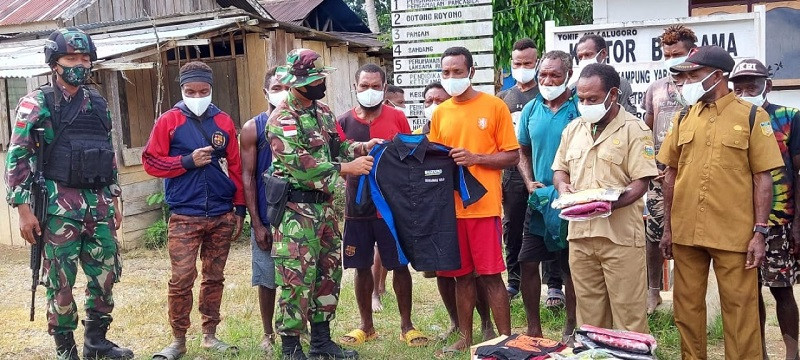
The TNI’s deployment in remote areas in Papua therefore must be balanced with implementation of the territorial role, which aims to bring welfare to the community.
Under the Papuan Special Autonomy Law, 80 percent of local revenues go back to Papua. However, local administrations have not maximized the huge budgetary allocation, leaving behind people living in remote villages.
Human development is part of the TNI’s territorial role, which certainly requires a synergy with other elements of the state, including health-related sectors, to implement. As we know, malnutrition and other health problems remain the chief challenges for people in remote and mountainous areas.
We have also learned that the KKB launched arson attacks on school buildings. The most damaging impact is that Papuan children are afraid of going to school and enjoying their basic right to education. The TNI can contribute to educational development by reconstructing school buildings and other public facilities.
The policy is in line with the TNI’s civic missions, as stipulated in Line (b) Article 7 of Law No. 34/2004 on the Indonesian Military. This article stipulates two types of TNI operations: (a) Military Operation to War (MOTW); and (b) Military Operation Other Than War (MOOTW).
Preparing reinforcement troops for combat operation is deemed necessary in anticipation of armed attacks that will endanger the life of Papuan civilians. However, deployment of combat troops is subject to coordination, cooperation, and communication with civilian authorities, in this case the police, and the consent of the local government.
As part of the TNI’s response to injustices felt by Papuans, all field commanders should implement stern measures against soldiers who commit violence against civilians.
Implementation of the TNI’s territorial role is a tangible manifestation of the fourth paragraph of the Preamble of the 1945 Constitution, which mandates the state to protect the entire nation and the homeland of Indonesian people, to advance public welfare, and to educate the nation.
The absence of security threats, effective civilian-military cooperation, good coordination between the TNI and the police in providing security to the local people, and the well-being of Papuans are a complete package that will spare Indonesia from internationalization of the Papuan issue.
***
The writer is deputy defense minister..