TheJakartaPost
Please Update your browser
Your browser is out of date, and may not be compatible with our website. A list of the most popular web browsers can be found below.
Just click on the icons to get to the download page.


Popular Reads
Top Results
No results found. Please check your search term and try again
Can't find what you're looking for?
View all search results
Popular Reads
Top Results
No results found. Please check your search term and try again
Can't find what you're looking for?
View all search resultsPhase out fossil fuel-fired electricity, embrace biomass energy
Biomass power generation is relatively more expensive than coal, but is actually quite competitive if compared with diesel fuel.
Change text size
Gift Premium Articles
to Anyone
Share the best of The Jakarta Post with friends, family, or colleagues. As a subscriber, you can gift 3 to 5 articles each month that anyone can read—no subscription needed!
T
he Russia-Ukraine war has caused the price of oil and other energy sources such as gas and coal to skyrocket and consequently increase the cost of electricity, notably in remote islands and isolated areas in Indonesia, which still depend mainly on diesel-generated power.
On the other hand, Indonesia currently holds the presidency of the Group of 20 this year pursuing the theme "recover together, recover stronger". One of the group’s focus programs is mitigating climate change through the development of renewable energy.
The transition into renewable energy targets three priorities; access, technology and funding. In Indonesia, there are many potential sources of renewable energy such as solar, wind, water, geothermal and biomass and the government has pledged to accelerate the phasing out of fossil fuels like coal and oil.
As a tropical country with year-round heat and high rainfall, Indonesia has great potential for energy-producing biomass both from forest and agricultural plantations. Unsurprisingly, Indonesia is often dubbed the Saudi Arabia of bioenergy because biomass plants grow very easily in this archipelago.
According to the Energy and Mineral Resources Ministry, Indonesia has a biomass potential of 50 gigawatts (GW). Meanwhile, the utilization of biomass energy, especially for electricity supply only amounts to 50 megawatts (MW). Therefore, efforts are needed to accelerate its utilization in line with the government's program to exit fossil fuels. Abundant biomass energy sources include rice, sugar cane, oil palm, wood and bamboo. All types of vegetation are utilizable as fuel in biomass power plants.
Several types of large-scale crops such as oil palm, rice and sugar cane can be integrated with the processing industry. Some plants can also be developed into energy plantations such as wood and bamboo where these plants are devoted to supply fuel to biomass power plants. Interestingly, biomass energy has an advantage because it is locally sourced.
Various technologies are applicable to generating electricity from biomass, nevertheless, thermal technology is the most feasible one to use considering its several advantages. There are three main schemes in thermal technology; combustion, gasification and pyrolysis. Some schemes combine the three technologies.
The first is a combustion technology whereby biomass is burned to produce heat to drive the turbine of an electricity-producing generator. In principle, there are four stages of the combustion process, namely the pre-treatment process, the combustion process, the energy recovery process and exhaust gas handling. Combustion technology is currently very mature and is widely used in several countries. However, this kind of combustion system can only be used on a large scale, so it is necessary to generate power that is concentrated at a point for a certain area.
The next is pyrolysis and gasification technology. Pyrolysis is an air-free heating process. The end product is liquid fuel or biofuel, which can later be connected to the generating system as in the combustion process. However, this pyrolysis technology is more focused on the production of liquid fuels than electricity, so there is not much development of this technology into electricity generation because of the length of the process to produce electricity.
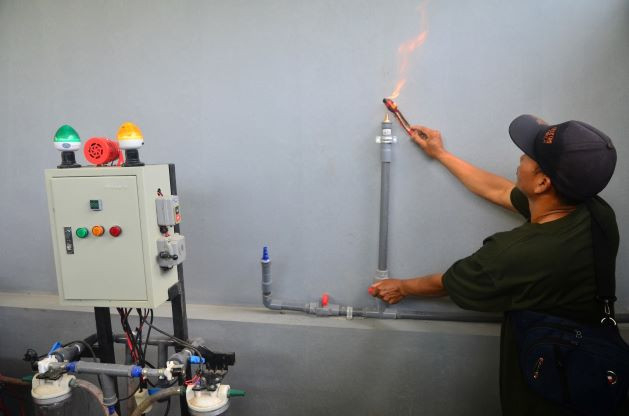
Gasification is a branch of thermal technology where biomass is mixed with air or limited oxygen at high temperatures to produce fuel gas, better known as syngas (synthetic gas). The resulting syngas is then used to drive the gas engine (as in commonly used generators) and generate electricity. Therefore, with this gasification technology, no emissions are produced from the process, emissions are only generated from the use of a gas engine where the exhaust gas will be like a diesel engine in general.
With the technological configuration as described above, it is possible to use gasification on a small scale. Gasification engines (gasifiers) and gas engines can be designed on a small scale with high efficiency.
However, there are only a few biomass-fired power plants that have been built and operated to date in the country. The reasons are, first, biomass power generation is relatively more expensive than coal, but is actually quite competitive compared with diesel fuel. Second, it is necessary to guarantee the supply of biomass at the site during operation. Therefore, the local community plays a very important role as a suppliers of biomass feedstock.
The development of a biomass power plant could also lead to more community involvement so that it can drive the local economy. The community can participate in cultivating biomass plants such as wood and bamboo as fuel to produce electricity. Therefore, apart from being able supply electricity, the community also gets an economic benefit with additional income from cultivating energy crops. This kind of mutually beneficial scheme will motivate the community to keep the generator operating properly.
In order to achieve good management and to maintain the relationship between the community and the power plant operator, the community needs to prepare better institutions to improve their power plant management. The Villages Law authorizes village heads to administer their areas with funding support from the central government, hence, many villages have established village-owned enterprises (BUMDes).
The Villages Law grants more authority to villages along with funding support from the central government for the management of their areas, so many village administrations have established BUMDes. These enterprises can be assigned to manage the biomass-fired power plants and the distribution of the power to the local community and ensure the supply of biomass to the plant.
Thus, all parties will benefit from this synergy.
***
The writer is director of the Center for Waste Management & Bioenergy and lecturer in the Mechanical Engineering Department, Janabadra University. The views expressed are his own.