TheJakartaPost
Please Update your browser
Your browser is out of date, and may not be compatible with our website. A list of the most popular web browsers can be found below.
Just click on the icons to get to the download page.


Popular Reads
Top Results
No results found. Please check your search term and try again
Can't find what you're looking for?
View all search results
Popular Reads
Top Results
No results found. Please check your search term and try again
Can't find what you're looking for?
View all search resultsCooking oil still too pricey to end ban
No quick resumption of CPO exports in sight as staple commodity price remains stubbornly high.
Change text size
Gift Premium Articles
to Anyone
Share the best of The Jakarta Post with friends, family, or colleagues. As a subscriber, you can gift 3 to 5 articles each month that anyone can read—no subscription needed!
T
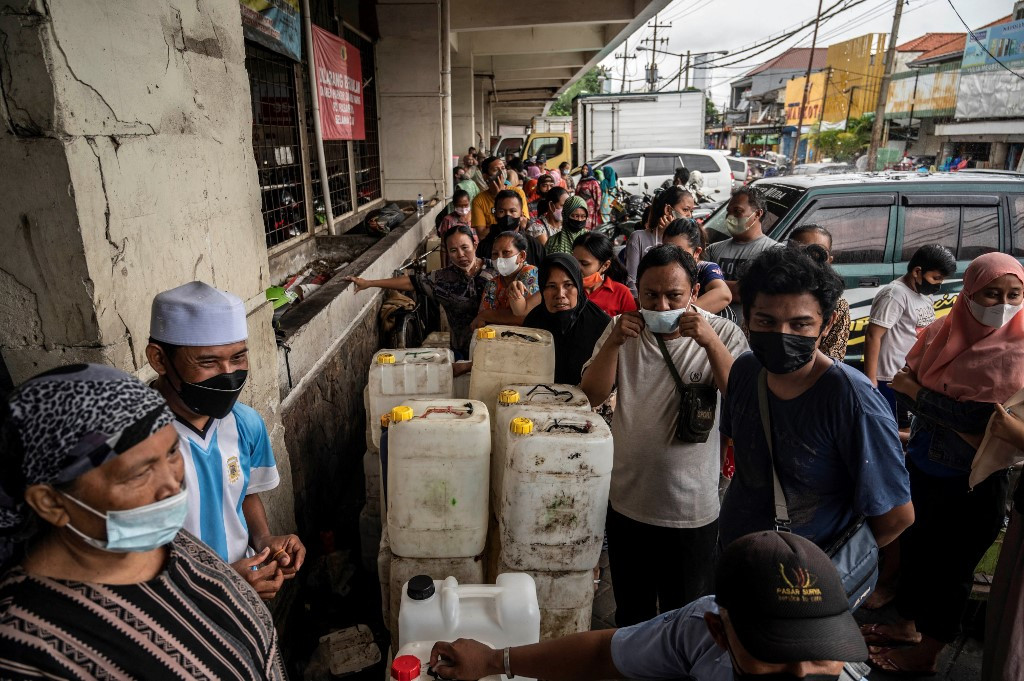
he price of cooking oil remains far above Rp 14,000 (US$0.97) per liter, a cap the government has said must be met in order for the palm oil export ban to be lifted.
Almost a week after the shipment of cooking oil and cooking oil materials – notably crude palm oil (CPO) – was suspended, the absence of a substantial decline in domestic market prices raises questions about the effectiveness of the ban.
The national average price of subsidized bulk cooking oil had dropped to Rp 17,200 per liter on Wednesday, Trade Ministry data show, which is down only 1.15 percent over the course of the week since the ban started, on April 28.
However, the ministry data also show that bulk cooking oil was still sold at Rp 18,491 per liter in Jakarta and even at prices surpassing Rp 20,000 per liter in other major provinces, like Banten and West Java.
“So far, the export ban has not had any big effect [on the bulk cooking oil price],” Indonesian Vegetable Oil Refiners Association (GIMNI) executive director Sahat Sinaga told The Jakarta Post on Thursday.
Read also: Indonesia to ban exports of cooking oil, ingredients
Coordinating Economic Minister Airlangga Hartarto said on April 27 that the export ban would remain in place until the bulk cooking oil price came down to Rp 14,000 per liter across Indonesia.
The ban is stipulated in Trade Ministry Regulation No. 22/2022, which was issued on April 27 and took effect the next day. The regulation imposes a widescale ban on the export of CPO and related products, including raw material for cooking oil like crude and refined palm oil as well as refined, bleached, deodorized (RBD) palm olein and used cooking oil.
The ban came after government efforts to stabilize the price of bulk cooking oil through multiple policy changes in the first quarter of the year proved insufficient to bring the price down to Rp 14,000 per liter.
The suspension of shipments abroad is aimed at increasing domestic supply and thereby pushing down the price for consumers at a time when economists warn of increasing inflationary pressure in Asia.
Read also: The shock is coming: Economists warn of inflation in Asia
“This temporary export ban aims to boost the availability of cooking oil raw materials, improve cooking oil supply in the country and lower the price of cooking oil to make it affordable,” Trade Minister M. Lutfi said in a statement on April 29.
GIMNI’s Sahat went on to claim that current policies would be to little avail in bringing down the bulk cooking oil price. He suggested the government involve the State Logistics Agency (Bulog) and state-owned staple food holding company FOOD ID to distribute the subsidized bulk cooking oil, and to give both firms fresh capital to ensure the success of the operation.
He estimated that the government would need to increase subsidized bulk cooking oil supply in the market to 250,000 tons this month to bring down the price. Increased and improved supervision of the distribution of cooking oil would also be vital, he said.
“If we could flood the market properly, then, at the end of May this year, in my opinion, the target set by Bapak President should be achieved and the export ban could be revoked by June 1, 2022,” Sahat said.
Sahat urged the government to act fast, arguing that a prolonged export ban would hurt oil palm farmers. He said storage tanks would remain full, potentially leaving oil palm harvests to rot amid an inability to sell the stocks. Meanwhile, he suggested, the government should increase the amount of CPO in biodiesel by mandating the use of B40 fuel instead of the current B30 requirement, arguing that that could be a solution both for farmers and in light of high oil prices.
Read also: Palm oil crisis shakes up Indonesia's politics, global supplies
Indonesian Market Traders Association (IKAPPI) chairman Abdullah Mansuri concurred, saying the CPO export ban had done little so far to lower the prices of either bulk or packaged cooking oil.
“In reality, we, traders, do not feel the impact of the export ban. In fact, bulk cooking oil – sold at the government's price of Rp 14,000 per liter – remains scarce,” Mansuri told the Post.
Similarly, the nonsubsidized packaged cooking oil, which is subject to market pricing, dropped only 2 percent over the past week to Rp 23,300 per liter on Wednesday, Trade Ministry data show that prices in several regions of Sumatra and Kalimantan are seeing higher prices at between Rp 24,000 and Rp 25,000 per liter.
“It is still far from our expectations,” Mansuri said.
He added that traders were urging the government to come up with a better solution, one that should be discussed beforehand with CPO producers to avoid further policy miscalculations due to “one-sided decision-making”.
Executive Office of the President undersecretary Panutan Sakti Sulendrakusuma defended the export ban, arguing that the policy had shown some positive impact on the availability and price stability of cooking oil, albeit not yet significant.
“The [bulk cooking oil price] is on a sloping and falling trend,” Panutan said in a statement on Wednesday.
He said the effect would become more apparent, saying: “It takes time to see the outcome. Moreover, the new policy has [only] been in effect for a week”.