TheJakartaPost
Please Update your browser
Your browser is out of date, and may not be compatible with our website. A list of the most popular web browsers can be found below.
Just click on the icons to get to the download page.


Popular Reads
Top Results
No results found. Please check your search term and try again
Can't find what you're looking for?
View all search results
Popular Reads
Top Results
No results found. Please check your search term and try again
Can't find what you're looking for?
View all search results24 years on, can we agree to realize a violence-free Indonesia?
There are, indeed, constant tensions between the youths aspiring for a change and the grown-ups aiming to preserve the status quo in Indonesian human rights history.
Change text size
Gift Premium Articles
to Anyone
Share the best of The Jakarta Post with friends, family, or colleagues. As a subscriber, you can gift 3 to 5 articles each month that anyone can read—no subscription needed!

A
lmost 77 years since independence and precisely 24 years after the Reform era, Indonesia's human rights history (or lack thereof) is filled with stories of tension. It is as if the respect, protection and fulfillment of basic human dignity are issues the nation cannot seem to agree on.
One of the strains that persistently emerge from time to time is between the youths and the grown-ups. On the one hand, the youths consistently demand justice and freedom, but on the other hand, the grown-ups look unfailingly reluctant (or even brazen) to embrace positive changes. Often, the youths are represented by students, while statespersons characterize the grown-ups.
During Sukarno's era, students organized the Tritura movement in 1966. Short for Tri Tuntutan Rakyat (Three Demands of the People), the Tritura movement was a response to Sukarno's “lighthouse politics” that prioritized confrontative foreign policies to improve Indonesia's international recognition, which, unfortunately, and in turn, brought adverse impacts to the domestic economy. Students, thus, demanded that Sukarno reshuffle his Cabinet and lower the prices of basic needs, among other ultimatums.
Unwilling to bow down altogether to the people's demands, Sukarno reacted forcefully. First, he deployed the Cakrabirawa Regiment, an elite presidential detail, to curb rally participants, which led to the fatal shooting of a medical student, Arif Rahman Hakim. Secondly, Sukarno disbanded a student organization he accused of being a “provocateur”, the Indonesia Students Action Forum (KAMI).
Thirdly, Sukarno signed the Order of March 11 (Supersemar), which ordered then-Army commander Soeharto and the military to restore “national order”. Ironically, Supersemar was used by the latter to delegitimize the former from the presidential position and began the Soeharto-led authoritarian New Order regime.
The New Order regime encountered its first youth-initiated protest in January 1974. The Malari protest, short for Malapetaka Lima Belas Januari (Jan. 15 Catastrophe), was started by students and young activists to demand, among other things, lower prices and corruption eradication.
Nevertheless, for reasons and by means similar to his predecessor, Soeharto responded with muscle. Reports state that the excessive use of force claimed 11 lives, wounded 130 to 300 civilians and led to the arbitrary arrest of between 750 and 775 people, including the late human rights activist and lawyer Adnan Buyung Nasution.
Nevertheless, one difference between Sukarno and Soeharto was that the latter could remain in power much longer, even after confronting a mass protest. Continued human rights abuse was critical to Soeharto's 32 years in power. Smaller-scale protests and criticisms were curtailed via censorships, tortures, kidnappings and killings.
It was not until 1998 that Soeharto faced another nationwide mass rally known as Reformasi (reform). After witnessing more than enough human rights abuses, students and activists worked hand-in-hand to demand democracy and respect, protection and the fulfillment of fundamental human rights and freedom.
Unfortunately, history repeated itself. Brute force was used to quell protestors at Trisakti University on May 12, 1998, killing four students and leaving more than 680 others injured, according to the Commission for the Disappeared and Victims of Violence (Kontras). Simultaneously, racially motivated riots, which many believe to be state-backed, occurred from May 13 to May 15, 1998, in multiple cities across the nation. Women of Chinese descent were raped and killed, and businesses presumed to be owned by people of Chinese descent were looted.
Eventually, Soeharto resigned on May 21, and many believed that a post-Reform Indonesia could be freer and more democratic. Unfortunately, the road to hell is paved with good intentions. Soeharto's successors seem unwilling to establish a more human rights-friendly Indonesia.
BJ Habibie failed to prevent the Semanggi II tragedy in September 1999, which claimed 11 lives and wounded 217 others. Megawati Soekarnoputri reinstated military operations and later martial law in Aceh after Habibie had revoked it. Megawati's predecessor, Abdurrahman Wahid, maintained it. Susilo Bambang Yudhoyono, in turn, failed to fully uncover the Sept. 7, 2004, assassination of human right defender Munir Said Thalib.
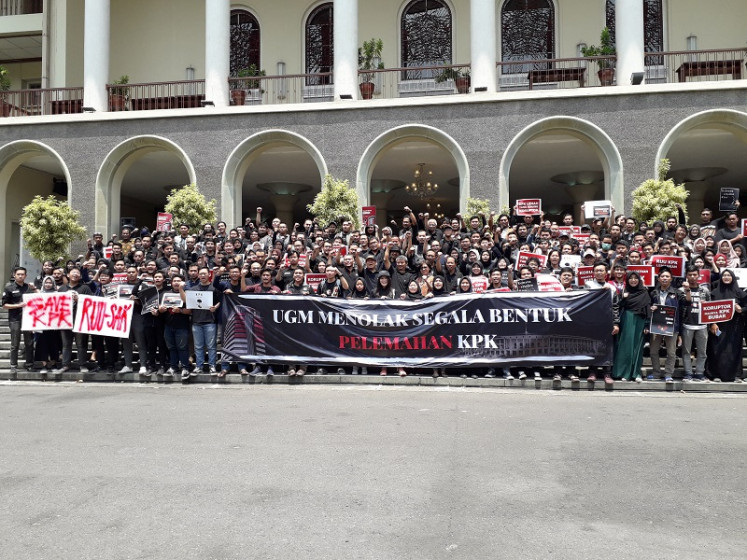
It took 21 years before Indonesia witnessed yet another youth-led national rally. In 2019, triggered by the government's plans to weaken the Corruption Eradication Commission (KPK), continued violence in Papua, unaddressed past abuses and potential harm that the Job Creation bill may bring, students across Indonesia staged demonstrations under the banner of the #ReformasiDikorupsi (Reform Corrupted) movement.
President Joko “Jokowi” Widodo, however, adopted an eerily similar approach to previous regimes: using force. As a result, Kontras records at least five deaths and around 390 violent incidents.
The instances mentioned above illustrate that there are, indeed, constant tensions between the youths aspiring for change and the grown-ups aiming to preserve the status quo in Indonesia's human rights history. Those having the slightest conscience can by now realize that the youths were the vanguards of nurturing freedom and neglecting violence. We were there and are here to stay.
The question, thus: Will the grown-ups continue to dismiss us and our goal of making a more democratic and human rights-amiable nation? Can the youths and the grown-ups finally agree that a freedom-nurturing and violence-neglecting Indonesia is the common pursuit?
***
The writer is coordinator of the Commission for the Disappeared and Victims of Violence (Kontras).