TheJakartaPost

Please Update your browser

Your browser is out of date, and may not be compatible with our website. A list of the most popular web browsers can be found below.
Just click on the icons to get to the download page.


Jakarta Post

Why North Natuna Sea zonation regulation matters

None of the Indonesian policies have been effective in preventing China from asserting its nine-dash line claim and its fisherman and coastguard vessels from entering the Indonesian exclusive economic zone (EEZ).

Aristyo Rizka Darmawan (The Jakarta Post)
Jakarta
Tue, June 28, 2022 Published on Jun. 27, 2022 Published on 2022-06-27T13:08:09+07:00

Change text size

Gift Premium Articles
to Anyone

Share the best of The Jakarta Post with friends, family, or colleagues. As a subscriber, you can gift 3 to 5 articles each month that anyone can read—no subscription needed!

E

arlier this year, President Joko “Jokowi” Widodo signed a new presidential regulation on the zonation of North Natuna Sea. Newly enacted Presidential Regulation No. 41/2022 aims to boost governance in the contested maritime area.

Indeed, the North Natuna Sea, the southern part of South China Sea, has become one of Jokowi’s most significant security and foreign policy challenges since he took office in 2014. With his second and final term nearly coming to an end, it remains to be seen whether the new regulation will become his long-lasting legacy.

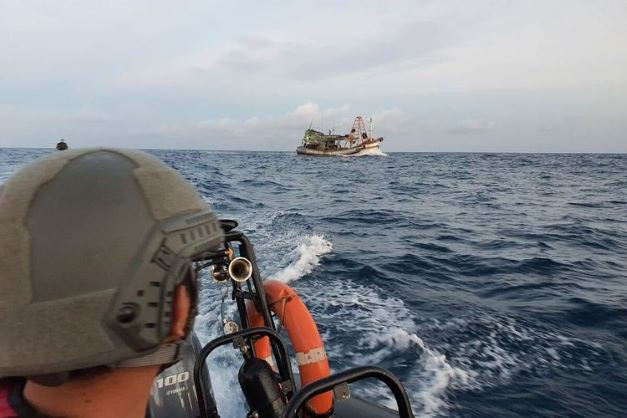
Throughout the Jokowi administration, there have been a number of policies that respond to escalating tension in the North Natuna Sea. The overlapping of Indonesia’s exclusive economic zone with China’s nine-dash line, for example, has often provoked a standoff between law enforcement agencies and navies of the two countries as well as threats to Indonesia’s fishermen.

Prior to the enforcement of the regulation, the Indonesian government had taken a variety of measures in response to the tension. Among the initiatives were Jokowi’s visit to North Natuna Sea to chair a meeting, sending a diplomatic note to Beijing asking for clarification, renaming the southern part of the South China Sea as the North Natuna Sea and deploying fishermen from Java to catch fish in the North Natuna Sea.

But none of the policies have been effective in preventing China from asserting its nine-dash-line claim and its fisherman and coastguard vessels from entering the Indonesian exclusive economic zone (EEZ).

One of the biggest challenges for Indonesia in safeguarding the North Natuna Sea from foreign vessels is the lack of resources, infrastructure and budget allocated for the law enforcement agencies. Critics insist the budget constraints should not justify the inadequate protection of Indonesia’s sovereignty and sovereign rights in the North Natuna Sea.

The state’s presence in the maritime territory, manifested not only by the law enforcement agencies but also civil society and commercial activities, is mandatory. In this regard, the new regulation serves as an important step to assure governance and presence in the North Natuna Sea, for at least two reasons.


First, the North Natuna Sea is one of the richest maritime areas in Indonesia. It boasts huge economic potential in diverse areas, such as natural resources, capture fisheries, aquaculture, marine conservation and marine tourism.

The new regulation divides the North Natuna Sea into several zones to ensure an effective and integrated location to develop each of these potentials. For instance, to maximize the sea’s capture-fisheries potential, the regulation stipulates establishment of more fisheries ports in the surrounding islands and development of a biotechnology center to maximize the fisheries recourses.

To maximize economic potential, investment in infrastructure is unavoidable. And with the new regulation, there would at least be a plan to develop the infrastructure most needed to boost economic activities and to attract domestic and foreign investment in the North Natuna Sea.

Second, the new regulation also put a strong emphasis on the defense sector. Article 13 of the regulation states that in the context of realizing defense and security zones as well as supporting regional security and defense stability, the regulation mandates creation of defense-areas management in an effective, efficient and environmentally friendly manner, improvement of the infrastructure and facilities for state defense and security to support national sovereignty and security of state borders.

It is also necessary for Indonesia to build sufficient defense and law enforcement infrastructure. Currently, three main law enforcement agencies hold the authority to patrol up until the Indonesia’s EEZ in the North Natuna Sea. They are the Indonesian Coast Guard (Bakamla), the Indonesian Navy and the Maritime Affairs and Fisheries Ministry. Therefore, coordination mechanism and resource distribution among the three institutions in the North Natuna Sea is very crucial.

As the government has entrusted Bakamla as the leading coordinator of law enforcement at sea, the coast guard should also coordinate maritime security efforts in the North Natuna Sea.

Another important and interesting aspect of the presidential regulation is its emphasis on the environmental aspect of maritime defense. It says the conduct of defense and security should take into consideration environment protection so as not to harm the ecosystem of the North Natuna Sea.

That being said, the regulation on zonation in the North Natuna Sea is very important for economic and defense purposes. It sets forth a clear plan on how to develop and maximize potentials in the area for the long term. With a clear long-term plan, hopefully the aforementioned budget constraints can be addressed.

Even though it is not yet proven whether or not the new regulations can effectively prevent conflicts with China’s nine-dash line claim, at least it has shown the government’s strong commitment to not only responding to any violation in the maritime area, but also how the government really has a plan to develop its presence in the area.

Last but not least, it is important to observe how the regulation is implemented in the next few years and really lives up to expectations.

 ***

The writer is a lecturer in international law at University of Indonesia with a MA in international law from the Fletcher School of Law and Diplomacy at Tufts University, United States.

Your Opinion Matters

Share your experiences, suggestions, and any issues you've encountered on The Jakarta Post. We're here to listen.

Enter at least 30 characters
0 / 30

Thank You

Thank you for sharing your thoughts. We appreciate your feedback.

Share options

Quickly share this news with your network—keep everyone informed with just a single click!

Change text size options

Customize your reading experience by adjusting the text size to small, medium, or large—find what’s most comfortable for you.

Gift Premium Articles
to Anyone

Share the best of The Jakarta Post with friends, family, or colleagues. As a subscriber, you can gift 3 to 5 articles each month that anyone can read—no subscription needed!

Continue in the app

Get the best experience—faster access, exclusive features, and a seamless way to stay updated.