TheJakartaPost
Please Update your browser
Your browser is out of date, and may not be compatible with our website. A list of the most popular web browsers can be found below.
Just click on the icons to get to the download page.


Popular Reads
Top Results
No results found. Please check your search term and try again
Can't find what you're looking for?
View all search results
Popular Reads
Top Results
No results found. Please check your search term and try again
Can't find what you're looking for?
View all search resultsSeventy-seven years of independence, but are we free of colonialism?
On the occasion of our 77th independence anniversary, can we truly say that the vestiges of our colonial past have been eradicated structurally, institutionally and mentally?
Change text size
Gift Premium Articles
to Anyone
Share the best of The Jakarta Post with friends, family, or colleagues. As a subscriber, you can gift 3 to 5 articles each month that anyone can read—no subscription needed!
O
n Aug. 17, like in many places around the nation, my residential complex went into a frenzy of activities and festivities in anticipation of Indonesia’s 77th Independence Day, on and after the day. There had been no celebrations for the last two years due to the COVID-19 pandemic, so the euphoria was understandable.
As my mother had just died on Aug. 9, I was not exactly in a gregarious or celebratory mood and didn’t join the festivities. I was more in a solitary, somber and reflective mood, which is a good way to be on anniversaries anyway.
I remembered Sukarno’s Independence Day speech on Aug. 17, 1966, his last as president. It was called “Jasmerah”, which literally means “red jacket”, but is actually an acronym from jangan sekali-sekali meninggalkan sejarah, meaning, “don’t ever leave history behind”; in other words, don’t forget history.
In his speech, Sukarno predicted that Indonesia would face times of strife, even civil war. A premonition of his own fate? On March 11, 1966, he signed the infamous and controversial Supersemar (Surat Perintah Sebelas Maret), which marked the beginning of the slow, sure and sly coup d’etat by Gen. Soeharto. On Feb. 20, 1967, Sukarno was stripped of all his titles and made to sign a document that transferred power to Soeharto, making him the head of government and giving him unlimited powers in a “state of emergency”.
Up to now, the Supersemar is shrouded in mystery, as the original document on the presidential letterhead has never been found. So was Soeharto’s militaristic and authoritarian 32-year New Order rule illegitimate from the start?
Sukarno’s admonishment in his Jasmerah speech is still relevant for Indonesia in 2022, that we should remain vigilant in the face of threats disguised as decisions made “for the good of the people”.
Indonesia proclaimed independence in 1945 from Japanese military rule, after it had been a Dutch colony for 250 years. But are we free from colonial structures, institutions and mentalities?
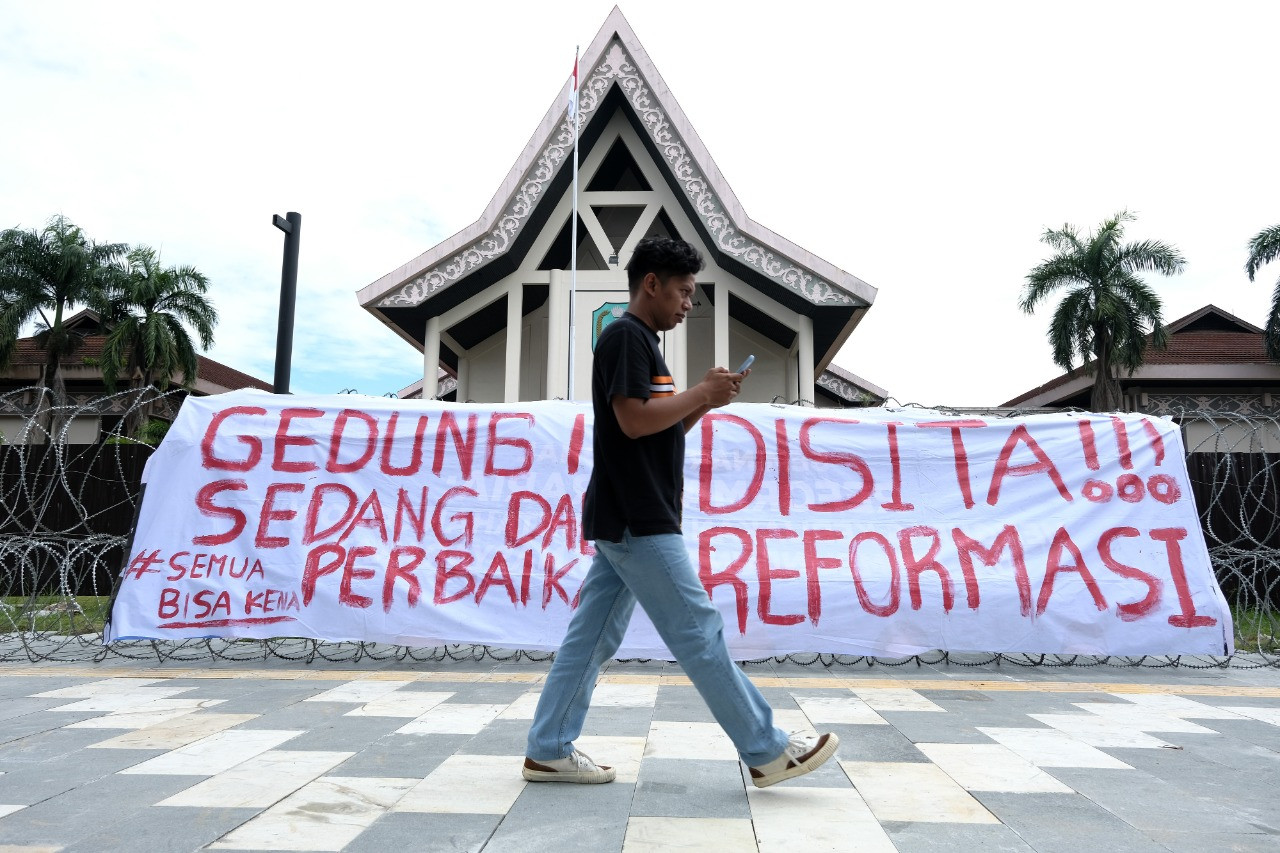
The Draft Criminal Code (RKUHP) is one example related to the above two points. It first generated controversy when the contents were made public in 2019, triggering widespread demonstrations across the country. Concerns were raised over various articles related to blasphemy, a lèse-majesté article that criminalizes insulting the president, cohabitation, adultery and others, which could be used against religious and sexual minorities and to clamp down on civil liberties in general.
According to Human Rights Watch researcher Andreas Harsono, “Indonesia’s Draft Criminal Code reflects the growing influence of Islamism, as many Islamists consider it to be the crown jewel of what they claim to be sharia law. […] It will be disastrous, not only for women and religious and gender minorities, but for all Indonesians.”
Further revisions were made since 2019 but not released to the public, which raises questions about transparency. So what’s new?
The latest version of the RKUHP, “submitted by the government to the legislative body for speedy deliberation on Wednesday still retains several ‘colonial’ provisions that critics say will further curtail civil liberties in the country” (The Jakarta Post, July 7, 2022).
Ironically, the revisions were made to update the existing Criminal Code (KUHP), codified in 1946 but which in fact dates back to 1918 during the Dutch colonial period.
Hey, why not just make a new, homemade penal code rather than revise something that is clearly outdated and not relevant to our times? Duh. This is the 21st century for heaven’s sake. The realities of today and the future are far removed from that of colonial times, no?
Clearly, passing a bill or creating a new law should not be akin to a cat-and-mouse game. This is also what happened with the passing of the Omnibus Law on Job Creation in October 2020, when the government and the legislature outmaneuvered the people.
Other than the KUHP, what else in Indonesia still retains vestiges of colonial times? Plenty.
The haatzaaiend artikelen (hate speech articles) are still in force and used to launch actions against libel. According to Shidharta (Binus University, 2018), these articles are widely distributed in the Criminal Code, such as in articles 134, 136, 137, 154, 155, 156, 157, 160, 161, 207 and 208. One article that has recently been highlighted is Article 155 of the Criminal Code, similar to Article 260 in the Draft Criminal Code, which is said to be soon to be approved by the legislature. With Article 260 in the RKUHP, it is expected that haatzaaiend artikelen will continue to exist as part of Indonesia’s positive laws.
Despite the country having gone through economic booms and technological advances, colonially induced patriarchy is still in force, as seen in gender relations and local systems of authority, even within the male hierarchy.
According to the United Nations, Indonesia has the highest gender inequality of all ASEAN nations. There is not even sex-aggregated data, which has resulted in “an incomplete picture of women’s and men’s lives and the gaps that persist between them” (The Jakarta Post, March 8, 2022). Child marriage is still prevalent, as is stunting at a staggering 37 percent for children under 5. That is one child out of three, folks, meaning that Indonesia has one of the world’s highest burdens of child stunting and wasting. What a tragedy!
In a Muslim-majority country like Indonesia, homosexuality is condemned, yet there are also colonially induced rules on homosexuality that are still in force, e.g. raids on homosexuality. Between 1938 and 1939, massive raids were conducted on homosexuality, also known as zendenschandaal (moral scandals), during which Indonesians were used to eradicate homosexuality. This moral panic, also against adultery and prostitution, is still very much the norm today.
Present-day social stratification is similar to that in colonial times. In the past, the upper strata were the Europeans, then Vreemde Oosterlingen, non-European foreigners such as Chinese, Arabs, Indians and Pakistani, and the lowest were the brown-skinned inlander (natives). Social stratification in contemporary Indonesia is based on religion, with Muslims at the top, followed by adherents of the recognized religions (Catholicism, Protestantism, Buddhism, Hinduism and Confucianism) and at the bottom, Shia and Ahmadi, who are considered deviant.
There is also a cringe factor related to Western knowledge and civilization. Indonesians still have a chip on their shoulders with regard to the perceived superiority of Western science and knowledge. On the other hand, foreign languages, especially English, are considered superior while not much attention is paid to upgrading Indonesian and writing literature in local languages.
Contradiction or what? Sigh!
Let me end on a positive and bright note so that we can still be proud after 77 years of independence. Despite all these drawbacks and deficiencies, “the International Monetary Fund has painted an optimistic outlook for Indonesia, which has fared better than other countries in withstanding the shocks of the pandemic and Russia’s war in Ukraine” (The Jakarta Post, July 19, 2022).
Merdeka! (Freedom!)
***
The writer is director of the Gender and Democracy Center at the Institute for Social and Economic Research, Education and Information (LP3ES).