TheJakartaPost
Please Update your browser
Your browser is out of date, and may not be compatible with our website. A list of the most popular web browsers can be found below.
Just click on the icons to get to the download page.


Popular Reads
Top Results
No results found. Please check your search term and try again
Can't find what you're looking for?
View all search results
Popular Reads
Top Results
No results found. Please check your search term and try again
Can't find what you're looking for?
View all search resultsIn Bali, G20 countries agree on need to fix global trade
Proud of accomplishments, host says, despite lack of joint statement.
Change text size
Gift Premium Articles
to Anyone
Share the best of The Jakarta Post with friends, family, or colleagues. As a subscriber, you can gift 3 to 5 articles each month that anyone can read—no subscription needed!
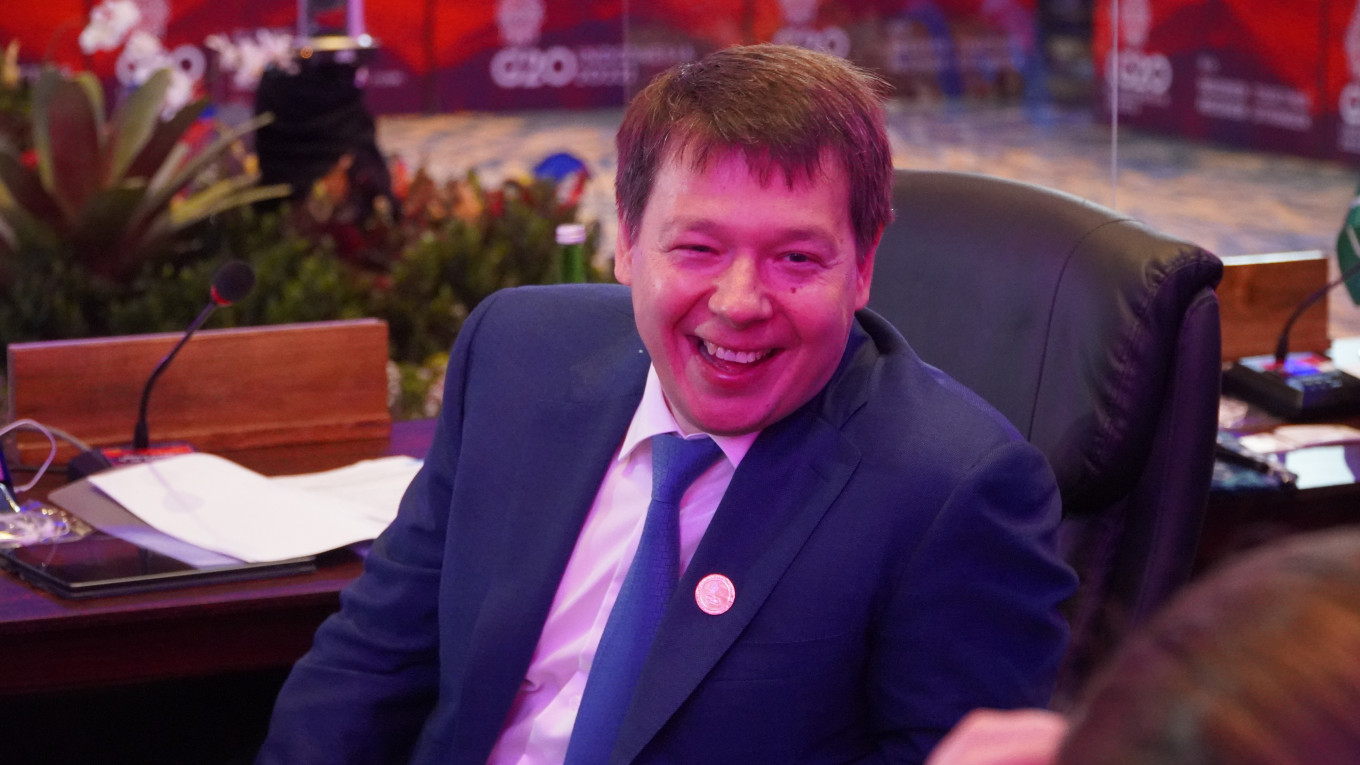
Despite deep fissures in global politics, Indonesia as the host country of the Group of 20 Trade, Investment and Industry Ministerial Meeting (TIIMM) in Bali got all member countries to agree on the need to reform the World Trade Organization (WTO).
Moreover, Jakarta hopes that what it calls the Bali Compendium, which it introduced, gives it the upper hand in a dispute on nickel exports.
While failing to produce a joint statement as it closed on Friday, the TIIMM saw the participating ministers agree on several aspects that it is hoped will improve rules of international trade and investment.
“We must be grateful and proud for achieving numerous concrete accomplishments in today’s G20 meetings,” Trade Minister and TIIMM chairman Zulkifli Hasan said on Friday.
First and foremost, Zulkifli praised the G20 countries for unanimously backing WTO reform.
“The G20 states have emphasized the importance of strengthening the fundamental principles of the WTO and have agreed that WTO reform is the key to reinforcing confidence in the multilateral trading system,” said Zulkifli.
Moreover, Zulkifli revealed that the state members had agreed on the idea that multilateral trade was the key ingredient for reaching sustainable development goals (SDGs), which was in line with a separate meeting chaired by Indonesia’s investment minister.
“G20 states must join hands to solve global supply chain issues and achieve the SDGs, especially goals number one and two, namely reducing poverty and the war on hunger,” said TIIMM co-chairman and Investment Minister Bahlil Lahadalia in his opening remarks on Thursday.
Bahlil revealed that the state members were initially at each other’s throats on the discussion of downstream investment but managed to reach a consensus by the end of the meeting.
“[It is important] to optimize natural resource policies, just as developed countries did when stepping up the ladder [of development] in the era of the early industrial revolution,” Bahlil said.
“Is it fair for developed countries to have stepped up the ladder to reach the top, and now emerging countries are not allowed to step up the same ladder?” he asked, emphasizing how important it was to resolve the issue of downstream investment.
Bahlil pointed out that the only issue brought up by the Investment Ministry on which no consensus was reached in the meetings was carbon pricing. Zulkifli, for his part, also revealed on Friday that only one proposal on trade failed to produce agreement.
“All the issues brought to the table have been agreed on, except for one, and that’s why this [overall] meeting has not resulted in a consensus […] there won’t be a joint statement [because] one of 27 [paragraphs] was not agreed on,” said Zulkifli in a press conference.
He explained that that one paragraph was related to geopolitical tension between the Group of Seven (G7) and Russia on the Ukraine war.
“[Russia] argued that logistics [in global trade] were disrupted because of the economic sanctions, while the [West] defended itself, [arguing the sanctions were necessary] because the other side had decided to go to war,” said International Trade Cooperation director general Djatmiko Bris Witjaksono.
“Politics sneaked into the discussion where we should have just focused on the economy,” he added. “It’s not our job to be the peacemaker.”
Despite the lack of a joint statement, the trade meetings got all sides to agree on the following: policy coherence on trade, investment and industry; the need to involve those three sectors in global cooperation on health care; and the necessity to increase emerging countries’ participation in digital trade and global value chains.
In meetings on investment, the delegates also agreed on mandatory involvement of local businesses or state-owned enterprises (SOEs) for inbound investment and wrapping up work on a G20 members’ frame of reference for investment policy known as the Bali Compendium, which elicited unanimous agreement on day two of the TIIMM.
Bahlil explained that the Bali Compendium would serve as a policy reference for strategies to attract sustainable investment and allow countries to formulate policies to benefit from comparative advantages. The minister took this to apply to Indonesian policies aimed at developing downstream industries such as by banning certain commodity exports.
Investment Coordinating Board (BKPM) spokeswoman Tina Talisa told The Jakarta Post that the Bali Compendium was to be finalized this week at the latest.
“Essentially, all the substance of the Bali Compendium is already agreed on, and it will be published and finalized by the United Nations Conference on Trade and Development. All that is left to do is the packaging, like the cover, for example,” Tina said on Friday.