TheJakartaPost

Please Update your browser

Your browser is out of date, and may not be compatible with our website. A list of the most popular web browsers can be found below.
Just click on the icons to get to the download page.


Jakarta Post

Agritech firms offer farmers helping hand

Homegrown start-ups strive to convince smallholders to go new ways.

Deni Ghifari (The Jakarta Post)
Jakarta
Tue, November 22, 2022 Published on Nov. 21, 2022 Published on 2022-11-21T18:41:26+07:00

Change text size

Gift Premium Articles
to Anyone

Share the best of The Jakarta Post with friends, family, or colleagues. As a subscriber, you can gift 3 to 5 articles each month that anyone can read—no subscription needed!

I

ndonesian tech firms are proposing new ways to make farming more efficient at a time when food security is causing headaches around the world, but the start-ups have some convincing to do to get farmers on board.

Beleaf Farms, an agriculture technology (agritech) start-up based in Bogor, West Java, says viewing farming as a service is key to optimizing processes with the fundamental idea of producing more with less.

“We can help farmers all across Indonesia to improve the quality and productivity of their crops and thus provide more food with the same amount of land to our population,” said Beleaf Farms CEO and founder Amrit Lakhiani.

Eighty million of the 120 million hectares of forests in Indonesia have been degraded, Defense Minister Prabowo Subianto stated recently, adding that if the country converted 16 million of that land into food production areas, it “could be the breadbasket of the world”.

“This existential threat and, let us say, ecological or environmental disaster, we can turn into an environmental opportunity and food opportunity for the world. […] Nature has given us this, let us say, comparative advantage,” Prabowo said at the Global Food Security Forum on Nov. 13.

Notwithstanding that potential, a projection by BPS and Euromonitor forecasts that Indonesia’s agriculture sector will achieve a mere 4 percent in compound annual growth until 2026, while farming costs are expected to rise because of an insufficient adoption of technology, a reduction in the farming workforce and logistical inefficiencies.

Read also: G20 agriculture ministers to improve global food security and nutrition

Lakhiani said the notion behind Beleaf was to work with underperforming farms to improve their yields, quality, productivity and profitability by evaluating operations, providing quality inputs, bringing technology to bear and having an agronomist pay the farmers weekly visits.

On top of that, Beleaf has its own farms for research and development to find optimal methods of growing specific crops and then share that know-how with the farmers it works with. The start-up also acts as an off-taker of its clients' produce, so that, in Lakhiani’s words, “the farmers only have to focus on the actual farming.”

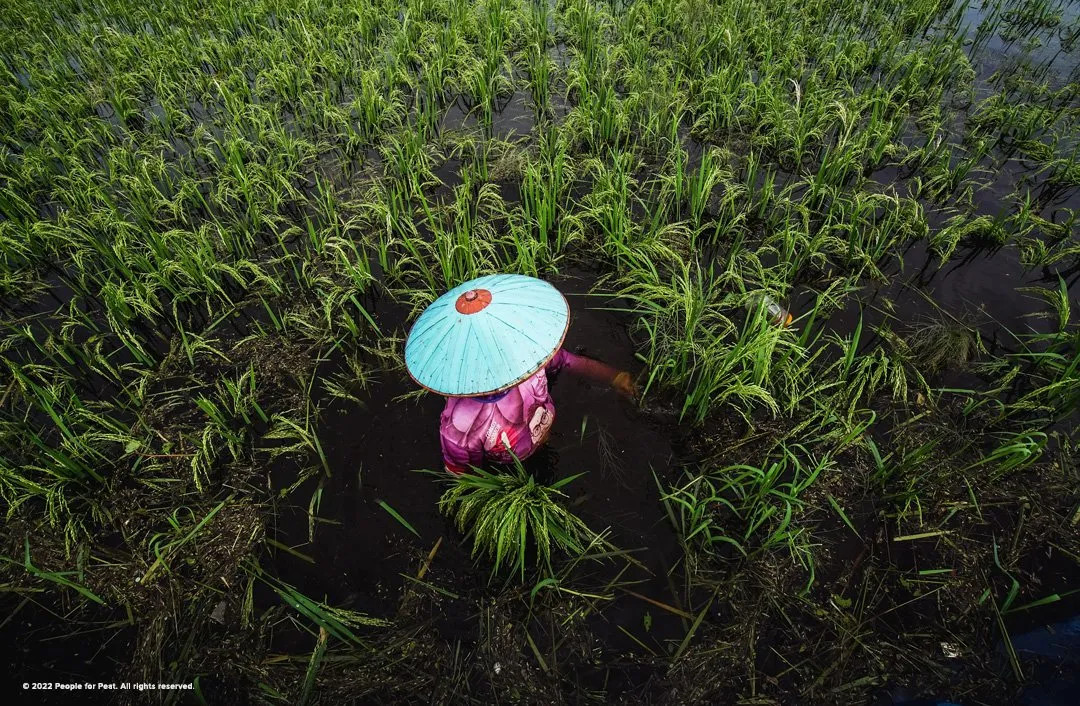
Rural regions of Indonesia have seen an exodus of farmers in recent years, which has reduced the production of crops significantly and rendered the archipelago dependent on imports for many commodities, which then enter the market at high prices and often low quality due to the lengthy journey.

“Every year, approximately 1 million farmers leave to find better-paying jobs in nearby cities. Most farmers in Indonesia are smallholders and thus only have small plots of land to work with. This prevents them from getting financing, technology and direct access to clients,” said Lakhiani.

“Beleaf Farms' farming-as-a-service [approach] is the solution to this problem. We have begun operations in three areas and hope to grow quickly and eventually be able to help millions of farmers across the country,” he added.

The biggest challenge, Lakhiani said, lay with the adoption of technology by farmers, as many felt it was “too much of a hassle or tedious”, despite the benefits it could have for productivity.

Echoing that conviction, Pitik CEO and cofounder Arief Witjaksono said the biggest challenge in Indonesia’s poultry sector was the adoption of digital innovation, which he attributed to a lack of human capital.

“Apart from that, there also is the factor of a lack of capital, which stunts technological development in this sector, especially from the farmers’ side. In response to this challenge, Pitik offers activation of smart farming and internet of things [IoT] [technology] for free to our farmer partners,” Arief said.

Founded in July last year, Pitik focuses on optimizing poultry farming using technology that the start-up offers to small-scale farmer partners, whom the company refers to as Kawan Pitik (Pitik Friends).

“The food crisis is very real. People think that war is about bombs and flying missiles, but food now is a weapon. I think Pitik has a real role in fixing this situation, because our goal is to optimize the chicken feed supply chain,” said Arief.

Read also: Tempeh, cassava 'the answer’ to staple-food insecurity

He explained that feed accounted for around 60 percent of poultry farming costs and claimed his start-up’s technology, which ranges from IoT to cameras for monitoring chickens’ behavior, could reduce the total cost of feed by as much as 12 percent.

Pitik currently works exclusively on the island of Java, given that the majority of Indonesian chicken comes from there. Arief said Pitik currently helped more than 400 farmers manage some 8 million chickens.

Much like Beleaf, Pitik purchases 100 percent of what its farmers produce, which it then sells as a finished product to the market, be it through brick-and-mortar retailers like Transmart or online ones such as Bukalapak, Segari and Sayurbox.

Indonesia’s poultry sector has recently experienced significant price volatility, which Arief said was the result of excess supply from aggregators and decreasing demand due to inflation.

In a bid to resolve that, Arief said, Pitik was developing a technological solution to gauge supply and demand and would use that information to advise farmers on optimal times to harvest and go to market.

“We can help in that because we have an overview of the market and we are developing the technology. Hopefully, we can launch it next year,” said Arief.

Your Opinion Matters

Share your experiences, suggestions, and any issues you've encountered on The Jakarta Post. We're here to listen.

Enter at least 30 characters
0 / 30

Thank You

Thank you for sharing your thoughts. We appreciate your feedback.

Share options

Quickly share this news with your network—keep everyone informed with just a single click!

Change text size options

Customize your reading experience by adjusting the text size to small, medium, or large—find what’s most comfortable for you.

Gift Premium Articles
to Anyone

Share the best of The Jakarta Post with friends, family, or colleagues. As a subscriber, you can gift 3 to 5 articles each month that anyone can read—no subscription needed!

Continue in the app

Get the best experience—faster access, exclusive features, and a seamless way to stay updated.