TheJakartaPost
Please Update your browser
Your browser is out of date, and may not be compatible with our website. A list of the most popular web browsers can be found below.
Just click on the icons to get to the download page.


Popular Reads
Top Results
No results found. Please check your search term and try again
Can't find what you're looking for?
View all search results
Popular Reads
Top Results
No results found. Please check your search term and try again
Can't find what you're looking for?
View all search resultsF&B merchants bemoan ‘too high’ delivery platform fees
Online platforms have fundamentally changed the way food outlets operate, offering merchants wide market access on the one hand but also increasing competition on the other, while taking a sizeable chunk out of merchant's revenues in platform fees.
Change text size
Gift Premium Articles
to Anyone
Share the best of The Jakarta Post with friends, family, or colleagues. As a subscriber, you can gift 3 to 5 articles each month that anyone can read—no subscription needed!
T
he decade-long rise of online food delivery platforms has fundamentally changed the way food outlets operate, creating joy for some merchants but resentment for others.
On the one hand, merchants rely on these platforms to reach more potential customers; on the other, platforms put small businesses in fierce competition with one another while demanding sizeable fees from merchants to generate revenue.
The three biggest players, GoFood, GrabFood and ShopeeFood, charge platform fees of at least 20 percent per item, an amount some merchants say they find agreeable but others say greatly impacts their performance.
“It’s 50:50 when it comes to whether or not the [platform fee] is fair, because we have no say in the fees a certain platform [charges]. But at the same time, that platform is of central importance for micro, small and medium enterprises [MSMEs],” says 24-year-old entrepreneur Bryan (not his real name).
Most merchants add 20 percent to the prices of items they sell on these platforms to maintain profit margins, which can make their products less affordable for customers.
Read also: High e-commerce fees squeeze small F&B firms’ margins
Bryan, who sells his Satebox product to customers directly for Rp 25,000 (US$1.62), said he had no choice but to mark up the price to Rp 30,000 for delivery platforms. He added that that price tag had turned some customers off, as the figure looked “psychologically more expensive because it starts with a three”.
Farhan Fadlillah concurs with Bryan, saying that the 20 percent platform fee makes his products unaffordable for customers, who also pay delivery fees on top of their food orders.
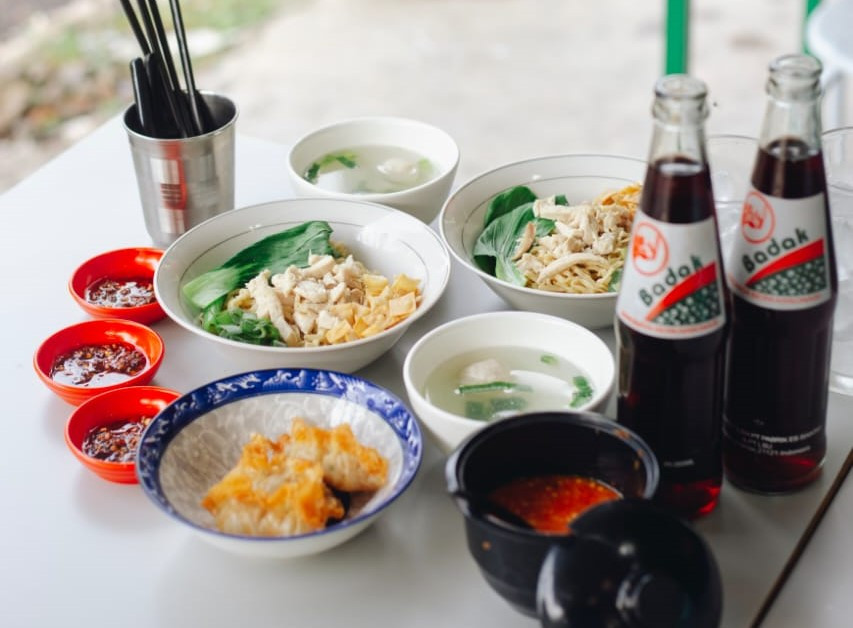
Farhan sells Chinese noodles called Sadjang Bakmie at his brick-and-mortar store in Bogor, West Java, and for customers further afield, he relies on GoFood, the food delivery arm of tech giant PT GoTo.
He also complained that, on top of the 20 percent revenue share, merchants had to pay an additional Rp 1,000 per item.
Farhan said 20 percent was “inappropriate, because it is too high for MSMEs”, and instead suggested that 10 percent would be more agreeable.
Both Farhan and Bryan admitted that the platforms helped them reach a larger number of customers than they could conventionally, but that the increased market access came with fierce competition.
Read also: B20 Trade & Investment Task Force: MSME empowerment key to global economic recovery
Yumilda Yunis, a food and beverage (F&B) entrepreneur who sells se’i sapi (a type of smoked beef from Kupang, East Nusa Tenggara) under the Mil’s Kitchen brand, believes that the 20 percent platform fee is fair.
Her business model differs from that of other eateries, however. Before joining a food delivery platform, she used to deliver her dishes in person to offices in Jakarta.
“Twenty percent is fair enough for me; it’s worth it,” said Yumilda, as selling online was more efficient and cost-effective for her, saving both time and physical energy.
“In my opinion, the app is very helpful for household businesses,” she added. Yumilda acknowledged that she had an advantage, however, given that her business sold a unique product and had few competitors.
Ahmad Fadhrois, who is known by his nickname Bang Ois, or “brother” Ois, was of the same mind as Yumilda, saying that the delivery platforms helped merchants save on capital that would otherwise be put toward offline stores.
At the same time, however, he said the competition online was relentless. “It all depends on [merchants] offering promotional deals to boost” digital transactions, he said.
The 26-year-old entrepreneur, who runs two F&B businesses, said delivery platforms were very helpful in boosting the revenues of MSMEs, since online sales could exceed offline sales.
“When a restaurant or a business has a big market online, it is very good [for sales]. To use a street term, it’s gacor [very lucrative],” said Ois, who also believes that the 20 percent platform fee is fair and “makes sense”.
He noted that “people are dependent on these platforms because they are very helpful, especially for those who want to order food they crave from stores that are too far away”.