TheJakartaPost
Please Update your browser
Your browser is out of date, and may not be compatible with our website. A list of the most popular web browsers can be found below.
Just click on the icons to get to the download page.


Popular Reads
Top Results
No results found. Please check your search term and try again
Can't find what you're looking for?
View all search results
Popular Reads
Top Results
No results found. Please check your search term and try again
Can't find what you're looking for?
View all search resultsPerry seen as guarantor of stability at central bank
BI governor’s second term would ensure policy continuity.
Change text size
Gift Premium Articles
to Anyone
Share the best of The Jakarta Post with friends, family, or colleagues. As a subscriber, you can gift 3 to 5 articles each month that anyone can read—no subscription needed!
E
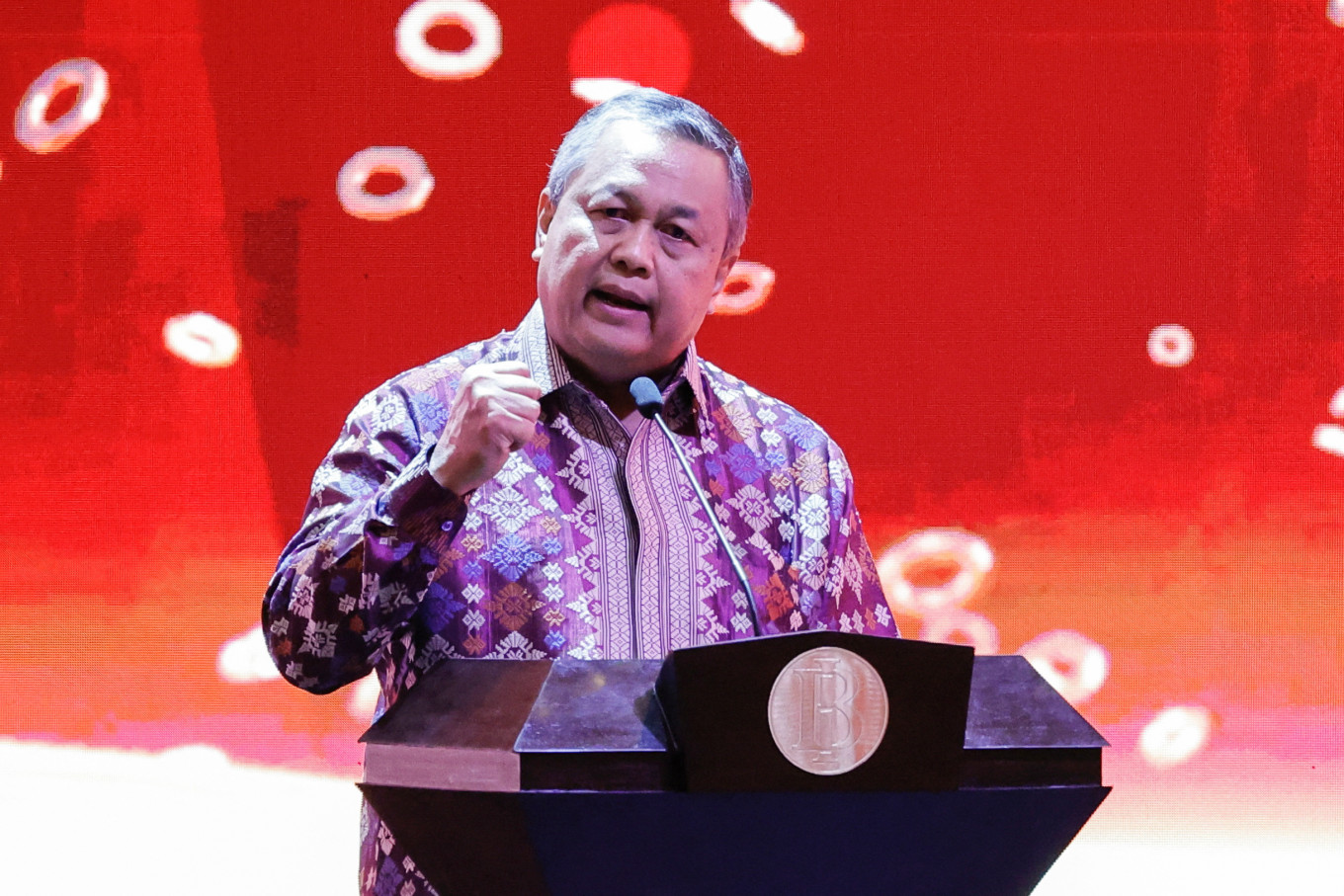
conomists say President Joko "Jokowi" Widodo's decision to nominate Bank Indonesia (BI) Governor Perry Warjiyo for a second five-year term in office signals continuity in monetary policy ahead of next year’s presidential elections, but not all agree that that is a good thing.
Most experts have welcomed the stability the move promises to provide for the national economy amid uncertainty on the global stage, but some have expressed discomfort, arguing that the central bank needs a new figure with a more progressive monetary vision.
According to the chairman of the House of Representatives budget committee, Said Abdullah, Jokowi has sent Perry's name to the House as his sole candidate for the post. Lawmakers are expected to deliberate on the appointment when they return from recess on March 13.
Jokowi confirmed the news when speaking to journalists at the site of the new capital city on Thursday and stressed the need for “synergy of monetary and fiscal policy” to overcome the impact of the global economic crisis.
“We have to choose a figure with a lot of experience,” Jokowi said, as quoted by Antara.
A governor’s reappointment to a second term in office is a rarity in the central bank's history.
Rully Wisnubroto, a senior economist at Mirae Asset Sekuritas, said Perry had a good track record and "more than enough" experience in devising monetary policy, especially safeguarding the stability of the national economy during the pandemic.
BCA chief economist David Sumual concurred, opining that financial markets needed a figure who could instil public confidence and maintain stability.
"Perry has vast experience. We saw good coordination [between him] and the Financial System Stability Committee (KSSK), as well as regional governments. Thus, inflation could be brought under control," David told The Jakarta Post on Thursday.
However, Center of Economic and Law Studies (CELIOS) director Bhima Yudhistira expressed concern about Perry's renomination, arguing that it would be better for a fresh figure to lead BI. He contended that many executives from the central bank had the "vision" and "bravery" to navigate post-pandemic economic uncertainty.
"Perry still tails the [United States Federal Reserve’s] interest hike policy and proved too slow in requiring exporters to store their [foreign currency] receipts in the country," Bhima told the Post on Thursday.
Read also: BI stops hiking interest rates after months of hawkish stance
All economists asked by the Post agreed that whoever became the BI governor in May would face major challenges in maintaining the stability of the rupiah while facilitating growth, given that many of the nation's economic risks stemmed from outside the country.
"The monetary policies of central banks in other countries are unclear. We don't know whether they will keep interest high for a longer period or reduce it next semester," BCA's David said.
Perry's leadership of the central bank has drawn praise from many economists who say his monetary policy resulted in high economic growth and manageable inflation.
"We usually call Perry 'jamu manis, jamu pahit' (sweet and bitter herbal drink), meaning his moves are quite balanced," David said, noting that the rupiah was one of the best-performing emerging market currencies this year.
Central bank independence in a political year
Some critics have questioned Perry’s performance in defending the central bank’s independence. CELIOS' Bhima pointed to the so-called burden-sharing policy, where BI agreed to buy government bonds at a maximum coupon rate to fund healthcare and social spending in response to the COVID-19 outbreak, as a stance that was "too obedient to the government."
"Bank Indonesia needs an unequivocal figure [who dares to say] that its independence cannot be influenced by government intervention and is brave enough to stop 'money-printing' through government bond purchases, as that adversely impacts inflation and becomes a long-term burden for the central bank," Bhima said.
Read also: BI to impose new policy to keep export earnings at home
BCA's chief economist David said empirical studies had shown negative economic impacts in countries where central bank independence had been undermined.
"One of the examples is what happened in Turkey, where the central bank decided to lower the interest rate despite rising inflation due to political pressure. It resulted in even higher inflation," David said.
However, David contended that Perry was a professional figure who had no affiliation with any political party and said he was confident that BI would not get involved in a political tug-of-war prior to the presidential election.
David also praised Perry for implementing the BI-FAST and QRIS initiatives after thoroughly studying the digital payment systems.
Perry, who will turn 64 on Saturday, began his career at the central bank in 1984. He secured a deputy governor position in 2013 before being promoted to the governor's post in 2018.
He also served as an executive director at the International Monetary Fund, representing 13 member countries under the auspices of the Southeast Asia Voting Group from 2007 to 2009.