Can't find what you're looking for?
View all search resultsCan't find what you're looking for?

View all search resultsAnalysts call out AUKUS for double standards.
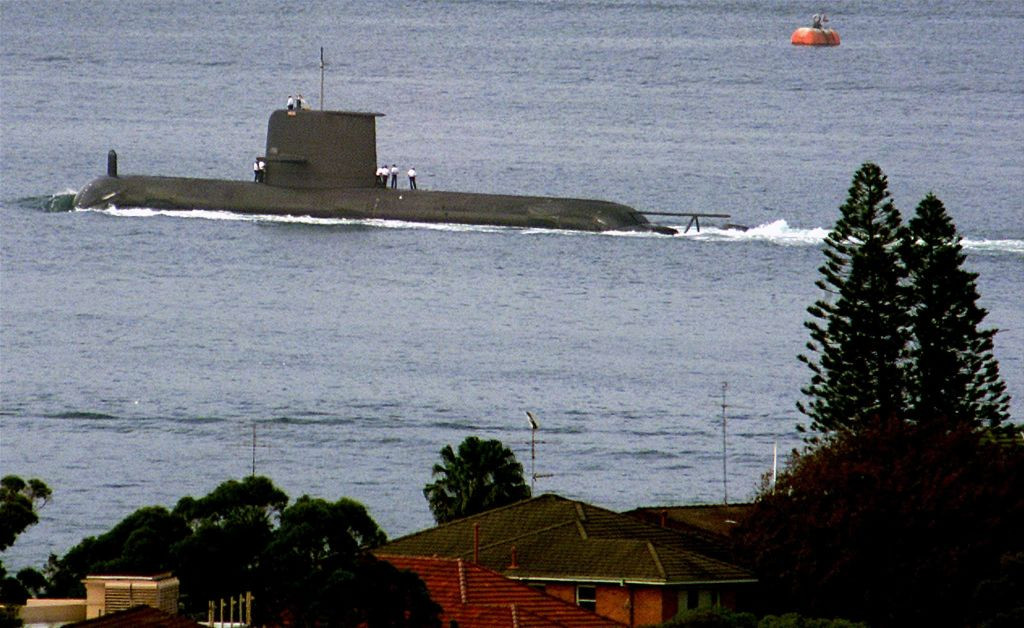
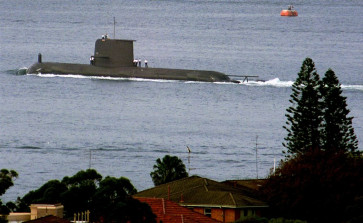
ndonesia is calling on Australia to fulfill its nuclear nonproliferation duties under international law, following an update on a trilateral defense pact that equips its neighbor with up to five nuclear-powered submarines by the 2050s.
The Foreign Ministry took to Twitter on Tuesday to state Indonesia had been closely following the recent developments on the Australia-United Kingdom-United States (AUKUS) security arrangement, particularly regarding the “pathway to achieve [...] critical capability”.
The ministry made no direct mention of the plan for Australia to purchase nuclear submarines from the US and the UK, but the statement came hours after a joint statement by US President Joe Biden, Australian Prime Minister Anthony Albanese and UK Prime Minister Rishi Sunak.
It said maintaining regional peace and stability was the responsibility of all countries, and that it was “critical” for all countries to be part of that effort.
“Indonesia expects Australia to remain consistent in fulfilling its obligations under the NPT [Treaty on the Non-Proliferation of Nuclear Weapons] and IAEA [International Atomic Energy Agency] safeguards, as well as to develop with the IAEA a verification mechanism that is effective, transparent and nondiscriminatory,” the ministry tweeted.
On Monday, the three Western allies unveiled more details of a plan to provide Australia with nuclear-powered submarines starting in the early 2030s, with the US intending to sell to Australia three US Virginia-class submarines and up to two more if needed.
Biden stressed the submarines would be nuclear-powered, not nuclear-armed.
“These boats will not have any nuclear weapons of any kind on them,” Biden said in San Diego, California, the US, on Monday, according to a readout posted on the official White House website.
He added the US, Australia and the UK were committed to strengthening the nuclear nonproliferation regime and Australia would not produce the nuclear fuel needed for the submarines.
Australian Prime Minister Anthony Albanese said Australia’s “record of leadership” in the international nuclear nonproliferation regime would continue.
“We will continue to adhere to all of our obligations under the Nuclear Non-Proliferation Treaty [NPT] and the Treaty of Rarotonga [the South Pacific Nuclear Free Zone Treaty],” Albanese said at the same occasion.
The three allies also planned to develop a new submarine class, namely the SSN-AUKUS based on a UK design and US technology. Australia and the UK are expected to operate the new model in the future, which will be built by the UK Royal Navy starting in the late 2030s and the Royal Australian Navy in the early 2040s.
Monday’s announcement was the first big update on AUKUS since its unveiling in September 2021, which took many by surprise, not least Indonesia, which had moved to install guardrails for the technology at the United Nations.
Unlike the last time, when Jakarta clearly expressed its displeasure at not being warned about the arrangement, the US and its two partners made sure to brief their partner countries.
At a separate briefing, US Assistant Secretary for East Asian and Pacific Affairs, Daniel Kritenbrink, said the US had consulted and discussed with its partners in Southeast Asia on the recent announcement, especially during a visit to Indonesia and Malaysia last week.
“Whether it’s friends in Southeast Asia or elsewhere around the world, we’ve underscored, as the President did today and as I tried to do in my opening, AUKUS is about promoting peace, stability, security and prosperity across the Indo-Pacific region,” Kritenbrink said on Monday, according to a readout from the US State Department.
Analysts have been quick to call out the AUKUS project for promoting double standards that could further undermine Southeast Asia’s goal as a nuclear weapon-free zone.
Lina Alexandra, head of the Centre for Strategic and International Studies’ (CSIS) politics and international relations department, said while AUKUS claimed Australia’s new submarines would not be nuclear-armed, they would be able to expand military presence in the region.
She pointed out nuclear-powered submarines could stay at sea for up to 84 days without refueling, compared to the 23 days conventional submarines could last at sea.
“We need to keep monitoring this development. We cannot be fully sure of it yet, as we can still become collateral damage even if the nuclear submarines are not directly pointing their arsenal at us,” Lina told The Jakarta Post on Tuesday.
She also noted her concern that Australia, a non-nuclear state, would be able to acquire a nuclear-powered vessel, and this could undermine nonproliferation efforts and create additional challenges to the NPT’s implementation.
That said, there was not much Indonesia could do to respond besides continuing to remind AUKUS to adhere to international norms.
“As a developing country, our power is to call for international norms [to be adhered to] and demand the commitment of those countries to nonproliferation,” she said.
Share your experiences, suggestions, and any issues you've encountered on The Jakarta Post. We're here to listen.
Thank you for sharing your thoughts. We appreciate your feedback.
Quickly share this news with your network—keep everyone informed with just a single click!
Share the best of The Jakarta Post with friends, family, or colleagues. As a subscriber, you can gift 3 to 5 articles each month that anyone can read—no subscription needed!
Get the best experience—faster access, exclusive features, and a seamless way to stay updated.