TheJakartaPost
Please Update your browser
Your browser is out of date, and may not be compatible with our website. A list of the most popular web browsers can be found below.
Just click on the icons to get to the download page.


Popular Reads
Top Results
No results found. Please check your search term and try again
Can't find what you're looking for?
View all search results
Popular Reads
Top Results
No results found. Please check your search term and try again
Can't find what you're looking for?
View all search resultsRI joins Board of Peace despite domestic unease
Change text size
Gift Premium Articles
to Anyone
Share the best of The Jakarta Post with friends, family, or colleagues. As a subscriber, you can gift 3 to 5 articles each month that anyone can read—no subscription needed!
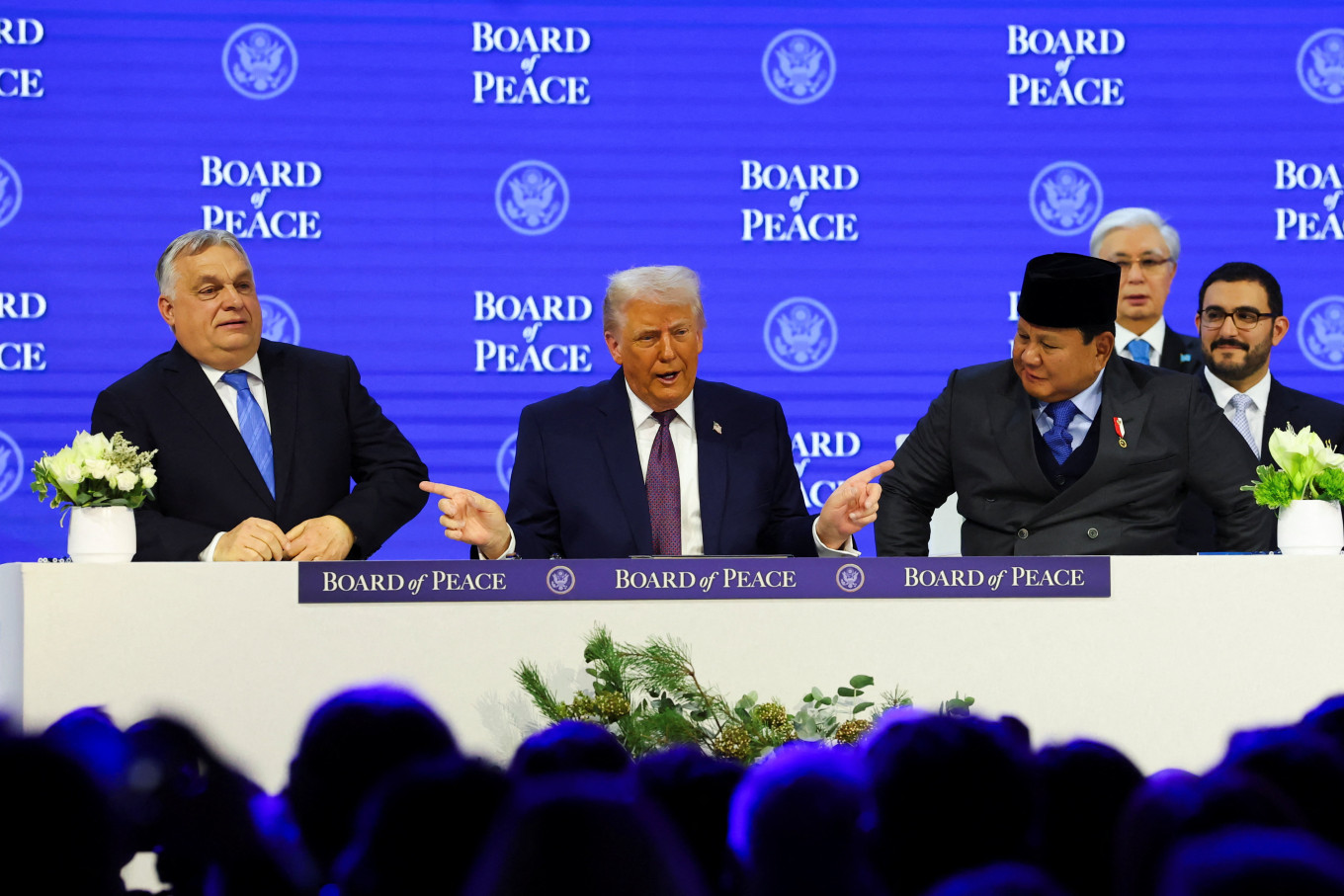 United States President Donald Trump (center) gestures toward President Prabowo Subianto (right) and Hungary's Prime Minister Viktor Orban, as they take part in a charter announcement for his Board of Peace initiative aimed at resolving global conflicts, alongside the 56th annual World Economic Forum (WEF), in Davos, Switzerland, Jan. 22, 2026. (Reuters/Denis Balibouse)
I
ndonesia’s entry onto the Board of Peace for Gaza on Thursday has stoked fresh fears that Jakarta could be coerced into a United States-controlled agenda in the war-torn territory, amid concerns it might stray from or even rival existing United Nations mechanisms to restore peace.
President Prabowo Subianto signed off on Indonesia’s membership of the board at the launch ceremony held by US President Donald Trump on the sidelines of the World Economic Forum (WEF) in Davos, Switzerland.
The move came after the Foreign Ministry confirmed earlier that day that Indonesia would accept Trump’s invitation together with a coalition of countries from the Islamic world: Turkey, Egypt, Jordan, Pakistan, Qatar, Saudi Arabia and the United Arab Emirates.
The board's creation was first proposed in November as part of Trump's Gaza peace plan under United Nations Security Council (UNSC) Resolution 2803. The board is a US-driven panel tasked with overseeing the territory’s post-conflict administration and reconstruction.
“[As] endorsed by the UNSC resolution, [the board is] aimed at consolidating a permanent ceasefire, supporting the reconstruction of Gaza, and advancing a just and lasting peace grounded in the Palestinian right to self-determination and statehood in accordance with international law,” the Foreign Ministry said.
But with details and mechanisms of the Board of Peace still largely unclear, and what has been widely seen as an underrepresentation of Palestinian voices within its structures, experts have criticized Indonesia’s decision to join the board as “hasty”.
“This is a slippery slope. It is unclear whether the board is genuinely intended to manage the Palestinian issue or deliver peace, let alone advance a two-state solution,” Lina Alexandra, head of the international relations department at the Centre for Strategic and International Studies (CSIS), told The Jakarta Post on Thursday.