TheJakartaPost
Please Update your browser
Your browser is out of date, and may not be compatible with our website. A list of the most popular web browsers can be found below.
Just click on the icons to get to the download page.


Popular Reads
Top Results
No results found. Please check your search term and try again
Can't find what you're looking for?
View all search results
Popular Reads
Top Results
No results found. Please check your search term and try again
Can't find what you're looking for?
View all search resultsG20 in 2023: A perspective of the Global South
It is exactly in such a context that the Group of 20 is meant to play a role, by taking global governance reform further into the post-COVID era.
Change text size
Gift Premium Articles
to Anyone
Share the best of The Jakarta Post with friends, family, or colleagues. As a subscriber, you can gift 3 to 5 articles each month that anyone can read—no subscription needed!
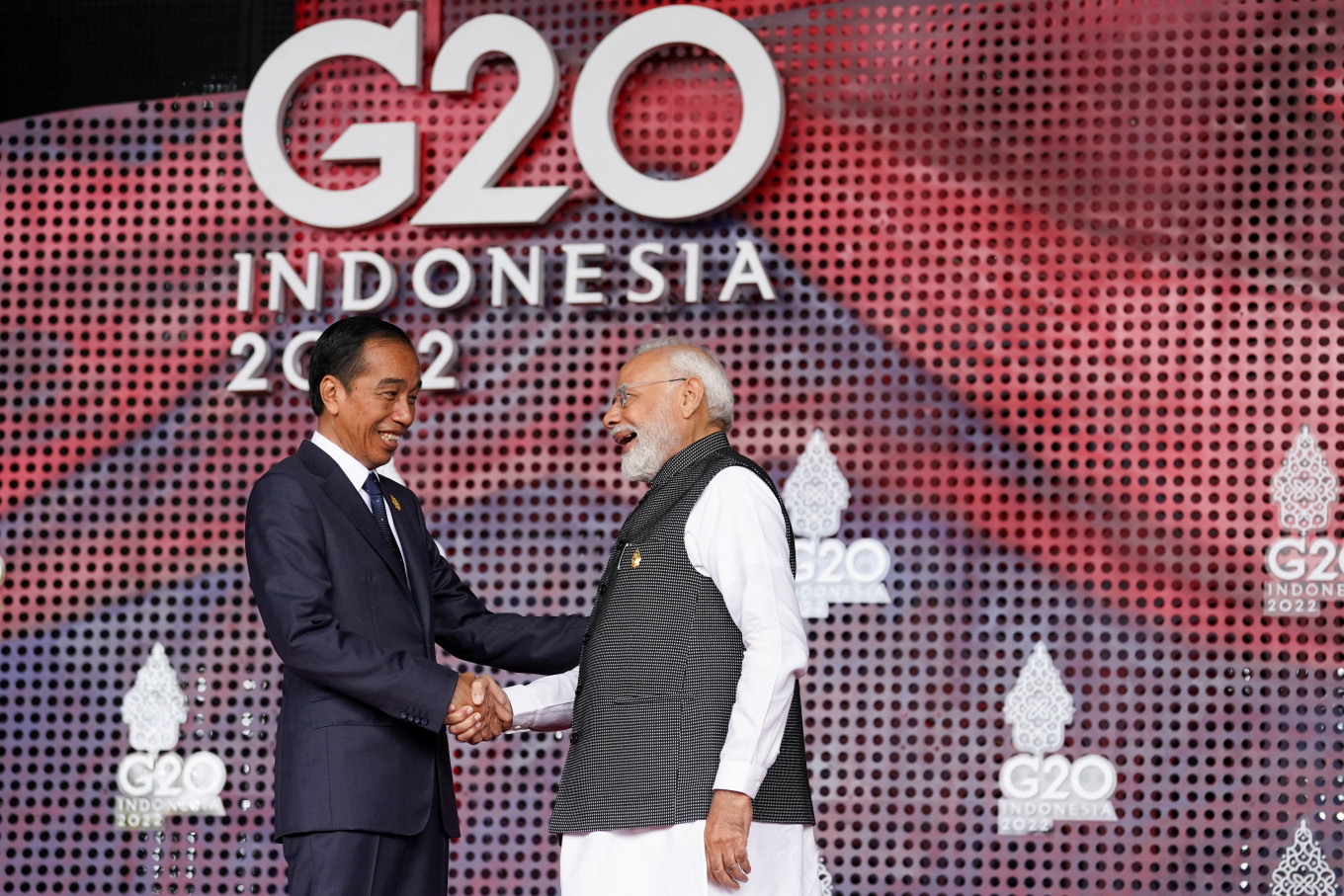
Top diplomats from the Group of 20 met in India in early March. As the South Asian nation takes over the G20 presidency from Indonesia, the Foreign Ministers’ Meeting sets the tone for an upcoming summit later this year. The world has been watching, but only to see the ministers end their contentious meeting divided, with discussions on Ukraine dominating much of the talks.
For countries around the world, 2023 is shaping up to be a crucial year. The COVID-19 pandemic is stabilizing, and the global economy is on the path to recovery. On the other hand, countries around the world, especially the Global South, are still going through a tough time. Under such circumstances, solidarity and cooperation are needed more than ever.
Back in 2022, when the world was still recovering from COVID-generated shocks, the G20 Bali Summit stood as a powerful shot in the arm for global confidence. The world looks to the G20 to build on this momentum for even greater progress. The Global South, which is most hard hit by the pandemic, has high hopes for the 20 most influential economic powerhouses.
They hope to get assistance from the G20 to address the dual crisis of food and energy security. The ongoing impacts of COVID-19 and the geopolitical tensions have led to rising commodity prices and shortage of supplies. To get enough to eat and a warm room to sleep in has become a luxury in some developing nations. To them, “the pursuit of happiness” might have now given place to just earning bread, butter and a barrel of firewood.
They hope to get assistance from the G20 to address a lingering debt crisis. According to the World Bank, emerging markets and developing economies have experienced a significant increase in their external debt since the start of the pandemic.
As much of the debt is in foreign currencies, such a situation has left the borrowing countries, particularly those in Africa, vulnerable to rising global interest rates. UNCTAD, the UN’s trade and development body, cautioned that currency depreciation has increased the cost of debt repayments “by the equivalent of public health spending in the African continent.”
They hope to get assistance from the G20 to address global challenges like climate change. Although responding to the climate challenge and the transitioning to green growth feature prominently on the governance agenda of developing countries, many of them lack the ways and means needed for capacity building and are ill-prepared for future crises. Should another global pandemic or more extreme natural disasters strike, the poorest countries will bear the brunt again.
It is exactly in such a context that the G20 is meant to play a role, by taking global governance reform further into the post-COVID era. As a flag-bearer of multilateralism, the G20 is created with a commitment to bridging the North-South development gap.
But if the meeting in New Delhi is any guide, this commitment seems to be sidelined, and the organization’s economy-centered trajectory now risks taking a detour toward geo-strategic issues, most notably Ukraine.
Under the Indonesian presidency, the group managed to produce a relatively balanced stance on that matter at the Bali Summit, in a spirit of accommodation and cooperation. Yet as the situation continues to evolve on the ground, the G20’s main agenda risks being further eclipsed by the Russia-Ukraine conflict, with the organization losing sight of its focus on the growth needs of developing countries and on the 2030 Agenda for Sustainable Development.
It is therefore an imperative to have G20 representatives focus on the economy, instead of getting into a polarized debate on Ukraine. As Indian Prime Minister Narendra Modi cautioned when opening the G20 Foreign Ministers’ Meeting, global divisions were putting sustainable development at risk, and nations must find ways to work together.
Modi’s words were echoed by the participants of other developing members of the group. Qin Gang, China’s newly appointed foreign minister, called on the G20 to rise to the occasion, enhance cooperation and contribute its share to global development and prosperity. He urged stronger commitment to multilateralism and development cooperation, and made a clear stand against protectionism and power politics.
Qin’s remarks, and the Global Development Initiative proposed by China, captured the widely shared aspirations of developing countries, who want nothing but peace and development in a volatile world. Such a development-first stance is inspiring the actions of more and more major global stakeholders.
Our world continues to grapple with emerging challenges, and COVID-19 and the food and energy crisis won’t be the last ones to be crossed out from the list. That makes global cooperation and solidarity all the more important.
The whole world will be watching again when global leaders meet for the G20 Summit later this year. To rise above differences for dialogue and cooperation is not a “mission impossible,” but a mission that must be fulfilled.
***
The writer is a Beijing-based observer of international affairs.