TheJakartaPost
Please Update your browser
Your browser is out of date, and may not be compatible with our website. A list of the most popular web browsers can be found below.
Just click on the icons to get to the download page.


Popular Reads
Top Results
No results found. Please check your search term and try again
Can't find what you're looking for?
View all search results
Popular Reads
Top Results
No results found. Please check your search term and try again
Can't find what you're looking for?
View all search resultsUnlocking Indonesia’s future-fit talent in an age of technological disruption
Education should help students understand their strengths and passions and, at the same time, stimulate curiosity.
Change text size
Gift Premium Articles
to Anyone
Share the best of The Jakarta Post with friends, family, or colleagues. As a subscriber, you can gift 3 to 5 articles each month that anyone can read—no subscription needed!
T
he world is at a crossroads. A global pandemic, economic recession and advanced technological developments are among the few game-changers. The Indonesian talent pool faces massive uncertainties and the national education system has not fully equipped it with the skills to turn these challenges into opportunities.
These problems can be viewed by understanding three prominent barriers: the unfit education system, efficiencies and leaner structures in industry and technological advancements to replace the human workforce.
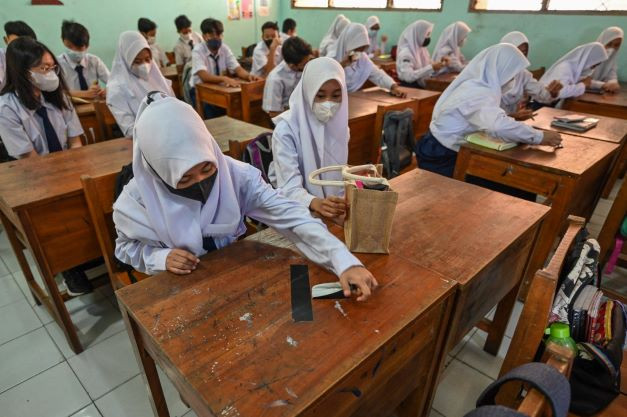
The national education system needs to prepare the talent to adapt and thrive in an age of uncertainty. High-quality education is a deep-rooted issue in the existing education system. We have experienced how education forces students to memorize history, theory or even formulas to achieve higher grades. Text-book-based education systems appreciate individuals with higher grades and judge success or failure based on them.
The lack of context-based learning leads to a student learning process that neglects the importance of critical thinking and nurturing self-development. Recent research published by SMERU shows that Indonesian students' learning achievements do not improve despite moving up a grade. This problem is worrying for a country that aims to be globally competitive. Access to high-quality education is essential to ensure high-quality talent to compete in emerging markets such as the technology industry.
However, Indonesia's competitive talent index, shared by INSEAD, is still below that of its closest ASEAN competitors.
Education should help students understand their strengths and passions and, at the same time, stimulate curiosity. Grading indicators based on memorization may neglect their ability to adapt to the changing world. Moreover, a recent investigation by Kompas on academic-thesis jockeying has exposed this chronic problem in the Indonesian education system and with regard to future talent.
Students are no longer curious and passionate about further developing their potential but look for a shortcut to complete their education.
Second, industry is getting leaner and more efficient. Although the data show that Indonesia has successfully reduced the unemployment rate to 5 percent compared with August 2021 (Statistics Indonesia, 2022), Indonesia's talent still faces unprecedented challenges.
At the end of 2022, Indonesia faced a tech winter. Many promising start-ups and tech companies laid off employees and tightened operational costs. This was not unique to Indonesian corporations as some of the world's biggest tech companies, such as Microsoft and Amazon, also cut operational costs by laying off over 28,000 employees in 2022.
Whether talent becomes a victim of business efficiency or not, the challenges for talent entering the market lie ahead, the market is getting more competitive, business is becoming more efficient, and an education degree is no guarantee for survival.
In addition, many businesses or industries aim to fully replace the human workforce with artificial intelligence (AI)-powered automation due to its potential to improve operational efficiency and increase return on investment.
Take the example of ChatGPT and Open AI, which have passed business, law, microbiology and medical tests and can even produce essays, or Netflix which has geared up its animation production with AI. Despite mistakes and criticisms, AI-powered technology shows a glimpse of the future job market.
Moreover, the question remains: What can Indonesia do to create future-fit talent? We need to empower future talent to be adaptable and resilient. The phenomena of today’s and future challenges are dynamic. They should be seen as excellent opportunities to revisit the status quo and reinvent ourselves with new approaches.
The role of education, once again, is essential in shaping future-fit talent. Indonesia should transform its education system by adopting a future-fit curriculum. Students should not be strained with too many irrelevant learning materials that do not fit their preferences and strengths.
A collaborative approach is needed to accelerate education reform. The future-fit curriculum should adopt an agile, collaborative and adaptive approach where students can choose their learning path.
The future-fit curriculum orientation will equip students with knowledge, skills and values aligned with the current and future context. Education is an essential element in shaping future talent. It has become the fundamental element of our identity, shaping how we think and act in society.
The introduction of the new Indonesia Education Road Map 2020-2035 and signature programs, such as Merdeka Belajar-Kampus Merdeka, should be appreciated despite further improvements being needed. One of the positive takeaways from the new curriculum initiatives is that they consider soft skills and character development integral to future talent development.
Skills such as critical thinking and problem-solving are now necessary for future-fit talent, especially to adapt and thrive in this uncertain era. These skills accommodate them to understand, react to and solve problems effectively, skills highly appreciated in the job market.
The Merdeka curriculum can be a good foundation and opportunity to provide students with a high-quality education beyond text-book based learning. Students and teachers should also evolve to adapt to emerging challenges, contradicting some criticism of the Merdeka curriculum.
Allowing students to experience the learning processes outside the classroom can help them balance hard and soft skills in their areas of interest. As mentioned earlier, industry is getting leaner, and technology is advancing. Encouraging this process is beneficial for both educators and students, as well as businesses. Future talent should be able to link taught subjects with real-world experiences and bring valuable feedback to their subjects.
Furthermore, reforming the education system in Indonesia requires collaboration among the public, educational institutions, private sector and students. It is a collective action to ensure future generations can adapt to the changing world.
The future is no longer far away. Our talent should be prepared for the prominence of technological adoption and industrial efficiency. As we commemorate National Education Day, which falls every May 2, we need to keep our heads up to help future talent fit into the frame.
Our future talent can thrive in the new era if we can transform our education system to help them. The future-fit talent is about empowering abilities and skills to adapt and be resilient to future challenges.
***
The writer is a policy specialist at Pijar Foundation. The view expressed are his own.