TheJakartaPost
Please Update your browser
Your browser is out of date, and may not be compatible with our website. A list of the most popular web browsers can be found below.
Just click on the icons to get to the download page.


Popular Reads
Top Results
No results found. Please check your search term and try again
Can't find what you're looking for?
View all search results
Popular Reads
Top Results
No results found. Please check your search term and try again
Can't find what you're looking for?
View all search resultsJakarta sees influx of newcomers after Idul Fitri holiday
Number of new city residents expected to rise 20-30 percent.
Change text size
Gift Premium Articles
to Anyone
Share the best of The Jakarta Post with friends, family, or colleagues. As a subscriber, you can gift 3 to 5 articles each month that anyone can read—no subscription needed!
J
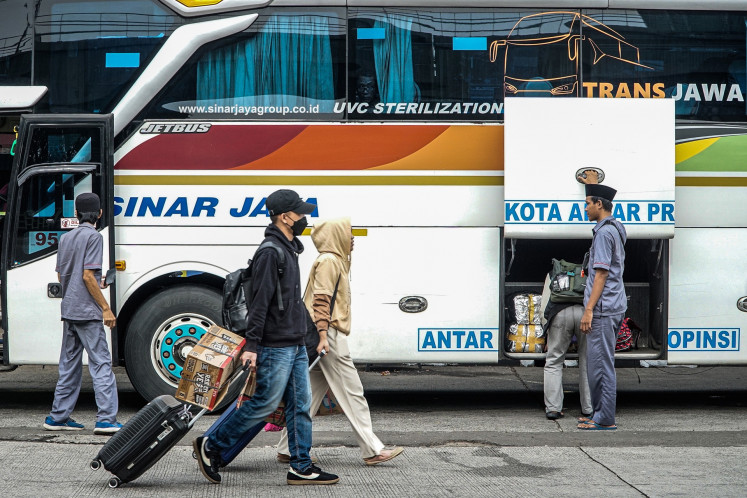
akarta is expected to see up to 40,000 newcomers flocking to the already densely populated city in search of a better life after the Idul Fitri holiday.
By Tuesday, less than two weeks following the Idul Fitri holiday, city officials had recorded more than 1,200 newcomers moving to Indonesia's capital.
"We expected the number of newcomers entering the capital city post-Idul Fitri to increase around 20-30 percent compared to last year, so between 36,000-40,000 people [throughout a month after Idul Fitri]," Jakarta Civil Registration Agency head Budi Awaluddin told The Jakarta Post on Wednesday.
Last year, Jakarta welcomed some 27,000 newcomers after the Idul Fitri holiday.
"This influx happened because the national economic conditions are starting to improve as the COVID-19 pandemic is slowly turning into an endemic," Budi said.
This made people living outside the capital believe they would have a better chance of making a living in the capital than anywhere else.
But data from the Jakarta Civil Registration Agency revealed the number of newcomers migrating to the city has been rising each year, even during the pandemic.
Throughout 2020, the first year of the pandemic, more than 113,814 newcomers moved to Jakarta; the following year, the number increased by 18.5 percent to 139,700 people. Last year, when the pandemic showed signs of easing, the figure rose again by 7.9 percent to 151,755 arrivals.
Authorities estimated around 180,000-190,000 newcomers would move to Jakarta throughout this year.
Budi previously said Jakarta officials would cooperate with the heads of community units (RW) and neighborhood units (RT) across the city to ensure all newcomers were properly documented.
“It’s crucial to register and track all newcomers to anticipate problems [related to overpopulation] such as the possible increase of stunting, unemployment and crimes,” he said as reported by kompas.com.
Discouraging newcomers
Jakarta acting governor Heru Budi Hartono previously discouraged residents who return to the city after their annual Idul Fitri mudik (exodus) trip from bringing additional family members or friends to live in the capital, highlighting that it is on the verge of overpopulation.
However, he said authorities would not forbid newcomers who want to try their luck in Indonesia's largest city.
"We cannot forbid [newcomers] to come to Jakarta. They have every right [to be here]; we can only urge them to have jobs and places to live before coming to the capital," Heru said as reported by Tempo.co.
Heru said before the Idul Fitri holiday, the city administration had sent back many newcomers, particularly those who had been scavengers, beggars and buskers in Jakarta, back to their places of origin, although he did not specify the number.
"We gather them in the Jakarta Social Agency and educate them before sending them back to their hometowns," he said.
New regulation
Home to more than 10.6 million people, Jakarta has been grappling with overpopulation issues. With almost 16,000 inhabitants per square kilometer, Jakarta is not only among the most densely populated cities in the country, but also the world.
Budi previously said the city administration was currently formulating a regulation to tighten moving requirements for newcomers, including compelling them to have a job, a place to stay and useful skills before coming to the capital.
This approach was taken as most people migrating to Jakarta came from a population of lower education and socioeconomic levels, making them prone to poverty.
According to Jakarta Public Order Agency (Satpol PP), in the past month alone authorities have netted close to 800 homeless people in Jakarta, with more than half of them being newcomers.
Last year, from 27,478 newcomers moving to Jakarta, a staggering 80 percent of them were high-school graduates or lower. About 45 percent of the total newcomers turned out to earn low wages in Jakarta and some 20 percent lived in densely populated areas or slums in the city.