Can't find what you're looking for?
View all search resultsCan't find what you're looking for?

View all search resultsThe trial has been divided into two phases: the first for invited public officials and the press from Wednesday to July 26 and the second for registered members of public from July 27 to Aug. 17. The LRT will begin full operations on Aug. 18.
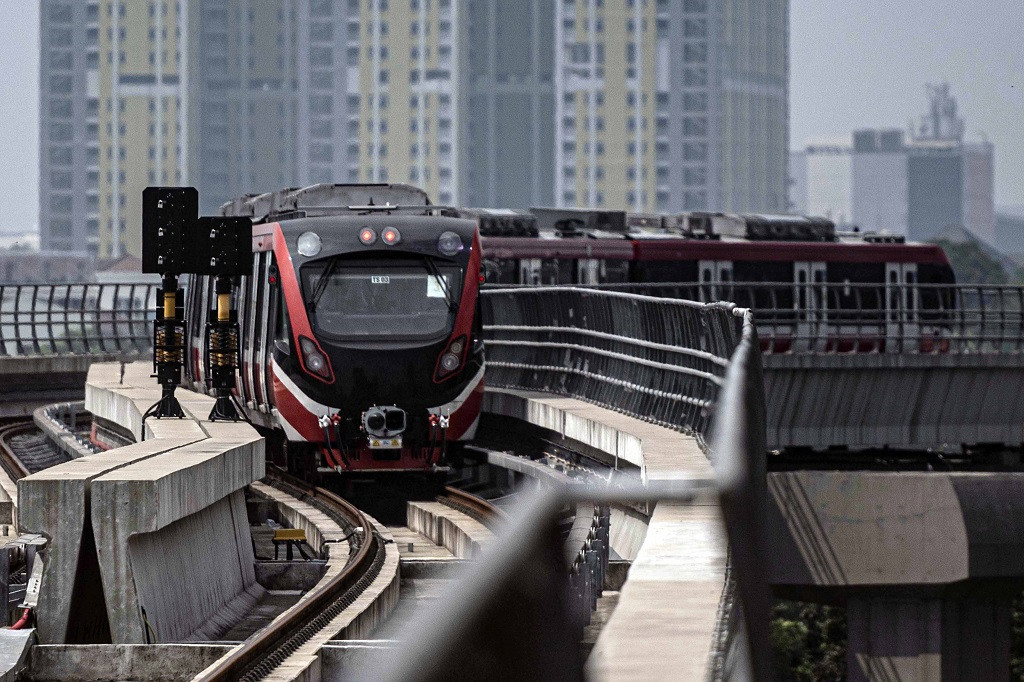
tate railway company Kereta Api Indonesia (KAI) kicked off a limited trial of the Greater Jakarta LRT on Wednesday, ahead of the full opening scheduled for August.
The trial service starts at Dukuh Atas Station in South Jakarta and consists of two routes: the Cibubur Line to Harjamukti Station in Depok, West Java, and the Bekasi Line to Jatimulya Station in East Bekasi, West Java.
The Greater Jakarta LRT is distinct from the similarly named Jakarta LRT, which runs from Velodrome in East Jakarta to Kelapa Gading in North Jakarta.
The Greater Jakarta LRT's trial has been divided into two phases: the first for invited public officials and the press from Wednesday to July 26 and the second for registered members of public from July 27 to Aug. 17. The LRT will begin full operations on Aug. 18.
“During the first run, we’ll focus on checking our system’s readiness and safety aspects,” said KAI president director Didiek Hartantyo on Wednesday. “Meanwhile, we’ll focus on the ticketing system, access, facilities and services during the second trial phase.”
The train operator opened public registration for the trial on Monday, and the tickets sold out in hours. More than 24,000 people registered within three hours of its opening.
“We’re considering adding more trips to accommodate citizens’ enthusiasm for trying our new service,” Didiek said.
During the public trial, the LRT will offer a total of 434 trips a day from Dukuh Atas Station, Harjamukti Station and Jatimulya Station. However, only six trips a day are open to the registered public.
Glitches
The Greater Jakarta LRT uses a technology called communications-based train control (CBTC). This railway signaling technology allows LRT trains to be fully automatic. The Skytrain connecting the terminals of Soekarno-Hatta International Airport in Tangerang, Banten, uses the same technology.
Nonetheless, a human operator will always be on board in case the train encounters any problems, the LRT’s operators say.
One such problem occurred on Wednesday.
On a trip from Dukuh Atas to Harjamukti that included a journalist from The Jakarta Post, the train made three sudden stops along a portion of elevated track. The glitch prolonged the trip from the expected 45 minutes to 54 minutes.
The ride was also rougher than that of the Jakarta MRT, which was launched in 2019, because of hard breaking and acceleration.
Transportation Minister Budi Karya Sumadi, who was on the same trip, said the train operator would improve the service during the course of the trial, with a particular focus on safety.
“We’re trying to be very cautious. We’ll delay the launch for full service should we encounter any issues,” the minister said. “Although the technology is sophisticated, we cannot ignore human error.”
In October 2021, an LRT train car crashed into a parked train on the same set of tracks during a trial run. The National Transportation Safety Committee (KNKT) later declared that the accident was caused by human error: a miscommunication on WhatsApp between train operators.
The LRT had trained its employees “on a massive scale” to improve the train’s operations, said Budi.
Easing traffic
KAI will operate 31 trains on the Greater Jakarta LRT when the service opens fully to the public. Each six-car train has a capacity of 1,308 passengers, 174 of whom would be seated.
The LRT will run from 5 a.m. to 11:30 p.m. and offer around 560 trips a day.
Authorities estimate that 140,000 passengers will use the service every day after the public launch, but minister Budi previously said it could accommodate a maximum of 500,000 passengers a day.
Serving 18 stations along a 44 kilometer route to suburban areas and some of Jakarta’s satellite cities, the LRT is expected to help alleviate the capital’s chronic traffic issues by encouraging the use of public transportation.
Authorities are planning to integrate the LRT with other public transportation services in Jakarta, including the Transjakarta city bus service, the MRT and the Commuter Line train.
The Greater Jakarta LRT and the existing Commuter Line train, which follow similar routes, could together carry around 1.7 million passengers per day, officials say.
The government is considering extending the LRT network farther south to Bogor city and east to Karawang regency, both in West Java. The Commuter Line train is currently the only rail transportation option in both places.
Share your experiences, suggestions, and any issues you've encountered on The Jakarta Post. We're here to listen.
Thank you for sharing your thoughts. We appreciate your feedback.
Quickly share this news with your network—keep everyone informed with just a single click!
Share the best of The Jakarta Post with friends, family, or colleagues. As a subscriber, you can gift 3 to 5 articles each month that anyone can read—no subscription needed!
Get the best experience—faster access, exclusive features, and a seamless way to stay updated.